Saturday, 26 November 2022

Francesco Borraccino's 1/72 Hayate - Yes, That One!

Francesco Borraccino has very kindly shared these images and details of his splendid build of the Arma Hobby Ki-84 Hayate in 1/72 scale, representing an aircraft of Hiko Dai 73 Sentai. 


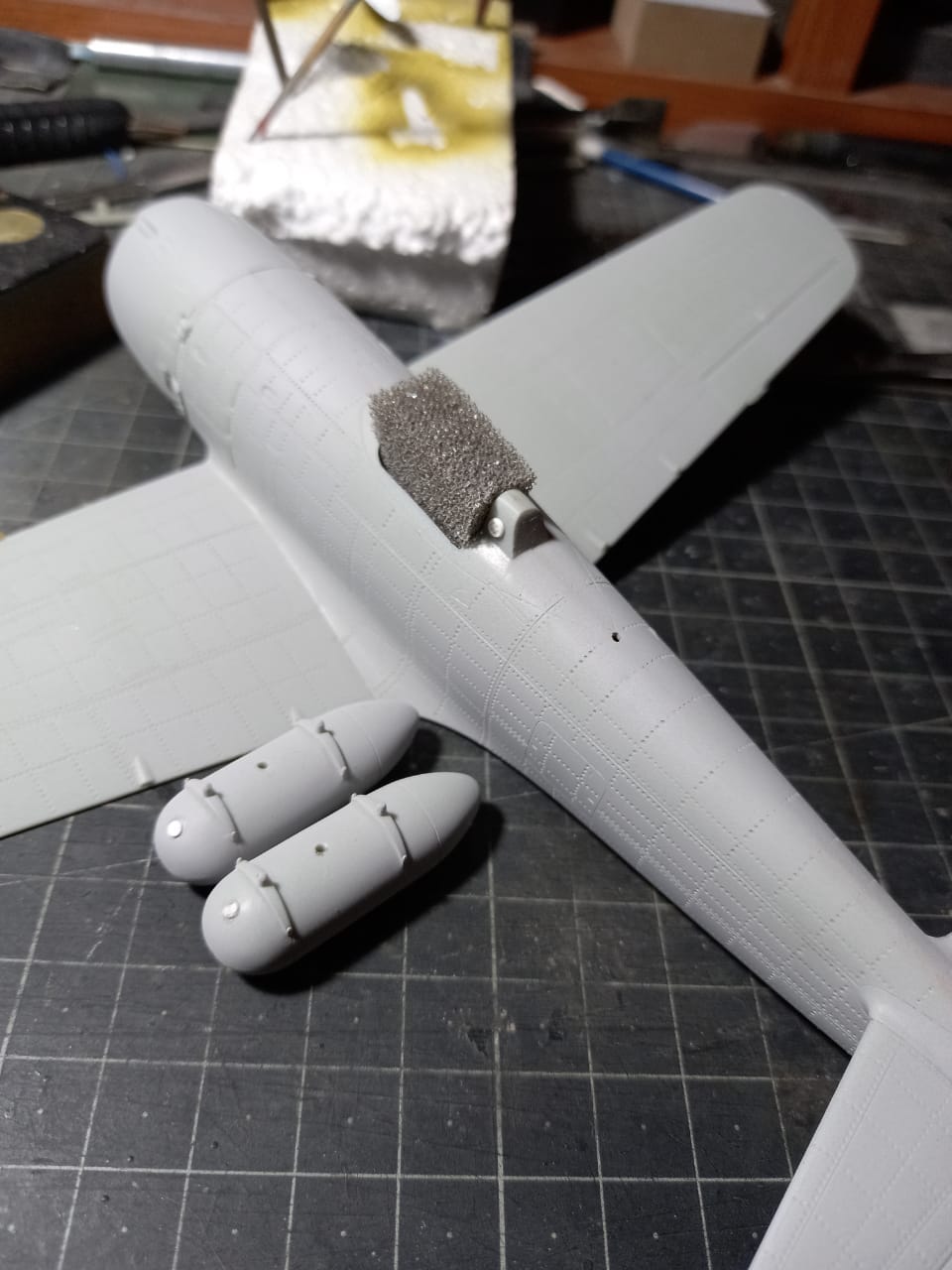
Francesco deems the new Arma Hobby kit as beautiful and a really enjoyable, carefree build, maybe not to a Tamiya standard but really amazing. A negative for him were the landing gear covers - too thick! He found the kit relatively easy to build except for a couple of passages, firstly in the placing of the photo-etch engine spark plugs (a problem was also that the instructions were a bit confusing) and secondly the rear portion of the canopy that require some filing to fit on the fuselage depression. I would add to that the rather disappointingly chunky pilot seat which lacks detail.


Francesco opted for a representative Depot finish of blue-green paint over natural metal. He tried the new # 27 by Mr Paint, but in his opinion it lacks the blueish hue and is too olive, so he chose to mix Gunze H-59 IJN Green with AK RC332 Blue Green.


Francesco interpreted the tail number as yellow on a yellow outlined red panel and hand painted it together with the sentai insignia, adding a red painted spinner and aerial mast. The hinomaru are the Techmod decals provided. The only detail he added to the model was the antenna wire which was tricky. 


The 73rd (No. 18431) was formed at Kita-Ise airfield, a branch of the Akeno Flying Division, at Kamayama in Mie Prefecture in May 1944 and together with Hiko Dai 71 Sentai made up the 21st Air Brigade. The simple three line sentai insignia was designed by painter and unit member Tsuruoka Yamamoto. From September 1944 the unit was deployed briefly on Homeland Defence operations at Tokorozawa before being designated (with the rest of the Brigade) as the third phase reinforcement for Sho operation No.1 in the Philippines. The unit deployed to Mabalacat East Airfield, Luzon in December and together with other Hayate units was placed under command of the 30th Fighter Group which as losses mounted became the de facto Hayate unit in operations. The 73rd engaged in airfield and shipping attack operations as well as special attack escorts. The sentai commander Maj Teruo Misumi and the Hikotai leader Capt Hiromitsu Kajiwara were both killed in action during January 1945. In the same month a special attack unit was formed within the 30th Fighter Group and three 73rd Sentai flyers including the former Olympics swimmer Kiichi Yoshida volunteered and were subsequently lost in action. The surviving personnel, eventually without aircraft, joined the Japanese ground forces although 70 ground crew members of the 30th Fighter Group, considered essential, were evacuated. The unit was formally disbanded in Japan in March 1945.


Some detail images of the build:-


With special thanks to Francesco for sharing these images and details.

Image credit: All photos © 2022 Francesco Borraccino.

Friday, 25 November 2022

More Hayate - Dario Risso's 1/48 Ki-84


This 1/48 scale Ki-84 Hayate model was built by Dario Risso from the Arii (former Otaki) kit. The model was built mainly out of the box but Dario added cockpit, engine and other details using plastic card, stretched sprue and copper wire.  


Dario detailed the cockpit (shown below) by adding some wiring made out of copper wire and stretched sprue, added some control boxes, and a seat cushion made from styrene sheet. He made the seat belts using tin sheet with copper wire buckles. 


The engine was detailed by making .3 mm holes for the spark wires. Dario used copper wire again, this time heated to make them softer and dull looking. More styrene sheet and plastic wrapped wire was used to detail the engine. (shown below).


Dario added the fuel tanks caps and the warning buzzer with small styrene discs Some putty was applied in the small gaps between fuselage halves, then sanded. After cleaning the model with dish soap and rinsing well he applied a coat of primer and after it dried, a couple of coats of Gaia Duraluminum.


Dario masked off the model undersides with masking tape and applied a coat of  hairspray, direct from the can. Then a coat of Tamiya JA Green was applied and after 10-15 minutes he used a brush to wet the surface, applying water in zones and rubbing with a short bristle brush and a toothpick. Following that he masked off the wings and fuselage to paint the white Home Defence bands, followed by masking and painting the hinomaru. Then the orange-yellow markings, so more masking, hairspray, painting and paint chipping. 


The next step was to apply two coats of acrylic floor polish and the unit decals to represent an aircraft of the Hiko Dai 47 Sentai's 2nd Chutai, one of the subjects of the original kit. That was followed by painting the almost black antiglare zone. The final step was to apply oil washes, black on green painted surfaces, grey-brown on other surfaces.  The paints used were:-
  • Interior green: a Tamiya mix Dario already had in a jar - possibly XF-26 and XF-4 
  • Primer: Tamiya Liquid Surface Primer diluted with Tamiya Lacquer Thinner 
  • Aluminum base: Gaia 123 
  • Green camo: Tamiya XF-13 J.A. Green 
  • Underside: A Mix of Tamiya XF-14 J.A. Grey and X-2 White (4:1 ratio) 
  • Propeller: Tamiya Mix: XF-26 Deep Green, XF-62 Olive Dran and X-8 Lemon Yellow (10:3:3) 
  • Yellow markings: X-8 Lemmon Yellow and XF-7 Flat Red (20:1) 
  • Black antiglare surface: XF-1 Flat Black and XF-57 Buff (18:1) 


With special thanks to Dario for sharing these images and details of his excellent Hayate build. The representation of wear over panel lines is especially well done. The Arii ex-Otaki kit was first released in 1973 so is approaching its fiftieth year of long service and good conduct. It is still in stock at HLJ at a sale price of only £6.77 (usually £8.46), remarkably good value in this day and age. 


Image credits: All photos © 2022 Dario Risso

Wednesday, 2 November 2022

ICM Ki-21 'Sally' Step By Step Construction

Hat tip to Peter Zanella for the heads up to this step by step construction video for the new ICM 1/72 Ki-21-I 'Sally'. Nice details. Interior colour should be the dark blue-grey throughout. 

Image credit: © 2022 ICM via YouTube

Tuesday, 1 November 2022

Rob's 1/72 scale Franks - No, Not That One!


A delight to share this collection of excellently realised and photographed 1/72 Hayate models by Rob Ronconi. All made from the 1982 vintage Hasegawa kit. This long serving kit was first announced as 'N1' in Hasegawa's 1978 kit catalogue with a photograph of the surviving Hayate in flight, but like its companion Ki-43-II in the same scale was not released until 1982 (and not 1987 as suggested by Scalemates) as kit # B18 in the 'blue flash' type box. The original box art by Shigeo Koike depicted a 29th Hiko Sentai example but alternative decals were included for '327' of the 73rd Hiko Sentai in 1944 in the factory-applied olive drab scheme with a colour profile of that aircraft on the side of the box. Since then it has been re-released many times in both standard and special editions and is still available from HLJ in the standard, now 'orange flash', edition box with the original art for the princely sum of £4.47.

Rob comments that the Hasegawa kit can still produce a decent effort, as his photographs more than show, if enhanced with pencils and shading to off-set the raised detail and lack of other features. Above images are the 'blue bird' of Hiko Dai 102 Sentai. Relatively short-lived as a fully operational unit it was established in July at Kita-ise as part of the 100th Air Brigade and after working up with many problems moved to Miyakonojo West airfield in March 1945. On 6 April 1945 the 102nd contributed 20 aircraft to the 40 aircraft despatched by the Brigade for special attack escort but many aircraft made forced or emergency landings on return after becoming lost. After participation and heavy losses in the Okinawa campaign during which a cadre of pilots volunteered for special attack sorties, its surviving aircraft and personnel were re-assigned to the two other 100th Air Brigade units Hiko Dai 101 and 103 Sentai from June 1945. The commander of Hiko Dai 103 Sentai Maj Michiaki Tojo has commented in interview that his unit had only two or three veteran pilots out of about 50 and the rest were inexperienced and straight from training.

Next, (above,) a Brigade-mate of the 102nd bird, a Hayate from Hiko Dai 101 Sentai. The unit also participated in the Okinawa campaign, notably conducting a low-level strafing attack against enemy ground forces on 15 April 1945. One of the participants in this attack, Lieutenant Masami Kodama made an emergency landing and fought on with Japanese ground forces. Between April and June the unit lost 21 pilots including the Sentai commander and Hikotai leader. This particular Hayate was flown by Sgt Noburo Saito as part of the 1st Special Shimbu-tai, one of 10 special attack volunteers drawn from the 101st and 102nd. Sgt Saito was lost with 2nd Lt Jiro Ito during attacks against US vessels on 12 April 1945.


This Hayate (above) is believed to be the aircraft of the leader of the 184th Shimbu-tai although the tail marking is also said to represent '182'. It was one of 50-60 Hayate concentrated in 19 Shimbu-tai at Tatebayashi airfield for special attack sorties and photographed there in August 1945 minus its propeller. 


Above is a Hayate from the 57th Shimbu-tai flown by Staff Sgt Takayuki Yamashita. The eagle and bomb was a personal marking. 


The 57th Shimbu-tai was one of four special attack units formed at Akeno on 29 March 1945 and equipped with Hayate, the others being 7th, 58th, 59th and 60th. The majority of pilots for the 57th were drawn from the 14th and 15th intakes of boy airmen who were under instruction with the 1st Training Squadron at Sagami. On 30 March the unit moved to Shimodate Airfield in Ibaraki Prefecture, and on 10 April received Type 4 fighters (Hayate) and began flight training, including taxi, takeoff and landing, familiarisation flights, and taking off and landing on short fields. After this basic training, navigation practice, formation flying, taking off and landing with heavy loads, and dive to low attack training were conducted, followed by special attack training against single ships. This strikingly marked Hayate (above) was flown by Cpl Tokuo Takano and was one of 11 aircraft led by Ensign Kitoku Ito which sortied from Miyakonojo East airfield on the early morning of 25 May 1945 to attack US vessels off Okinawa. 

With special thanks to Rob for sharing these images of his excellent Hayate models.

Image credit: All © 2022 Rob Ronconi