Tuesday, 7 September 2010

September Update ~ Arawasi Eagle Eye Series No.1 Ki-36 & Ki-51


The various link buttons on the site have been updated to my new email address. If anyone has had problems trying to contact me (or getting a reply!) please try the new address, thanks.

Arawasi's "Eagle Eye Series" # 1 on the "Sonia"/"Ida" duo is now available and highly recommended (see side bar). Just a few years ago modellers could only dream about having this amount of in-depth, quality coverage of such types - and in English! An excellent choice of subject matter for this first edition and full of information and inspiration. The format is very good with a substantial text interspersed with well captioned photographs and colour profiles, contemporary colour art and detail sketches. There are also two modelling articles with colour photographs and fold out plans for both types with a wealth of detail.
Fortunately 1/72nd modellers are well-served with good kits by Hasegawa (ex-Mania) and Fujimi. In 1/48th scale there is only the Nichimo Ki-51 and the Gull vacform of the Ki-36 - which is very hard to find. I suspect I'm not alone in thinking that 1/48th scale state of the art mainstream kits of these two important Army types would have been more welcome than a 1/32nd scale Shinden - even without the "big kit", "ooh-aah" factors involved. Both types lend themselves to interesting colour schemes, markings and dioramas.


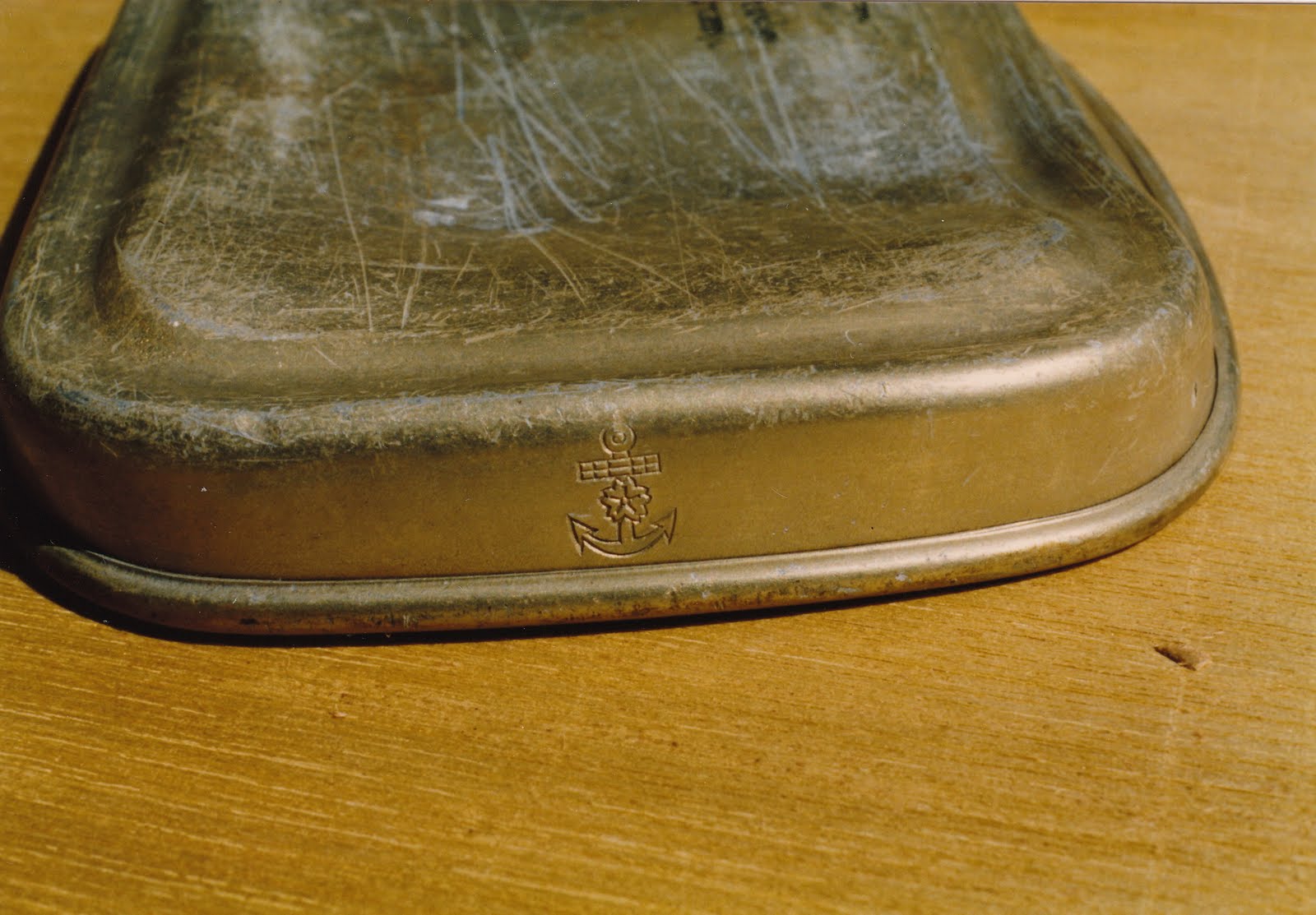
Further to the subject of anodised aluminium finishes on the Claude, Bob Alford has very kindly shared these images of a genuine IJN "Bento box" style ration tray lid which he recovered from the crash site of Mitsubishi m/n 5414, tail code T-359 of Takao Ku, which was shot down over Darwin on 23 November 1942. Bob notes that there are also some images of the ration containers and their preparation on p. 106 of Model Art No. 655, Aviator Uniforms & Equipment of IJN.


The next few updates will concentrate on catching up on showcasing photographs of some very excellent Japanese aircraft models kindly sent in by correspondents and also on featuring some newly released kits of interest.

Image Credits: Book cover & pages © 2010 Arawasi (with permission); IJN ration tray lid courtesy Bob Alford.

Sunday, 22 August 2010

Golden Claude & Updates


The release of Special Hobby's 1/32nd A5M has rekindled interest in the "golden" finish of this iconic type. One of the best representations I have ever seen is Tom Cleaver's superb model, featured at the Modelling Madness website. To my mind it captures perfectly the anodised "Bento-box" appearance remembered by some eyewitnesses. My thanks to Tom Cleaver and Modelling Madness for kindly giving permission to show and link to it here.

Whether this finish was the result of a clear varnish applied over the natural metal or of using anodised aluminium in construction (or both) remains unconfirmed. In the USA the National Bureau of Standards had begun an investigation into the corrosion of light metal alloys used in aircraft as early as 1925 and this included various coated and uncoated surfaces, as well as the application of paints. During the 1930's the subject was explored in the UK and Germany with particular interest in aluminium pigmented paint coatings. A 1938 National Bureau of Standards report by Willard Mutchler (NACA No.633) concluded that the use of surface treated alloys together with aluminium-pigmented paint offered adequate protection in maritime conditions, provided the materials were not subject to frequent immersion.

In the UK around the same time Cellon had produced a grey primer paint with zinc oxide and yellow oxide combination additives which was found to be more effective than alumium-pigmented paints in resisting maritime corrosion. This grey paint was subsequently marketed as "Cerrux Grey". In Germany similar developments in coating protection were being explored with the introduction of corrosion-resistant grey paints in place of earlier alumium-pigmented paints. Germany had sold several aircraft types to Japan in the late 1930's and it is inconceivable that these protective coating developments had not been communicated within the proprietory or technical literature accompanying these exports.

Anodising had first been used on an industrial scale in 1923 to protect Duralumin seaplane parts from corrosion. This early chromic acid process was called the Bengough-Stuart process and was documented in British defence specification DEF STAN 03-24/3. Oxalic acid anodizing was first patented in Japan in 1923 so the process was known to the Japanese. It may have been considered an appropriate means of protecting aircraft in maritime environments where full immersion was not expected (as with carrier based aircraft). It is not unreasonable to expect that there may have been a certain amount of experimentation in developing corrosion-resistant finishes and coatings once this all-metal type entered service, so where we expect a single finish there may have been several throughout the service life of the type, including ultimately painting with the "special grey paint for light metals". 

The aspect of anodising that may be of interest in respect of Claude is that it can produce yellowish integral colours without dyes. Shades of colour can be in a range which includes pale yellow, gold, deep bronze, brown, grey, and black. Some advanced variations can produce a white coating with 80% reflectivity. The shade of colour produced is sensitive to variations in the metallurgy of the underlying alloy and cannot be reproduced consistently. Therefore where one looks in vain for signs of a transparent coating in photographs of the natural metal finish A5M this does not necessarily mean that the aircraft in question was not "yellowish" (or "gold") in appearance. Some modellers may agonise over interpreting or choosing a finish but my advice would be not to sweat it and if you prefer a straightforward natural metal then go for it.

Japanese Aircraft Interiors by Robert C Mikesh

I was astonished to read some particularly dismissive comments about this important work of reference at a well-known modelling forum. In addition to citing a lack of information on actual interior colours, one poster stated that he had "read it through and then sold it". Is it a novel?  I cannot imagine trying to retrieve the copious amounts of information in the book without having it to hand. It is a work of reference and in my view indispensable. The main issue with using it is in the various colour standards cited and the occasional inconsistency in matching them.

Another poster commented that as a reference it was "dated". Really? Does this mean that the precise photospectrometric colour measurements from actual aircraft recorded in the book have been superceded? Hmm. Perhaps a blurring of the difference between knowledge and opinion. I encountered this once myself, where Mr Mikesh's measured values (colour values measured from the actual extant paint surface with photospectrometric equipment) were disputed in favour of the appearance of colour photographs and the memory of a museum visit.

Well to get back to Mr Mikesh's "lack of information" here are some facts. The book covers 18 Army types and 28 Navy types, of which precise colour information is given for 11 (61%) and 19 (68%) types respectively. The grand total is precise colour information for 30 (65%) types out of 46. On the shelf within reach, permanent and in the absence of anything else, pretty useful I should say.

RS Models E15K "Norm"

From correspondent Jeff Groves I received these useful comments about the kit .

"I recently finished the Xotic-72 Norm kit, and had issues getting it to sit right on the beaching gear.  If you look at the few pictures of the actual aircraft available, the main wheels of the dolly sit right under the leading edge at the wing.  Despite adding weight to the main float (and even the propeller spinner!), there is just too much plastic aft of the wheels and the plane sits on it's tail.  My solution was to add an extension to the after part of the dolly to place some support aft, as some IJN dollies had this "double ended" configuration.

As seen in the screen shots, RS have provided a dolly which is designed to sit too far aft.  The rear support rests aft of the step on the main float on the model, it was actually just forward of the step.  Correcting this is not simply a matter of scooting the model back - the support heights are different, plus the model will sit on it's tail when the dolly is properly positioned.  The dolly alignment markings on the box art match the prototypes, but the dolly provided will not match these.  Without some change, the finished model will have the glaring error of the dolly markings on the float not lining up with the dolly.

Models should decide on an acceptable correction before beginning this build."

Thank you for this!

Computer Woes

Please bear with me. I have been experiencing some pretty horrendous problems recently which make connection difficult and unpredictable. Normal service will, I hope, be resumed soon!

Image Credits: Special Hobby A5M2b by Tom Cleaver via Modelling Madness, with permissions.


Sunday, 25 July 2010

Paint Matters ~ Mr Color Ki-27 Mix


Recently Hasegawa have been suggesting a 50/50 mix of Mr Color 115 RLM 65 Light Blue and 128 IJA Grey Green for their Ki-27 kits (both 1/72nd and 1/48th scales). Not everyone has or can easily obtain Mr Color paints so I prepared the mix and then measured it using a photospectrometer.


The resulting colour is Munsell 2.9 G 5.8/1.2 with the closest "standard" Munsell being 2.5 G 6/1 @ 2.38 (where less than 2.0 = a close match) and the closest FS 595B value being 14277 @ 2.92. The latter has a stronger blue-green hue and is slightly darker, the mix being somewhat lighter and greyer. What is surprising about the mix is that it did not result in a more blueish colour as expected. It appears to represent a slightly darker blue-green version of JAAF #1 Hairyokushoku (ash green colour) and may be based on facsimile reproductions of the JAAF paint standards published by Gakken.

According to the Ki-27 factory manual in the Japanese Centre for Asian Historical Records Archive the original factory applied colour of the Ki-27 was a "sage green" paint described as "Mignonette". Mignonette is a genus of fragrant herbaceous plants native to the Mediterranean region and to southwest Asia, from the Canary Islands and Iberia east to northwest India, also known as Resada. Its colour is a pale yellowish blue-green or slightly blueish sage green. Rikyu Watanabe described the colour of the Ki-27 as "mei-hairyoku-shoku (IJA gray-green) - a glossy gray that has a very slight green tint".


When the film "Aa Rikugun Hayabusa Kettoutai" was made in 1969 the Ki-27 replicas were depicted in a noticeably glossy pale blue green colour (the screen shots below over emphasise the blue). This colour could be described as a "traditional" (and older) representation of Army Hairyokushoku, much brighter and more blue-green in character than the likes of Mr Color 128 or Tamiya XF-14 suggest. But more like the appearance seen in the Okinawa Ki-51 film.


The colour is estimated to be similar to 2.5 G 7/2, something like FS 34410, stronger, brighter and lighter than Hasegawa's mix. These pale blue-greens bear some resemblance to Thorpe's A4 Light Green and particularly A5 Light Grey Green but are bolder than the Hairyokushoku hobby paints. The problem is that the original paint surface would quickly succumb to oxidisation and chalking when exposed and unmaintained, resulting in a whitish-grey patina over the surface that would conceal any hint of blue-green subtlety in the original paint colour. Also extant samples have probably darkened and yellowed slightly with age.


Unfortunately I don't have a measured value for Mr Color 128 but it is similar to XF-14, slightly greyer, slightly less green and rather like a somewhat duller, greyer version of FS 34424 (which is often cited for RAF Sky). These descriptions are relative, as are the paint colours when seen in juxtaposition to each other as above. The paint colours 128 and XF-14 look inherently brighter away from the strong pale blue-greens shown here. They both seem to have been based on the 1927 archive sample.

Can these variances be resolved? Not really. But the original Hess-Ives values for the authorised colour range of JAAF # 1 do reveal a remarkable variance from a strong, bright pale blue-green to a much duller olive grey. Rather than fret over the variances, enjoy them.

In yesterday's blog post on RS Models re-released Ki-60 I mentioned that the photo-etch sheet is pre-painted. It is not. It is plain brass. I have amended the original blog accordingly. Having examined the kit more closely I discovered that the numbers engraved on the photo-etch sheet bear no relationship to the photo-etched parts numbers shown in the instruction sheet!  There is a schematic on the instruction sheet with the "correct" numbers that re-pays careful study. 

Image credits: Box art © 2002 Hasegawa; Rendered color chips © 2010 Straggler; Mignonette (Resada) author's collection; "Aaa Rikugun Hayabusa Ketouttai" images © 1969 Kadokawa Herald Pictures Inc.

Saturday, 24 July 2010

New Japanese Aircraft in 1/72nd!

Special Hobby have now released their Nakajima Ki-43-III Ko Hayabusa, the last operational version of this fighter. Not seen yet but presumably similar to their workmanlike Ki-43-II. From the box art it looks like the # 7 colour penny has finally dropped!

Sword have released an interesting looking early version Hayate. Also not yet seen, but their earlier Hayate release looked OK. Anyone built one?

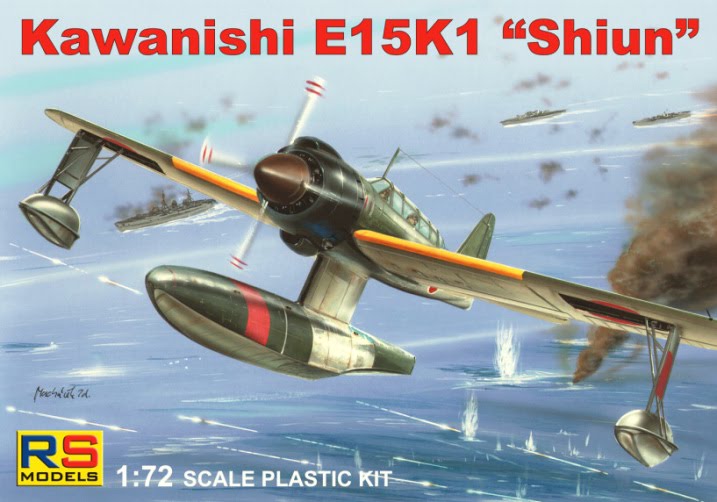
RS Models have released the Kawanishi E15K1 "Shiun". Two boxings are available, the "prototype" 92075  and service version 92076 but they appear to be identical apart from the markings options. Very simple kits these, without any resin or photo-etch, but they do include a beaching dolly. Previous kits of the machine in this scale were the very old and crude Aosima (or Aoshima) and the limited run Aviation Usk release which may still be available under the Xotic-72 label. Both are probably no contest to this latest model from RS but I can't help wondering what a Hasegawa, Fujimi or Fine Molds "Norm" might look like - and what they might cost!

This was a large and impressive looking floatplane with contra-rotating props and retractable wing floats. There is a fascinating operational history in Arawasi magazine # 1 by Komine Bunzo. Tail codes for the operational versions remain, as far as I know, speculative.


RS Models have also re-released their neat Kawasaki Ki-60 kit as 92068 which is good news. This important prototype "heavy fighter" makes an interesting table-top comparison to the Ki-28, Ki-44, Ki-61 and He-100. This kit includes a sheet of photo-etch and options include a couple of spurious "what if" versions, but not the semi-plausable 47th IFC version this time! Did this aircraft see service over Burma with the 47th? On 25th December 1941 AVG and RAF pilots (Dupouy and Bingham-Wallis) insisted that they had encountered and shot down a Japanese "Me 109" type  fighter with inline engine and square wing tips over Rangoon.


Important Update: Please see Dan's comment re the Quickboost "Pete" set in the previous JASIG Extra blog entry  !!!

Image credits: All ©2010 Special Hobby, Sword & RS Models


Monday, 5 July 2010

JASIG Extra - Aftermarket Goodies


From JASIG member Derek Cooper, via JASIG Leader Gary Wenko, comes this useful list of links for recently released accessories and aftermarket enhancements for Japanese aircraft types.


1/72 scale

Resin Art 7203 J2M3 interior & exterior sets (for Hasegawa kits)

Resin Art 7303 A6M5 exhausts & wheels (for Hasegawa kits)

Resin Art 7308 J2M3 simplified detailing set (for Hasegawa kits)


1/48 scale

Quickboost 48278 Ki-61-I Gun barrels & pitot tube (for Hasegwaw kits)

Quickboost 48283 Kugisho D4Y1/2 exhausts (for Fine Molds kits)

Quickboost 48290 J1N1-S exhausts (for Tamiya kits)

Quickboost 48294 Ki-43-II exhausts Type B (for Hasegwaw kits)

Quickboost 48295 Ki-43-II exhausts TypeA (for Hasegwaw kits)

Quickboost 48302 Ki-44 exhausts (for Hasegwaw kits)

Quickboost 48303 Ki-100 exhausts (for Hasegawa kits)

Quickboost 48311 Ki-61 undercarriage covers (for Hasegawa kits)

Quickboost 48312 A6M2/5 Zero pitot tubes

Quickboost 48313 F1M2 exhausts (for Hasegawa kits)

Quickboost 48323 F1M2 wire covers (for Hasegawa kits)

Resin Art 4902 J2M3 exhausts & weighted wheels (for Hasegawa kits)

SBS Model 48006 A6M seat (for Hasegawa & Tamiya kits)

SBS Model Ki-43 seat (picture not yet available)


1/32 scale

CMK Q32111 A6M2/5 wheels (for Tamiya kit)

CMK Q32116 A6M2b seat (for Tamiya kit)

Master Casters 32042 Ki-84 seat & frame (for Hasegawa kits)

Master Casters 32048 Ki-44 weighted wheels & seat (for Hasegawa kits) (no picture available)

Quickboost 32072 Ki-44 exhausts (for Hasegawa kits)

Quickboost 32075 Ki-61 undercarriage covers (for Hasegawa kits)

Quickboost 32077 Ki-44-II Hei gun barrels (for Hasegawa kit)

Quickboost 32083 A6M2/5 Zero pitot tubes (for Tamiya kits)

Quickboost 32084 A6M5 exhausts (for Tamiya kit)

Quickboost 32086 A6M2 exhausts (for Tamiya kit)

And one from me. The Rob Taurus range of vacform replacement canopies now available from HLJ. This range includes numerous Japanese types in both 1/72nd and 1/48th scales. The canopies are made of a more rigid material than most vacforms, easier to cut out and install but still crystal clear.

Thanks to Derek and Gary for compiling and sending this information.

Image credits: Author's Collection and ©Resin Art

Wednesday, 30 June 2010

Silver Sabre and Purple Rufe


It is very nice to be able to post some more pics of another Japanese aircraft from the era after WWII. Julien Dixon kindly provided these images of a Sabre F-86 F-30 in the markings of 1st Sqn JASDF at Hamamatsu AB in 1956 and very effectively displayed on a concrete ramp base. The model is built from the Hobby Boss 1/72nd kit, straight from the box, and with decals taken from the Fujimi kit. Japanese Sabre squadrons displayed a plethora of colourful markings and make very good modelling subjects. They were flown by several pilots who had air time in the earlier Japanese fighters of the wartime years, both Army and Navy, including a few aces.


The Sabre was Japan's first post-war fighter type beginning with the delivery of 29 ex-USAF F-86F-25 and -30 aircraft from December 1955. The first JASDF Wing was activated on 1st October 1956 at Hamamatsu with 68 T-33A trainers and 20 F-86Fs. A total of 135 ex-USAF F-86Fs were eventually delivered between 1956 and early 1957. Most of these aircraft were Korean War veterans which were gradually brought up to F-86 F-40 standard. Some of the Sabres were never flown and were returned because of a shortage of Japanese pilots.

Mitsubushi subsequently built another 300 Sabre F-86 F-40 under licence at Nagoya with the first being completed on 9th August 1956 and the last rolled out on 25th February 1961. The last Japanese F-86F made its final flight on 15th March, 1982. With its 27-years of service the Sabre enjoyed greater longevity than any of the Japanese wartime types.


Further to the blog about Humbrol Authentics Japanese Air Force paints, George Crozier has very kindly provided an image of his 1/72nd A6M2-N "Rufe", made in 2002 from the Jo-Han kit and painted with a 30 year old tin of Humbrol's HJ4 N.9 Mauve from the set which he purchased in 1972! George added aftermarket cockpit details and a Hasegawa beaching trolley. Wonderful! Any other purple Rufes out there? I'd be tickled - er - purple to show them here!

Thanks to Julien and George for kindly contributing these images. 

Image credits: Sabre model © Julien Dixon; Rufe model © George Crozier