Tuesday, 8 February 2011

More 1/72nd Scale Japanese Aircraft Models


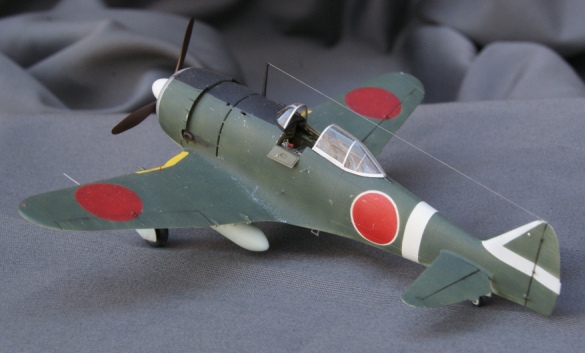
It is always a very great pleasure to see other people's models of Japanese aircraft and a privilege to be able to share them here. I confess a preference for both JAAF subjects and 1/72nd scale, especially those made from older kits, but Michael Driskill's prototype "George" from the superlative Tamiya kit is an attractive variation on the usual IJN colours so the whole package is a delight to see. The yellow colour is absolutely convincing and very well chosen in contrast to the very reddish oranges often seen on IJN prototype and trainer models.


Michael's "Babs" is particularly sharp, depicting the later type in Army service and with a very subtle and convincing colour scheme - more details please! A good looking aircraft and deservedly popular with modellers, with the LS/Arii kit still available and a sound basis for the type.


The "Nick", another of Michael's models is from the older Revell kit, one of a series of very fine Japanese twin-engine types produced in collaboration with Takara in Japan in about 1972. The other types were "Helen", "Sally", "Frances" and "Irving". The quality and detail on these models was well ahead of its time and the kits ooze both inspiration and nostalgia, but where are the molds now? A mystery. Michael's model displays the kit at its best and it remains a respectable alternative to the more recent Hasegawa variants.


Hasegawa's "Tojo" remains the only 1/72nd kit of this type, model production being almost as limited as the real aircraft and perhaps reflecting the fact that not a single example has survived. Michael's model depicts a less well-known scheme from the 85th Sentai in China and shows just what a fine replica can be made from the kit. Very fine models all and thanks to Michael for contributing them. I hope we shall see more from him in future.


From Jeff Groves come images of another superb late model Army "Babs", this one painted to perfectly represent the unusual and elaborately painted mottle seen in photos posted here and here. Jeff wrote about the build as follows:- 


"I was particularly interested in the picture of mottled Babs you posted on 9 October, and the picture of the same aircraft posted earlier.   It is a fascinating aircraft.   I found myself contemplating it on several occasions, to the point where I was inspired to order the old 1/72 scale LS kit and test my patience with the minute mottles.


I had built the LS Ki-15-I kit many years ago.  I have fond memories of that build, and 35 years or so after it’s initial release, the kit still does not disappoint!  Finely recessed surface detail, good fit, nice shape, and razor-thin trailing surfaces are highlights.  Cockpit detail is sparse, and some of the smaller bits are clunky, but those details are easily corrected.  Despite it’s age, many manufacturers could still learn a trick or two from this kit!


The build was very straight-forward.  The kit provides a basic cockpit floor, seats, stick, and instrument panel, with some details for the decking.  I built up the cockpit, mainly to prevent the see-though look.  Keeping with the VIP transport / liaison hack premise, the observer’s “stool” was replaced with a bucket type seat.   The kit supplied engine did not look the part, so I modified and wired a spare radial engine from an AMT Ju88 kit.  The cowl flaps were thinned, flexed open a bit, and the exhausts drilled out.  I also found the single central flap irresistible, so I dropped it and added ribbing from bits of Plastistruct.


I am not imbued with any special insight when it comes to determining colors from black and white photographs.  In this case, the tail markings are also subject to guesswork.  After checking references, I thought a base color of A4 light blue gray with (field applied?) mottles of A1 was defensible, although a case can certainly be made for others combinations.  Likewise, I chose a white stripe on the vertical stabilizer, although a white tip could also be argued, and yellow leading-edge stripes.

I masked off all the stripes and painted the base coat of A4 using Tamiya XF23 mixed with light gray, then applied Techmod Hinomaru decals.  The overall A4 scheme is quite pleasing, but I resisted the temptation to stop with that.  The mottling took over five hours, using Tamiya XF27 black green.  One note, the mottle appears more dense aft of the observer’s fuselage windows, especially in the picture with the gentlemen posing.  Perhaps the work of two painters?

A few other points to mention.  The prominent radio mast forward of the canopy is missing in the photographs, so I left it off of my build.  It certainly could have been present when the aircraft was serviceable.  Also, Ki-15’s had an intricate pitot tube assembly, and there are several variations.  The kit provides two choices, both very clunky.   I fabricated a wire replacement using the taller pattern, but the pictures do not show which was used on this aircraft.

A very enjoyable build, and I would welcome any additional information on this aircraft."

Jeff's build was inspired but serves in turn to inspire and his enthusiasm permeates throughout his description of the project. Genuine enthusiasm for the subject is always revealed, and rewarded, in the models themselves and invariably transcends all the old arguments. Thanks for sharing that enthusiasm here. I would love to see some more images of that older model "Babs" in the background too! 

Please do continue to send in photographs of your Japanese aircraft builds. All are appreciated, however long they might take to appear (!) and here they will find a more permanent and welcome home than on forums where they often "disappear" after a day or two. Japanese aircraft enthusiasts from all over the world are continuing to discover this blog for the first time and to enjoy trawling through the archived posts, but especially to be able to view the inspiring images of the models "preserved" here.

Correction Update

Corrected the "Kiroff" rendered chip in the second schematic of RLM 02 colours here (top row, left hand chip). It was rendered with the incorrect sRGB values. If you have downloaded and saved this schematic please replace it. The sRGB values in the table were/are correct.


Image credits: All photographs ©2011 and courtesy of Michael Driskill and Jeff Groves

Monday, 7 February 2011

Hayabusa #750 of the 11th Sentai


Some interesting colour photos of Hayabusa # 750 during restoration were posted on j-aircraft.com with an  observation that the only remaining paint that could be seen on the airframe was "dirty brown" and the "dark grey" of the anti-glare. This type of observation might give rise to a misperception about the original colours of this aircraft, especially in the absence of other, perhaps less accessible, information. 


Hayabusa #750 was an 11th Sentai machine found hidden four miles from Vunakanau Airfield, Rabaul by Sqn Ldr Denys Hamilton and RAAF party in September 1945. The aircraft was in the hands of a JAAF repair unit, the 14th Army Repair Depot. It was subsequently crated and sent to Australia in December 1945. The Hayabusa remained in the possesion of the Australian War Memorial Museum until 1953 when it was sold to R G Curtis. From 1962 until 1980 it was owned by Sid Marshall. In 1985 it was sold to Col Pay at Bankstown Airport NSW. Eventually in 1993 it was purchased by the Alpine Fighter Collection in NZ and completely restored by Jan Bullock and Doug James to its original colour scheme and markings. This veteran survivor is now in the possession of the Flying Heritage Collection at Paine Field, Washington, USA.


At the "Warbirds Over Wanaka" airshow on 29th March 1996, pilot Simon Spencer-Bower took Hayabusa # 750 on a high-speed taxi run and to the amazement of the watching crowd lifted her briefly into the air. This was the first time that a Hayabusa had flown since the end of hostilities in 1945 and remains the only time that an original Ki-43 has flown.


There is a fairly detailed restoration report for # 750 from the Alpine Fighter Collection which clarifies exactly how much original paint remained on the airframe and what it was. It is perhaps best to let the report speak for itself (with my emphasis):

"Before restoration commenced, original JAAF markings were clearly visible, along with what appeared to be a lightning flash on the tail. Research into this revealed that this was the insignia of the 11th Sentai. Also visible were three chevrons behind the rear canopy. Our research was inconclusive as to the meaning of these and they were to be a riddle for a few months yet.


"Unfortunately, because the aircraft had been paint stripped in Australia many years before no paint flakes were visible on the chevron outlines. Other parts still had original paint flakes remaining however, and prior to restoration paint samples were collected from each area to ensure as much original evidence was recorded and saved as possible. This paint research and colour matching continued throughout the restoration programme. We made a decision to paint the aircraft in lacquer to enable an adequate flattening agent to be used and to keep the appearance in the era in which the Oscar was constructed. It is important not to overglaze the paint and ruin the historic appearance of the aircraft. 


"A widely held theory that this aircraft was actually two different aircraft which had been put together some time since the war, probably evolved because in the main, the forward fuselage and wing sections had not been paint stripped. Through identification of serial numbers we were able to disprove this notion, but it is easy to understand how such theories come about.  

"We also thought the rear exit door was from another aircraft, as it was painted cream and visually did not tie in with the rear fuselage bare metal. However once we had stripped the rear exit door, which fortunately for us had escaped the early paint removal in Australia, we found the remains of the Hinomaru quarter, with white band and green paint flecks of what was to be the main colour of Hayabusa 750. Research indicates that aircraft with a white band encircling the Hinomaru on the fuselage normally had a dark colour scheme. The Oscar now fitted this evidence, tying up the rear exit door with small amounts of green found elsewhere on the body

"Another major find confirming the main colour (green) of the aircraft was discovered. The butterfly flaps (combat flaps) had at some stage in Australia been covered with modern Ceconite. Removal of this Ceconite to enable rework exposed the original fabric still intact in the main and in the same green as flakes removed from the rear exit door and fuselage. Because this fabric had been protected over the years with the Ceconite, a cutting agent was rubbed on the original paint to remove oxidisation providing a larger sample to ensure that the colour match was more accurate, Because the original fabric had been torn, which is probably why someone had recovered them in Ceconite, the flaps themselves required some rework. The original fabric was carefully removed before rework and refabricking was undertaken in the same fine linen material as we had used for the rudder. 


The restoration team were also able to make contact with one of the original maintenance crew of the 14th Army Repair Depot who had been photographed with this very aircraft when it was captured.

" . . . although not part of the 11th Sentai, but serving with the 14th Army Repair Depot in Rabaul, (he) did recall that the colour scheme of 750 was as we had deduced, but he told us that it also wore camouflage brown. He was not able to remember what colours the chevrons or lightning flash originally were, so we relied on our samples for the flash, and used white for the chevrons, believing that further information would eventually surface regarding this as indeed it did. 


" . . . veteran Japanese Army Air Force personnel and other interested parties solved the riddle for us. One of the veterans had actually served with the 11th Sentai although based elsewhere. He told us that the chevrons meant that our Oscar flew in the third flying position (three chevrons - 3rd - yellow), of the 11th Sentai’s 2nd squadron (red lightning flash). The chevrons were repainted yellow the next day."


Although note that no distinction in this finding was drawn between Shotai and Chutai formations. The well known restoration colours are probably as good as they might be and certainly not deserving of any presumption of inadequacy occasioned by ignorance as to what was actually done. Of course it is always possible to question the veracity or memory of the maintenance man, to challenge the integrity of the paint analysis or colour matching - but by what criteria and to what purpose?  Maybe, maybe, maybe?  Is the subjective interpretation of a greyscale photographic image really to be preferred to such documentation? Scepticism in research may be healthy but a tendency to throw the baby out with the bathwater is probably best avoided. 

In pursuing this subject further the original restoration team were requested for additional information regarding the paint colours, but unfortunately, although the analysis and matching had been carefully done, the actual colour values were not recorded. More on early Hayabusa colours to follow. 

A fine selection of walkaround and close-up detail images of # 750 are to be found in Aero Detail 29 which is recommended for Hayabusa enthusiasts as one of the best and most accessible English language references to the type.


Stop Press! New Airfix Zero due!


An image of the prototype model of the planned new Airfix 1/72nd scale Mitsubishi A6M2 Zero has been shown around the web, taken at the Nuremburg Toy Fair by Thomas Voigt. If the kit turns out to be as good as it looks this is to be welcomed as the Hasegawa Zero kits can be tricky to obtain and expensive, as is the superlative Fine Molds kit, whilst all the others are long in the tooth now. This should be a relatively inexpensive canvas on which to try out all those Zero colours, although no doubt its appearance will set the whole "debate" going again.

Credits: In flight photo © Dave McDonald; Airfix Zero © Thomas Voigt; Other photos from internet; Restoration report extracts Prue Wallis


Monday, 24 January 2011

Fine Molds 1/48th J8M Shusui Rocket Fighter


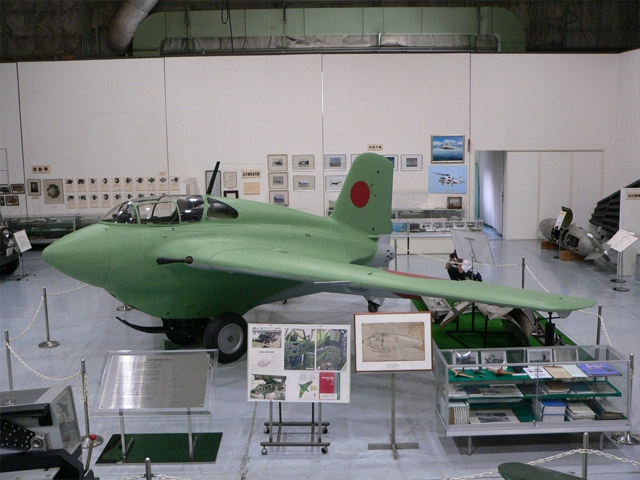
Andreas from Germany kindly sent these images of his excellent build of the Fine Molds 1/48th scale J8M Shusui. The model is finished in the colour scheme of a restored example on display at the Mitsubishi Heavy Industries Museum at Nagoya. The partial airframe of this survivor was found in the Japan Aircraft Manufacturing's Sugita plant in 1961 and later donated to the JASDF. It was put on display at Gifu Air Base but later transferred to Mitsubishi who completed a two year restoration project in 2001, displaying the aircraft together with a replica Toku-Ru No.2 rocket engine.


Andreas asks about the unusual colour scheme of the museum example and the basis for it. I have no idea about this - can anyone help?


The best available reference for this aircraft is probably Kazuya Shibata's 'A Photo History of the IJN's 312th Kokutai' published by Dai Nippon Kaiga in 2005 (below). The main text is in Japanese but the photographs and drawings all have useful English captions. There are many rare images packed into this neat little hardbound book which would be especially useful for anyone contemplating a large scale conversion project. As a bonus the book includes a DVD with an impressive cgi animation of a Shusui taking off and attacking a B-29 formation.


Image credits: Model photos © 2011 Andreas; Museum photo unknown internet; Book cover ©2005 Dai Nippon Kaiga

Sunday, 23 January 2011

Rising's 'Emperor's Eagles Pt.II'


Rising Decals latest foray in a continuing and welcome series of 1/72nd JAAF decals provides for no less than 9 fighter aircraft over China, Manchuria and Korea. The subjects are all excellent choices of individual markings for a single Ki-43 Hayabusa, four Ki-44 Shoki and four Ki-84 Hayate. Please note though that there are only sufficient Hinomaru included on the sheet for one of each type to be modelled.


First up is a kikusui (kiku – chrysanthemum and sui – water) adorned Shoki attributed to the 22nd Sentai. This aircraft is based on a single photograph published in the book Pacific War Pictorial #24 by Mainichi Newspaper on 8th November 1943 and has always been assumed to be from the 22nd Sentai because of their use of a similar device as tail insignia. However, the 22nd was not formed until March 1944 and there is little evidence it was ever equipped with the Ki-44. It is possible that the tail device symbolises the pilot's name 'Kikukawa' (chrysanthemum and river) and a recent suggestion from Japan was that the aircraft is actually an early Ki-44 assigned to the 85th Sentai. Indeed a Sgt Kikukawa of the 85th Sentai was subsequently killed in action on 12th February 1944 over Suichwan in China.

This aircraft is suggested to be painted green on the upper surfaces and the photograph does show what appears to be a solid colour. Some early Ki-44 were delivered painted overall in a medium grey (and in the 33rd Sentai mottled with blue-grey) but recently when examining a series of photographs of 9th Sentai Shoki captured by the Nationalist Chinese at the end of the war I noticed that an aircraft photographed from a similar angle, which also appeared to be painted in a solid "grey" colour was clearly revealed to be in oxidised natural metal finish (nmf) in photographs taken from other angles. You pays yer money and you makes yer choice - but have fun.

Next up is a Shoki of the 85th Sentai in an unusual (for that unit) "mesh" pattern in olive green over nmf bearing the tail character "Ni". This aircraft may have been flown by Ohkubo, a wingman to the ace Yokiyushi Wakamatsu, but probably did not have the red fuselage stripe.

The third Shoki is "Asakaze" ("Morning Breeze") one of the earlier Ki-44 aircraft of the 104th Sentai involved in B-29 interceptions over Anshan. This "big sword" adorned aircraft was also the subject of a 1/48th "special edition" Hasegawa Ki-44 kit so the provision of these markings in 1/72nd scale is especially welcome. Several Japanese sources, including Hasegawa, suggest the wingtips and fin tip on this nmf aircraft were painted grey or grey-green. The Hasegawa kit curiously includes decals for these areas which are printed in a colour similar to RAF Sky - a bright pale blue-green - but also suggests painting the rudder and ailerons in GSI Creos 128 grey-green. None of this is convincing. Probably uncoincidentally the 104th painted the wingtips and fin tips of its aircraft in Chutai colours. Rising sensibly suggest a choice between grey and yellow for these areas, the latter being more likely, but another possibility might be a light blue. 

The final Ki-44 is a nmf aircraft of the 70th Sentai's 3rd Chutai with an unusual lightning device behind the fuselage Hinomaru. Another excellent choice of markings difficult to achieve in 1/72nd scale without decals.

The first Ki-84 subject is an aircraft of the 22nd Sentai photographed in colour at Kimpo, Korea in August 1945. It is in a heavily weathered and worn dark green finish that will provide plenty of challenge to achieve convincingly in this scale.

The second Ki-84 is a command-stripe adorned machine of the 25th Sentai in an unusual (for Hayate) reticulated camouflage pattern. Again a good choice for Hayate modellers looking for something a little different. The tail stripes have been depicted in various colour combinations (as the original photograph is monochrome) but here yellow and red are suggested, with a yellow fuselage band.

The final two Ki-84 are both from the 104th Sentai and based on Russian photographs taken at the end of the war. These aircraft are in factory painted finish of olive drab over grey-green with various command markings. 

The sole Hayabusa on the sheet is an aircraft from the 25th Sentai flown by a 15-victory ace WO Iwataro Hazawa. The camouflage is olive green with a sparse mottle of either red-brown or a darker green and the large white tail number '51' painted parallel to the ground. Hazawa was one of the China-based Sentai's leading aces, receiving a citation from the 5th Air Army's Commanding Officer. He was killed in action over Hankow on 14th January 1945, attempting to bail out from his damaged aircraft which had been caught climbing after take-off.

Rising Decals are to be congratulated on another set of most interesting JAAF subjects.

Image credits: All ©2011 Rising Decals


Friday, 31 December 2010

Happy New Year ~ あけましておめでとうございます

Very best wishes for the New Year 2011 to all Aviation of Japan readers.

Image credit: 'Snow at Miyajima' woodblock print by Hasui, Kawase (1883-1957)

Wednesday, 29 December 2010

Japanese Biplane Models in 1/48th scale

Further to the display of his superb Ki-3 model at Telford, Peter Starkings has kindly shared these images of more wonderful models from his 1/48th Japanese biplane collection.

Ki-3 from Choroszy Modelblud resin kit

Ki-3

KDA-5 from Raccoon resin kit

Nakajima "Bulldog" Lindberg kit conversion

Ki-4 from Planet Models resin kit

Ki-4

Image credits: All photos ©2010 Peter Starkings