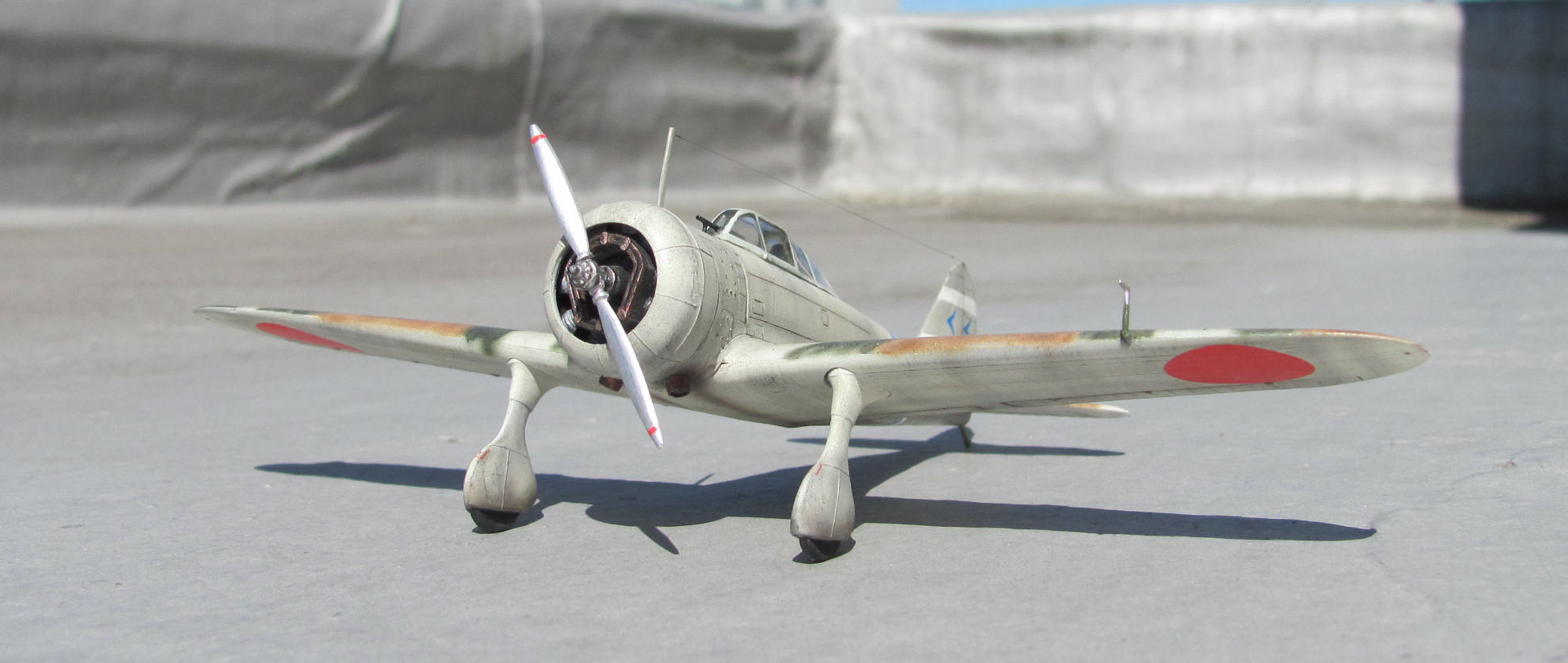
The Zero fighter is a perennial modelling favourite, the subject of many a continuing colour controversy and a type fascination never far from this blog. Aviation of Japan's Texas correspondent Mark Smith has penned another thoughtful and delightful journey down modelling's memory lane to consider Zero kits, cowlings and paint. Over to Mark then. . .
'About twenty years ago I wanted to build my two favorite models in the Zero’s development, the A6M3 Model 22 and the A6M5 Model 52c or hei. I did it as a tandem build. That meant building a relatively new kit at the time, the 1/48 scale Hasegawa Model 22 which debuted in 1994, alongside the Tamiya 52c released in 1983. The latter remains in many ways a worthy challenger to Hasegawa’s later 52c.

'At the time I was mainly using Aeromaster paints, and in their dedicated Japanese colors series they were pioneering the recognition that aircraft factories often showed noticeable variations in the standard colors as prescribed. Model Art publications had been the first source I had noticed which illustrated distinctive JNAF and JAAF colors through paint chip charts – actual chips and not printed colors, and these appeared to be linked to the appearance of the Aeromaster colors. Those hobby paints were not a ‘last word’ on the subject (what is?), and didn’t claim to be, but they were a big step forward (I stand with Nick regarding his recent comments on the Kawanishi Green however, one I would avoid. And there might be more accurate paints currently made to represent certain Japanese colors). First issued as enamels and then augmented by the same colors in acrylic, they were finely pigmented and sprayed beautifully (They also brushed nicely too, with thin but opaque and smooth coats. Ed). I still have some in usable condition. I used ‘Mitsubishi Grey’ for the Model 22 base color, and ‘Mitsubishi Green’ for the patchy green that covers it. For the Model 52c, I used ‘Nakajima Green’ for the topsides and ‘Nakajima Grey’ below. A very short time later I began reading pioneering articles by the late Jim Lansdale on the j-aircraft.com website and came to think that the Aeromaster greys should have been switched: the Mitsubishi grey should have been the one with the warm olive tone, and the Nakajima the one without it. As to the ‘Mitsubishi Green’ I like the color for a field-applied example, but it lacks the bluish cast that would be appropriate to most later production Zeros, as well as other types.
'I would like to know more about the earliest use of green in the field to camouflage frontline aircraft in the South Pacific. Generally (or among the examples in my limited collection), Japanese artists have shown it as a rich, deep green, usually without the slight blue element that later characterized many IJNAF airplanes. I realize my bias here; this general tendency began through the work of Japanese artists who had a background of experience in the war or were witness to its machines. On the other hand, the bluish dark green has also been documented (particularly in more recent years) for China-based aircraft used before Japanese involvement in the Pacific, so making that distinction is an issue for the modeler’s discretion. I have read on this blog and elsewhere about how carefully camouflage alternatives for the Zero were evaluated at Yokosuka, how stringently those colors were mandated, so it’s hard to imagine those colors not being too different than the ones adopted by units in the home islands (Please refer to the IJN Greens PDF for a discussion on green pigment character, degradation and colour shift. Ed).

'I knew the Model 22 subject that I wanted to do. I was fascinated by a grainy 1943 photo of '6-171', taken from the rear, that appears on p.88 of the Japanese
FAOW No. 9 of 1988 'Type Zero Carrier Fighter Model 22-63' (shown above), as well as the
Squadron Signal Aircraft No.59 'A6M Zero in Action' of 1983. It featured an odd ‘splattered’ camouflage appearance which seemed to have hard edges in the small area where that could be discerned on the rear fuselage and tail. The tailplane was solid green, and the wings were well out of focus but with an irregular pattern of coloring. I was never quite happy with my result in painting the model; I thought the superb 1/32 model of this aircraft by
Artur Domanski, shown on
Aviation of Japan 20 April 2018, was a much more successful attempt to extrapolate the areas at which photos only hinted, or did not reveal. And when I finally saw a much clearer scan of the picture, especially alongside a distant shot of it in flight (see below), I could tell I’d guessed wrong in a few areas. But the spirit of the thing is there. Maybe 201 NAG had another 22 that looked just like it. Who can say they didn’t? I hadn’t looked at this kit in the box in a long time, but in pulling this model out to photograph it, I was again impressed by Hasegawa’s fidelity of detail and shape in a kit now 28 years old, and one of very few parts. For a bridesmaid, it’s still a beauty.
Mitsubishi Grey according to Aeromaster around the turn of the century. You know you're old when you can finally use that phrase. Young punks will never know how it feels. Whatever the version, the Zero looked ready.
Riveting was engraved on the cowl with a scriber, the flaps cocked open slightly, not a kit option.
'The Model 22 was built as a surprise gift for my friend Ed Esposito. Ed was a great guy with wide interests, knowledge, and memory. With a doctorate in physics from Harvard, his passions also ranged from Martin Scorsese films to Boston Red Sox baseball lore to the Mitsubishi Zero. He was a stickler about many things (his restaurant orders could be torturous), but especially about Zeros! This was even mentioned at his funeral service in a tribute by a fellow teacher who had no aviation interests. Based on Shigeru Nohara drawings in the Aero Detail book on the Zero, Ed felt that the 1/48 Hasegawa kit, otherwise so fine in contour and dimensions, was sadly marred by being a little short in the rear fuselage. It made Ed sad anyway.

Bright sun! Aeromaster Mitsubishi Green was used for the Model 22's field-applied camouflage
'When I decided to secretly build this one for him, and put the parts on those drawings, I knew I’d have to do it. I taped the fuselage halves together, held my breath, and sawed them in half a bit forward of the empennage. Every instinct said don’t do this! My wallet concurred. And here I am twenty-two years later, still trying to blame my own obsessions on Ed. It worked out though, by adding a little less than 2 mm to the fuselage length via styrene inserts in each fuselage half. I suggested once that he wouldn’t have noticed if I hadn’t told him. He said ‘Not true' and although he was smiling I think he meant it. If the Nohara drawings are right and if the Hasegawa fuselage is a tad short, then the modern- day fix would be easier: buy the new tool Tamiya Model 22 kit released in 2010 instead.
Indirect sun! Aeromaster Nakajima Green enamel on topsides of Tamiya vintage Model 52c
'As I built the Tamiya 1983 Model 52c kit alongside Ed’s gift, I found it had the great advantage of offering two sets of cowl flaps, either open or closed, with weld seams on the thrust exhausts and beautifully molded machine gun ports and upper air scoop. The Hasegawa propeller from its 1982 Model 52 mold kit was better, so I used that in combination with the Tamiya spinner. One way to gauge the advance of kit technology is to consider the evolution of the distinctive cowling of the Zero 52 in 1/48 scale, from the dreadful Monogram take on it in the sixties; to the Hasegawa 1982 edition which was far better, the first to express the elegance of the design, but which today seems a little 'soapy by comparison with the Tamiya kit shown above, issued just one year later, and even more so (like the man in a $600 suit at the party, duly admired, suddenly eclipsed by the fellow coming through the door in a thousand dollar one);...against the winner and current champ, the Tamiya A6M5 Model 52/52a of 2008 vintage. The latter kit’s rendition is easily the best in fit and engineering, with certain refinements that should make any modeler smile. Tamiya’s 1983 cowling elicited a “How could it be any better?!” response – a question answered emphatically in 2008.


'After seeing a draft of this article my friend Chris Luevano sent me the above image of various vintage Zero kit cowlings. From left to right:- Aurora (!), resin 'fix' for Monogram, Monogram, Tamiya 1/50, and Tamiya 1982 A6M3 Hamp cowling to the far right of the line up.
'Considering this recap of quarter-scale Zekes, isn’t someone in Japan well overdue for a definitive A6M2 Model 21? One can hope. Since building this duo I’ve also built the Sweet A6M2 kit in 1/144 and the fairly recent Tamiya Model 21 in 1/72. But the Zero is not out of my system yet. I’m about halfway through Tamiya’s most recent 1/48 Zero kit, the 52/52a or ko, with only good things to say about it. The detail areas are mostly done, and its detail and great fit make it a marvelous project, whether from the box, or further detailed. I just hope I get the green right…'
While resin aftermarket and scratchbuilding augmented the cockpit, it was nicely rendered. Squadron’s vacform canopy replaced the kit parts for scale effect, but kit provided an option for an open canopy.
Bright sunlight. Aeromaster decals from 48-156 provided the base for overpainted codes. Note raised panel lines on fuselage and outer tail that were combined with the engraved detail on this kit.
With very special thanks to Mark for writing another delightful article, the images of his impressive models and his patience in waiting for it to appear here.
Image credits: All model photos © 2021 Mark Smith; Photo of 6-171 © 1988 Bunrin-Do Co., Ltd via Mark Smith; Photo of Zeros in flight web via Mark Smith; Cowling images © 2021 Chris Luevano via Mark Smith; Box art images © 1994 Hasegawa Corp., and © 1983 Tamiya Inc., both via Hobby Search