Wednesday, 15 March 2023

Grey Blue Cockpit Interior in Ki-61


Hat tip to Lorenzo of Italy for kindly alerting to this interesting Japanese video footage clearly showing the grey-blue # 3 Ash Indigo colour (Hai Ran shoku - 灰藍色) in the interior of a Kawasaki Ki-61 Hien 'Tony' recovered to Japan from New Guinea. The colour is similar to FS 36118 Gunship Gray, ANA 603.

From 1936 the grey-blue paint was to be applied as an overall primer to replace aotake, sometimes with the addition of # 17 Faint Blue colour (Tan Sei shoku - 淡青色)  as a middle coat before the grey green # 1 Ash Green colour (Hai Ryoku shoku - 灰緑色) was applied to external surfaces in top coats, sanded and polished. The whole interior, including the cockpit, was to be painted the grey blue colour and this was introduced with the Ki-15, Ki-21 and Ki-27. In practice this continued for the cockpit into the war years, certainly for early production Ki-61, whereas aotake continued to be applied to other parts of the interior. When the application of aotake to interior surfaces was discontinued in early 1943 in order to to speed production cockpits began to be painted in other colours in a more haphazard manner, including the # 1 grey green and another darker grey green paint similar to that used for Hayate propellers.     


The grey blue paint was also found inside the wing sections of the hybrid remains of Ki-61-I Ko/Otsu c/n 379/640 (379 constructed in Sep 1943 and 640 in Nov 1943), although the wheel wells appeared to be painted in a lighter grey colour, unspecified. Whether the lighter grey paint was very badly degraded, chalked or faded grey blue is now impossible to say. The problem, as referenced before, is that restorers take an inconsistent approach to measuring and recording extant paint in surviving airframes, often just stating that new paint 'matches the original' without actual providing colour values for it, the original paint being destroyed in the process. And laying standard paint swatches against the original paint surface and photographing them is not a valid scientific method for identifying the original colour value(s). 

Update

Added some additional details of painting technique for the 11 March 2023 blog post featuring Guillermo's Fine Molds Ki-43-III Ko .

Saturday, 11 March 2023

Guillermo's 1/48 Fine Molds Hayabusa III Ko


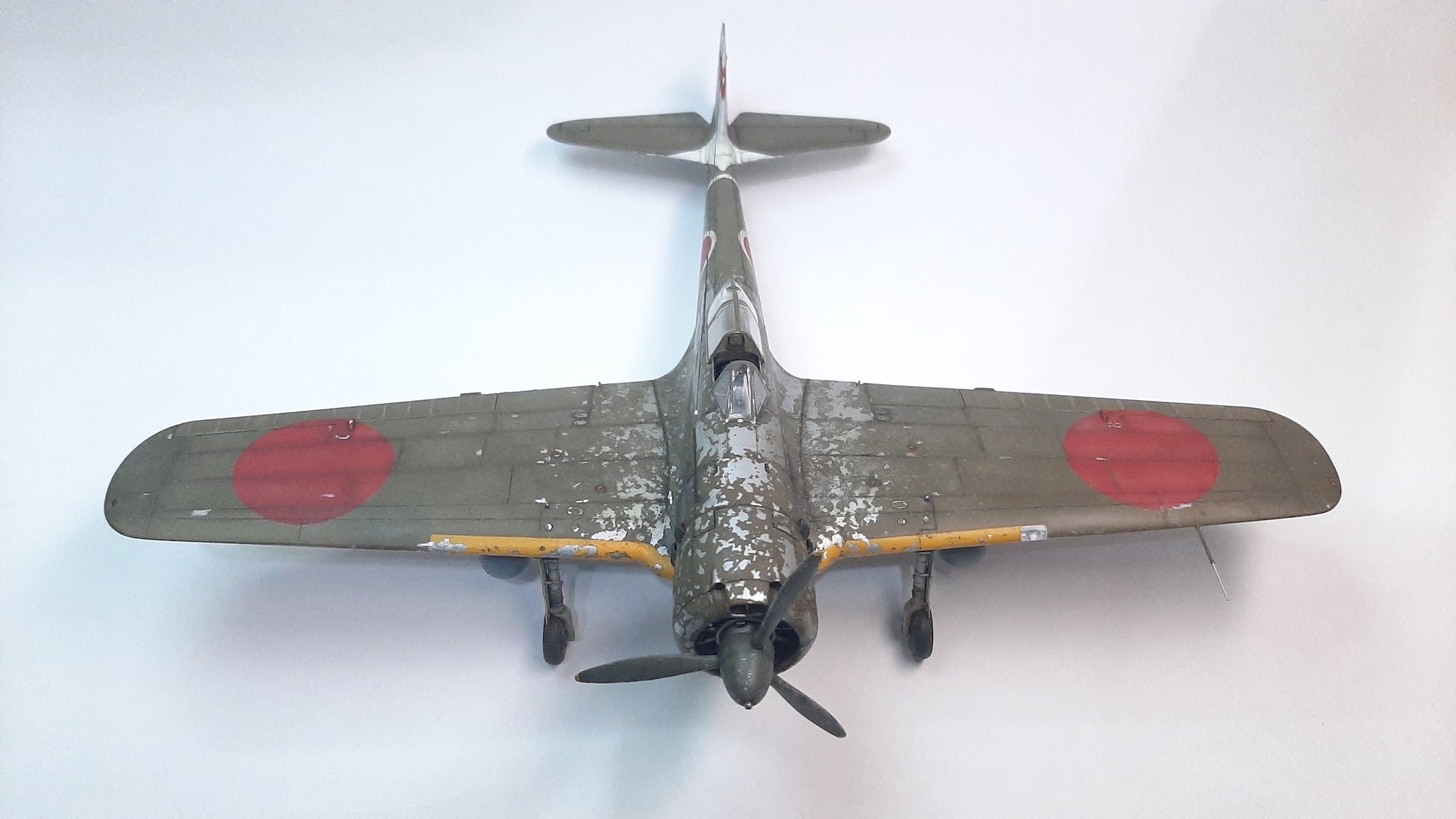
Another splendid Fine Molds 1/48 Ki-43-III Ko, this time Guillermo kindly sharing images of his build of the kit to represent a rather battered aircraft of Hiko Dai 204 Sentai  as photographed at Matsuyama airfield on the island of Formosa (now Taiwan) in August 1945. The tail number '01' has led to speculation that this aircraft was perhaps flown by 1st Chutai leader Lt Tatsukichi Nishimoto or even the Hikotai leader Capt Wataru Takahashi. Although no other obvious command markings are visible instructions were given during mid-1945 for formation leaders to avoid the display of garish identity markings which might lead to them being singled out in combat, instructions which were not always followed.


The 204th, which had been re-designated a Hiko Sentai from its previous Kyôdô (教導 - instructional) Hiko Sentai status in February 1944, lost all Ki-43-II aircraft sent to the Philippines campaign, with 17 pilots including all Chutai leaders being killed there. The surviving flying personnel returned to Mito, Japan, by transport plane in December 1944. At Mito the unit re-equipped with the III Ko before moving to Saigon, Indo-China in February 1945.  In April part of the unit moved to Formosa and was assigned to special attack duties as the Makoto (誠 - honesty or sincerity) 204 Sentai to participate in the Okinawa campaign and in July 1945 the main force of the unit joined it there. At the end of the war surviving  personnel of the unit still in Saigon were transferred into the 126th Airfield Battalion and Dai 64 Hiko Sentai. A 204th Hayabusa II in Burma displaying the previous form of unit insignia  is shown here.  It is now known that the white 'Chinzei Hachiro' arrow flight unit insignia on the fuselage, white painted fin tip, wingtips and possibly forward part of the spinner on that Ki-43-II aircraft denoted the 1st Chutai, with the 2nd and 3rd Chutai markings applied in red and yellow respectively.

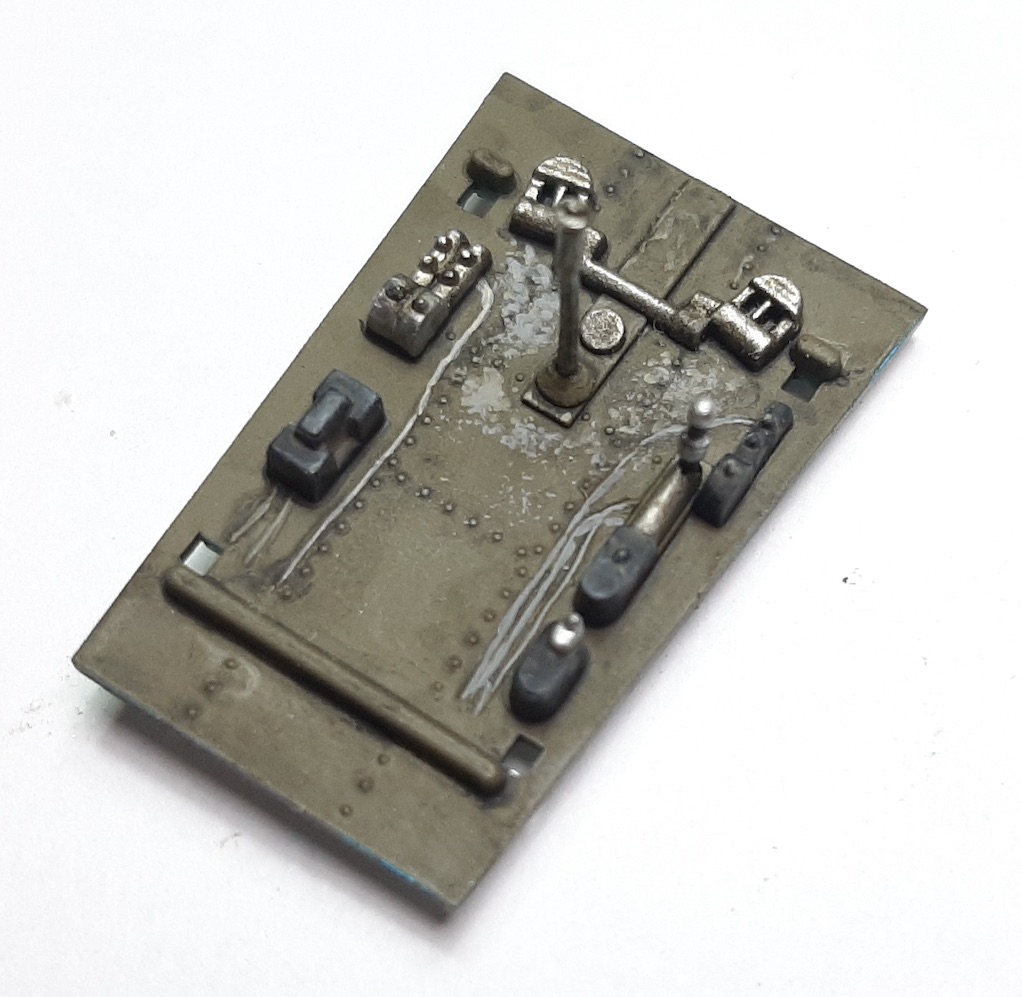
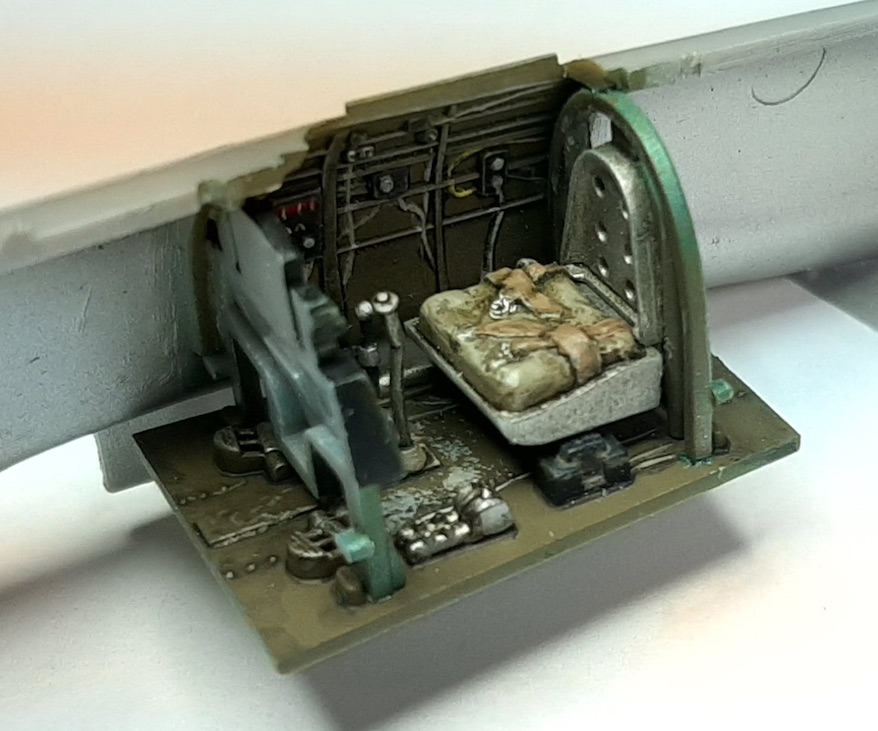
After first painting the cockpit aotake Gulllermo re-painted it using Vallejo  Model Air 71.016 FS 34088 to represent the late war olive drab colour which was also applied to the exterior upper surfaces. The seat was finished aluminium and other details painted in accordance with the Aero Detail # 29 book on Hayabusa, For the under surface Guillermo used Vallejo Model Air 71.326 IJA Grey Green (which despite the name is a warm, slightly brownish grey not to be confused with 71.321 IJA Light Grey Green). Revell Lufthansa Yellow was used for the wing leading edge IFF strips and Vallejo 70.830  WWII German Green for the propeller. The drop tanks were painted with a mix of Medium Sea Grey and Medium Blue with their data markings hand-painted using Vallejo paints.


Guillermo carefully replicated the weathering and chipping indicated in the photographs of '01' by first applying two aluminium paints, Vallejo for the fuselage and Tamiya XF-16 enamel for the wings, together with some pre-shading of panel lines. Vallejo liquid masking was then applied with a sponge. Afterwards some areas of chipping were repaired and improved, painting some irregular spots and re-touching them with Vallejo aluminium. The hinomaru and other markings were applied by paint using Colourcoats RAF Roundel Red and Tamiya XF-2 Flat White, with only the decals for '01' and minor markings used. Weathering was achieved Winsor and Newton oil paints with some pigments for soil and dust effects on the tyres. Note how the fin leading edge marking extends a point along the fuselage spine and 'wings' onto the tailplanes, a detail not always captured in illustrations or decal sheets. In some depictions the red flash is shown with a narrow yellow border.  


Guillermo's primed model tellingly reveals how the basic Hayabusa airframe remained relatively unchanged throughout production. 


And compels a repeat reiteration against the use of Ko and Otsu designations applied to the Ki-43-II as they persist in the modelosphere and with kit and decal manufacturers. The Ko, Otsu, etc., suffix designations, sometimes rendered as a, b, c, etc., in English sources, were most usually used by IJAAF to denote armament variations in fighters which do not apply to the Ki-43. The detail differences in the II series were production changes to the airframe and engine/cowling and in Japanese references these sub-types are often divided by their features into early, mid and late production types with the II Kai as the final Nakajima-built type, all using the character ki (期) which means period but is sometimes given as 'production' in English. Thus:-

初期 - (hatsu ki) = first period (Ki-43-II with annular oil cooler and long Ki-43-I wingspan)
中期 - (naka ki) = middle period (Ki-43-II with enlarged under cowling cooler and shortened wingspan)
後期 - (nachi ki) = later period (Ki-43-II with rearwards thrust exhaust stacks and landing light in port wing leading edge)
末期 - (matsu ki) = end or final period (this is the Ki-43-II Kai with individual thrust exhaust stacks but note that a further refinement was the provision of water-methanol boost to the Kai)

Only the main features of each sub-type are noted above but not all the additional detail changes, especially of armament, armour and other protective equipment/enhancements. The official IJAAF table of aircraft designations ('Table of Aircraft Desgnations and Armament, Army Air Headquarters Secret' # 16979 of 9 December 1943) makes no such distinctions as it does for other fighter types, whilst the official report 'Study of Increase of Armor, Bullet-Proofing, Fire Extinguishing Equipment and Armament on Various Aircraft; Aircraft Section; Supply Depot (Luzon)' of 22 March 1944  lists various upgrades to the II as production changes, detailing dates and first change serial numbers but no Ko or Otsu suffix are tabled. The incremental improvements in Hayabusa fuel and armour protection also counter that other persistent belief in the aircraft's inherent vulnerability. In a report on combat in Burma on 20 January 1944 the Japanese command expressed satisfaction with the improvement in fuel and armour protection for the Type 1 fighter (Hayabusa) from serial # 5800, noting that one aircraft had returned safely with 39 hits and no doubt that was one of the 23 Oscars of 50 and 204 Sentai's  47 sortied that were claimed as destroyed, probable or damaged on that day. The two Spitfire squadrons involved, 136 and 607, claimed 7 Oscars destroyed, 8 probables and 8 damaged. The Japanese reported one 'self destroyed' and two failed to return for a total of three lost. They also claimed 9 Spitfires (or 'P-40s') destroyed and 6 uncertain, whereas only two were lost. Three Spitfires returned damaged, one from a head-on attack by another Spitfire which was admitted, with two of their pilots wounded. After that digression onwards with Guillermo's excellent interior details.


With special thanks to Guillermo for sharing these images and details of his build. 

Image credit: All model photos © 2023 Guillermo; Photo via Guillermo

Wednesday, 8 March 2023

Dinah and Jay Part Two - Building a Classic


Building a Classic: Marusan’s Ki-46-III  
by Mark Smith

Considering its 1961 origins, the Marusan 1/50 scale kit of the Ki-46-III ‘Dinah’ captured the airplane's lovely lines remarkably. It was a pace-setter, as in comparison most contemporary models of Japanese origin were mere approximations of their subjects.  When Tamiya released their 1/48 scale Ki-46-III in 1996, it was streets better of course, and a lot more fun to build.  The first time I took the Marusan Ki-46 to a model show at St. Louis in 1982 I was confident that at least I’d be bringing something many had never seen built.  When I went to find the right table for the model, Roscoe Creed had already shown up with the same kit beautifully built, and to boot, it was a Dinah in brown over gray, in 81st Sentai markings.  I talked to him briefly, and he admitted traveling there with the same thought.  So much for assumptions.


I remember a few details about it. It had been needing repair for a long time, but I finally got it back in one piece and, like the old Tamiya Myrt model I recently showed here recently, getting good photos of it for the first time brought back some of the building experience.  For the top surfaces I used a Humbrol paint color of those days, N17, which had been altered very slightly but I don't remember how. (N17 Brown was an IJN color in the Humbrol Authentics range available in the 1980s). The lower surface was Humbrol A/N2 Grey from the same range. All markings were masked and sprayed with Pactra paints. The Mattel Vac-U-Form toy provided thinner parts for landing gear doors and under-cowling air-scoops. 


The kit portrays an early -III with a single external exhaust pipe for each engine, which greatly limits markings choices. The separate cowl flap pieces in the kit, however, made updating it to a later version easier. By vac-forming them and cutting each flap separately they could be mounted in the opened position; whilst the thrust exhausts of the later model were made from sheet plastic. 


The windows were cut from clear acetate, and all other transparencies in the kit, though ‘Monogram-nice’, were re-created by vac-forming them.  This really made a difference for the nose landing light, for which a mold was made and vac-formed. The kit's raised panel lines provided nice guides to re-scribe them, necessary because the fit of parts in places left a lot to be desired. The Monogram 1/48 Zero provided the prop spinners, with prop blades grafted on from . . something. This does not really convince, but looks better to me than the kit parts. The kit’s engines were poor as well, and replaced with ones from a Nichimo Ki-51 Sonia kit.  The tailwheel unit was scratch built. 


Unless it shows a replacement aircraft with identical markings, a blurry photo seems to show that this particular aircraft of the 17th Dokoritsu Hiko Chutai was eventually converted to a fighter configuration with a 20mm cannon mounted obliquely on the spine, between the crew stations.  I didn't know this in 1981, working from the color side view painting in the Maru Mechanic book on the type which showed no weapon. But it couldn't have looked too different before the conversion. There are photos of unarmed recon Dinahs with the cut-down antenna mast modification as seen on the model. In any case, it was a necessary step for mounting a weapon directly behind. The antenna aerial is a casualty.


When I started this, I knew the crew stations here could be the key to making the model I imagined. My influences here were two modelers, Raymond Waddey, met around 1969 while in high school, and Adrian Evans, whom I came to know after returning home from college. Unlike me, both were true artists with a brush or a pencil; they had that flourish. To a teenager’s ‘How do you do this?!’ questions, Ray gave thoughtful answers. A couple of times he even brought materials to the chapter meetings and showed me how he did things. He helped me find a Mattel Vac-U-Form machine, and gave me some quality Grumbacher brushes (when he saw mine!) which I only wore out over years.  His models were all brush painted, which set them apart, but he had a method for avoiding brush strokes and blending colors I’ve never seen equaled. He was squared-away Air Force, crew cut and all. Ray later made a name as an aviation artist. I always liked his three-dimensional art best, though! He worked in 1/72, and worked wonders on old Airfix kits like the Blenheim and Hampden. He had the Pilot’s Notes for many of this subjects, all of them, and tried to include all the cabin appointments they illustrated. Along with sheet plastic, I think he worked with stiff paper to create odd angles and scale edges.


This Dinah model, however, came much later, and was particularly inspired by the work of Adrian Evans, a fine Dallas jeweler and goldsmith whose fourteen-carat work was created through ‘lost wax casting.’ Many of the tools and techniques of his jewelry work translated beautifully to plastic modeling. Watching him work at a jeweler’s bench, his eye and his hand were on great terms. If a customer wasn’t exactly sure what they wanted, Adrian would draw it until they were.  Not long after I finished this model, he had said, ‘you could be a jeweler if you wanted,’ and soon after he took me in as an apprentice in his shop, ‘The Goldbrick’, where I learned enough to eventually make my way as a goldsmith and stone setter, though never a custom jeweler in Adrian’s fashion. Like Ray, Adrian was glad to share his techniques, and always keen to try new ones, though much of it boiled down to hard work - staying with it, a bit at a time, until an assembly was built and fitted. 


The sprawling Crown Hobby and Toy was right across Preston Avenue from his shop.  Some days neither of us got much done by going over to Crown so that they wouldn’t either. (The Goldbrick was aptly named!) Many Texas aircraft modelers were either first inspired or newly inspired by Adrian's aircraft on display in the big showcase at Crown; among many quarter-scale masterpieces, the Fujimi A-6 Intruder, Lindberg F-11F Tiger, and his Aurora A-7 Corsair II, with its hand-painted snake on the tail for VA-86 “Sidewinders” were favorites and very strong ‘maybe I could do that’ magnets. 


I’ve lost touch with both men, though I’ve tried to find them. In any case, thanks Ray, and thanks Adrian, you are missed but your kindness is always remembered.


With very special thanks to Mark for sharing these images of his strikingly beautiful Marusan Dinah build - the painted markings are superb -  and the fascinating back story anecdotes of personalities and places. Allowing for scale the khaki brown finish is uncannily close to the colour cited by Noburo Shimoune as being factory applied to both the late production Ki-46-III and Ki-67.

Image credit: All model photos © 2023 Mark Smith; Box art via Web

Monday, 6 March 2023

Dinah and Jay by Mark Smith and Dennis Naylor - Part One


AoJ Texas correspondent Mark Smith takes us on another enchanting trip down memory lane for a nostalgic, two-part remembrance of the Marusan 1/50 scale Ki-46-III kit of 1961 and modelling pioneer and author the late Jay Dial, with memories of him by Dennis Naylor. Over to Mark then:-

'“The Iron Dog.  A disheartening description for any aircraft designer to hear applied to his creation…”  When I think of the late Jay Frank Dial, this remark that opens his 1967 Aircraft Profile on Larry Bell’s sleek P-39 is usually not far behind.  It reflects the salty nature that marked his style as a writer and person.  While his subject was the technical and historical, the men who designed and flew the machines featured prominently.  Jay and David Aiken were members of IPMS North Central Texas (IPMS-USA’s founding chapter), which met monthly at the Coca-Cola bottling plant in Dallas. They were the first people I remember meeting who shared my passion for Japanese aircraft of WWII.  Each was kind to share reference material for model projects – and I was only one of many to benefit from their generosity.  Sadly, both are gone now. 

Marusan 1961

'Jay had a house in Arlington, David an apartment in Irving.  The most difficult part of each visit was finding a place to sit!  Each was an Aladdin’s cave of sorts, and that passion had overtaken almost all available space.  In the late sixties and early seventies, information on our beloved subject was almost always in Japanese: books, magazines, and photocopies I couldn’t read. The color gatefolds in Koku-Fan, Cyclone, and Aviation Journal, sometimes accompanied by a smaller page of color side views, seemed quite exotic in those days.  Jay somehow had a pretty complete collection of most of these magazines he’d begun collecting in the fifties, and some Japanese pen-friends who could offer selected translations and memories.  He introduced David to some of them, as I recall.  As a fairly new enthusiast I was typical; I wanted some hard and fast answers so I could accurately paint models - ha! I wanted a little more certainty about some things, but certainty was seldom on offer.  Both Jay and David certainly had a cryptic side, but looking back, much of that mirrored the hesitancy of their own Japanese sources to serve up simple dogma on the subject.  Jay was the first person to suggest to me that Japanese perceptions and descriptions of colors could differ notably from Western ones.


'Jay Dial’s seminal 1964 book, 'United States Camouflage World War II' (shown above), self-produced and published, was an early authority for many on that subject, well worth getting today if one can be found.  It included color paint chips inside each cover that, carefully overseen by Jay throughout, nevertheless proved the most trouble and greatest expense of the project.  Both his research and the production of those charts had assured him that the subject of aircraft colors involves untold vagaries and that color standards, at best, are only that: standards that in practice could yield remarkable variations.  

Marusan 1963

'Jay was also a 1/48 scratch builder who produced some beautiful work.  He showed me the model of Walker ‘Bud’ Mahurin’s P-47, “Pride of Atlantic City N.J.” which he had built out of basswood to present to the pilot, quite fine.  He built two; the first one was stolen (at a model show, as I recall!), so he did it again.  Looking at the second one shortly before its delivery, I admired the hand-carved propeller and sleek razorback fuselage.  I asked “Where do you start?” and received his all-purpose answer, “You just carve away everything that doesn’t look like a P-47”.  Pressed further, he said, “Study lots of photos and find the best drawings.  Start from there”. 

Marusan 1967

'He was frankly a little disdainful of plastic models.  But he must have not have been immune to them, for he had many, with a special weakness for Japanese kits.  There I saw the Okamoto Ki-115, the Otaki 1/90 Lily and 1/40 Judy, among other rarities.  Like the magazines and books, they were not organized in any discernible fashion, but he knew where everything was.  If not in sight, he knew what it lay beneath.  Jay was in a wheelchair, however.  If he couldn’t reach it with his trigger-handled grabber, access to most items might depend upon the next visitor.  There at his house I first spied the box-end of the Marusan 1/50 kit of the Ki-46-III Dinah.  Gold!  Gold I’d only heard about.  Having asked permission, I made it through a tunnel of kits and magazines without upset of either, and fished it out.  And I began to covet.  After managing the words, “Is there any way that…” he cut me off at the pass.  “Oh! – it’s not for sale or trade,” he said, eyes brightening and smiling now, relishing the moment.  With that voice, the goatee, dark eyes, and iron grey hair, he would have made a fine Mephistopheles in Goethe’s Faust. "Which is a shame, as it’s a very accurate kit". There for a moment I’d thought he might have pity on me for my youth, a common misconception among the young.  “It was designed by Kikuo Hashimoto, after his own drawings".

Fuji Issue 1960s

Fuji Issue 1969

'When I finally found one for myself at a model show, it was in different guise, under the UPC label (heading image).  A little flash was all that distinguished the difference.  I built it during most of 1981, with an excellent (Bunrin do) FAOW (FamousAircraft of the World) title and the 1978 Maru Mechanic already available then, which between them portrayed most detail areas that might interest modelers.  Time has been a little unkind to the finished model.  In the last ten years, the wings have started bowing upwards, from the engines out, and through several house moves, a few things have been knocked out of alignment; the same for me though.

UPC First Issue 1965

'Bud Mahurin lived to be 92, passing away in 2010.  I’ll bet the P-47D Thunderbolt Jay Dial made for him proved more durable over the years than my delicate Dinah – one of the reasons Jay liked to work in basswood and metal wherever possible.  That model wasn’t for sale or trade either.  It was a gift, one of admiration, built twice out of necessity.  I hope someone still has it, and it’s in a place it can be seen and appreciated.  

Sunny Issue (ex-Fuji) 1975 

Arc En Ciel Issue (Korea) 1985

'I was troubled by the fact that when writing this, I could not find one single obituary for Jay Dial in an online search, and could only find his dates (1936-2007) in U.S. Social Security records which tell me he was born in Tulsa, Oklahoma.  Otherwise, my searches mentioned 'Jay Frank Dial' only in relation to copies of his books for sale on various sites.  He was quite a character – how could he be forgotten so quickly?  I wrote to a mutual friend, Dennis Naylor, as I thought he had known Jay better than I.  I didn't realize how much.  Dennis had met Jay a decade earlier as well.  With his permission, it seemed appropriate to close below with the memories Dennis kindly provided:-'  

"Ah, Jay Frank Dial. He was indeed a pivotal figure in local model building history. I met him in the late 50's at Edgar Seay’s MAL Hobby Shop in Irving, Texas. At that time, we didn't see anyone in a wheelchair.  He and Charlie Thompson were the main figures in my taking up model building. Dial was famous for his camo book and 1/72 Corsair vac canopy set that allowed the builder an option to build the birdcage version. If I recall, the canopies were a whopping 25 cents, post included. I couldn't wait for mine to arrive and mounted one asap on the old Hawk kit. Badly. He was a true fan of the F4U (and authored the excellent Profile No. 150 on F4U-4 to F4U-7), and taught me the various cowl ring differences between variants, how to make a dash 2 (with 5 guns!), the clipped span RN types and why they existed at all, that one elevator worked on the right OR left sides, and a million other bits of trivia. He used to call me and without a hello, say something like "what is a Digby?" or "what is a Tarpon?", to which one was to reply ‘B-18’ or ‘TBF’ instantly. I visited him often and we talked aviation and models.

In 1964 Yasuo Oishi published one of the early English language books on  the subject of Japanese colors in collaboration with Dale Norman Flanagan

"He was pals with David Aiken and many others gone today: Lamar Kemp, Jim Sage, Gordon Stevens, Ed Seay, Tom Mitchell, Charlie Thompson, John Pidler, Yasuo Oishi, Bob Davies, Ray Beall, Russ Manning, Tom Ward and a horde of others critically important to the hobby and its growth. All were pals of Dial as well.

"He was a Colonel in the Confederate Air Force, and was very proud of his role in overseeing the "Sea Search" scheme applied to their C-47, and a major figure in the Texas Aviation Historical Society (TAHS) that met monthly at the Republic Bank in downtown Dallas.  Jim Sage brought the first Frog color series kits to these meetings. Talk about exotic!  MS406, Folgore, D.XXI, Baltimore, and other fantastic types. Astounding times for a whelp like me. Sadly, we grew apart over time. Firstly, cars and girls took all the time I could spare in my mid 60s teens. Then Kathy and I married, and the kids followed; jobs and careers required more time and effort. In the days before the American Disabilities Act, his life had to have been a special kind of Hell sometimes. Yet I never heard him complain or whine. I miss him.  

"In closing, I have little physical things or photos from many of my departed pals. He gave Kathy a SAAB J29 he had built as a kid. But when I went to an airliner show earlier this year. Kathy found a copy of the old Aero hardback 'Italian Civil and Military Aircraft'. I told her I already had it, but when she pointed out "this one was Dial's", I bought it on the spot.  It's now a treasure here in my collection of weirdness." - Dennis Naylor 

With special thanks to Mark Smith and Dennis Naylor for sharing these interesting reminiscences.

Image credit: Box art editor persoial collection or via web; Book covers editor