Wednesday, 26 March 2025

Ki-100 in 1/32 by Harvey Low


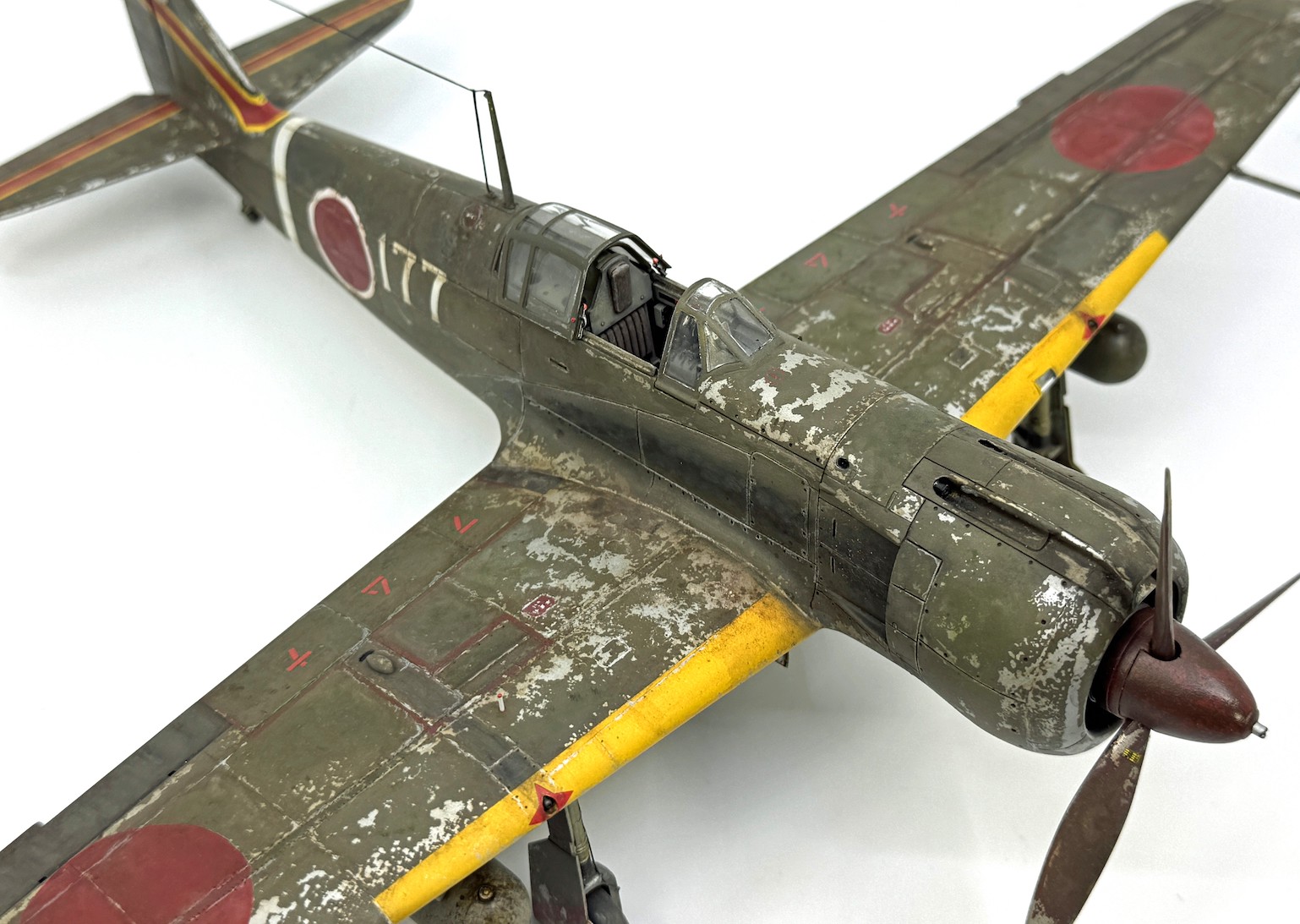
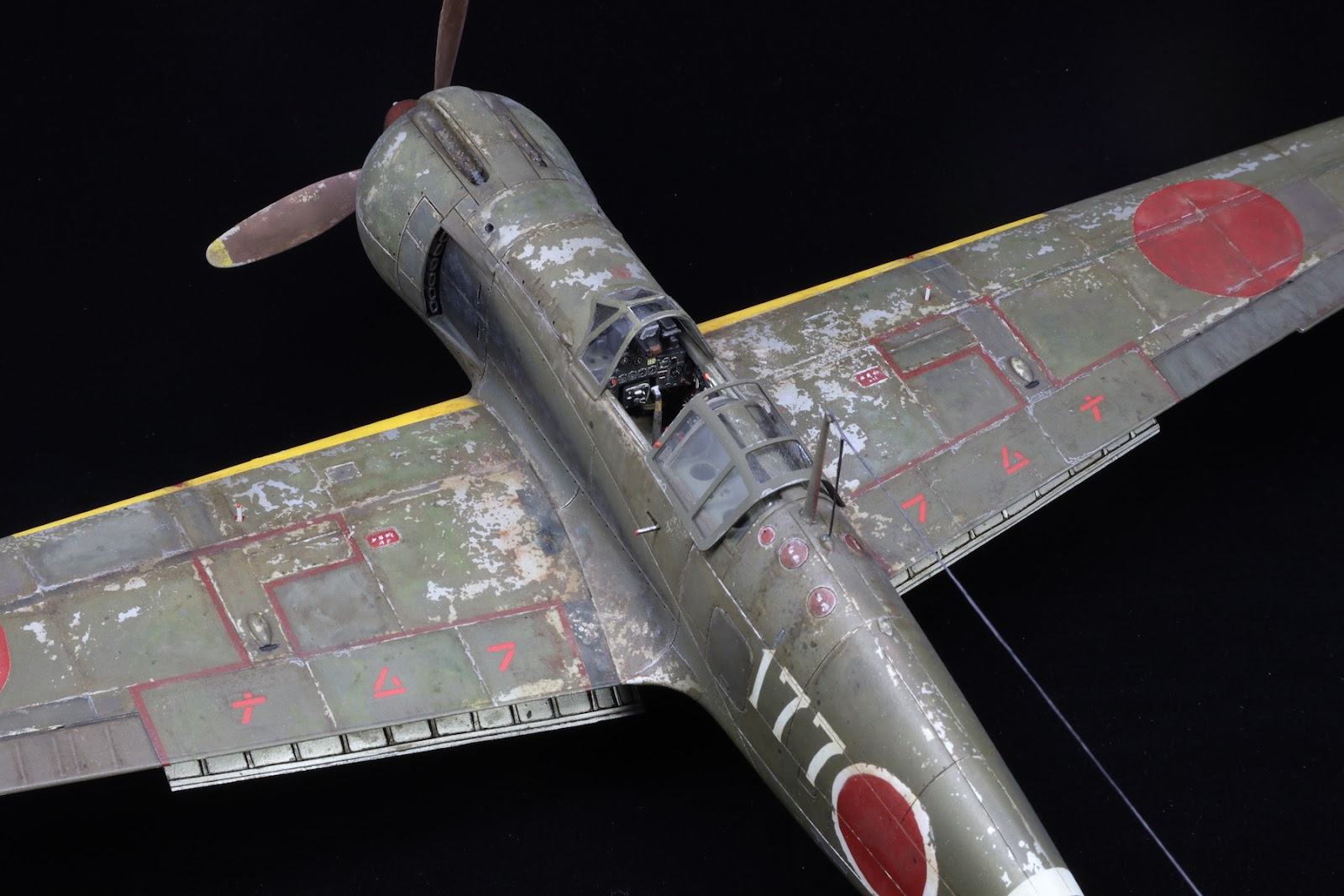
Master modeller Harvey Low has kindly shared these images and details of his 1/32 scale Kawasaki Ki-100 conversion. The Ki-100 was officially designated Type 5 fighter - Go Shiki Sentoh-ki 五式戦闘機 abbreviated to Goshikisen. It was never allocated an Allied code name and was variously identified as other types in combat reports. The cartouche beneath the port tailplane is 迷彩塗料 mei sai nuri ryu  - illusion colouring paint material - e.g. camouflage paint, reportedly to indicate a flammable benzyl based paint, but possibly indicating that the aircraft had been painted at an Army depot rather than at the factory.  


Over to Harvey then:-

'Here is my 1/32 Ki-100, which was a kit-bash mating the Hasegawa wings and tail assembly, onto the fuselage of a Ki-100 conversion kit from Alley Cat. I completed this model in early 2024 while trying to 'beat' Zoukei-Mura to the 'finishing-line' as in 2022 they announced that they would release a Ki-100 (as of March 2025, there is still no release date).  


'The markings are for aircraft 'white 177' of the 2nd Chutai, 59th Sentai, based at Ashiya Air Base, Japan 1945. A single photo of this aircraft was taken at Ashiya airbase in 1945. This model reflects this aircraft as she might have appeared shortly before her capture by Allied Forces. 


'The full build details of this model can be purchased as an e-book via  Kevin Futter at KLP Publishing  


'My thanks to Nick Millman and Ronnie Olsthoorn for their invaluable assistance in the research colours.'


Harvey Low

Toronto, Canada

With special thanks to Harvey for sharing these images and details of a very fine model.

Image credit: All photos © 2025 Harvey Low

Thursday, 20 March 2025

JAAF 'Late Colour' Paints & Scale Aviation Magazine Experimental and Projects Feature


Vic Hobby acrylic paints from Japan, reviewed here, have added a four bottle set of Imperial Japanese Army Colors (Late War) to their range. The accompanying notes on the paints are more towards 'Model Art' (Mr Nohara) than 'Gakken' (Mr Katabuchi) but may interest and intrigue for adventurous application to models. The cost of the set direct via HLJ is a modest £5.05. 


The following colours are included (with translated Vic Hobby notes):-

SP 036 Deep Blue (濃紺) There are various theories as no photographs of the actual aircraft have been confirmed, but this is a color that is said to have been used by units flying over the ocean. It is said to be a dark blue that matches the ocean.

SP 037 Dark Brown (暗褐色) It is said to have been a camouflage color applied to Imperial Japanese Army aircraft from the autumn of 1944 onwards. There are relatively many examples of its use in documents about the Type 4 Fighter Hayate. There are also documents that state that it was used on the Type 2 Toryu, a two-seater fighter.

SP 038 Dark Green (暗緑色) Some sources describe it as dark brown, but it is a much darker shade than the dark green. Some of the remaining aircraft at the base, photographed by the US military on color film after the war, are shown in a very dark dark green color. It is believed that it may have been used on some of the late production Hien and the Ki-100 fighter.

SP 039 Khaki (カーキー) There are documents showing that it was seen on the Hayabusa III in the latter half of 1944. Unlike the dark green, it is said to be the same color as that painted on tanks.

The pots are quite small but inexpensive and can be imported (to UK) safely without postal complications. The accompanying HLJ documentation makes it clear that the paints are water based and not 'dangerous goods'. (In the many decades that small tins of Humbrol enamels were posted throughout the UK and across the world were there ever any dangerous incidents?) 

Scale Aviation Magazine (Japan) March 2025

Blog readers with an interest in Japanese experimental and project aircraft might like to check out this magazine which features some stunning models of Japanese Army and Navy Experimental & Projected Aircraft in colour. The main colour features, with exceptional photography are:-

  • Nakajima G5N2-L Experimental 13-Shi Attack Bomber Shinzan-kai 'Liz' - scratch built in 1/48 scale (!)
  • Kyushu J7W1 Experimental 18-Shi Experimental Fighter - Hasegawa 1/48 scale
  • Kyushu J7W1 Shinden-kai - modified from Hasegawa 1/48 scale
  • Mitsubishi J8M Shûsui - - Fine Molds 1/48 scale
  • Mitsubishi J8M Shûsui - Fine Molds 1/48 scale depicting the aircraft in unpainted state with wooden wings and tail fin
  • Mitsubishi A7M Experimental 17-Shi Carrier Fighter Reppû 'Sam' - Fine Molds 1/48 scale
  • Mitsubishi J7M Experimental 17-Shi Interceptor Fighter Senden 'Like' - MicroMir 1/72 scale
  • Yokosuka R2Y Experimental 18-Shi Reconnaissance Aircraft Keiun - Fine Molds 1/72 scale
  • Mitsubishi Ki-46 IV HQ Reconnaissance Plane Type 100 Dinah  - modified from Hasegawa 1/72 scale  Ki-46-III - stunning in pale blue-grey finish and includes build report with images
There follows 12 pages of black and white photos of an array of experimental and project models displayed at a Scale Aircraft Convention, some with imaginative and skilfully created dioramas. And finally more colour features of models:-

  • Mitsubishi Ki-67 Type 4 Heavy Bomber 'Peggy' Prototype 2 - in 1/72 scale modified from Hasegawa Mitsubishi Ki-67 kit - beautifully achieved mottle
  • Mitsubishi Experimental Interceptor Ki-109 - Microace (Arii formerly LS) in 1/72 scale - beautifully modelled in bare metal finish 
  • Tachikawa Ki-94-II - RS Models in 1/72 scale
  • Tachikawa Ki-94-I - Ushi Models (resin kit) in 1/72 scale
  • Kawasaki Ki-88 - Raccoon Models (resin kit) in 1/48 scale 
  • Mitsubishi Ki-83  - Special Hobby in 1/72 scale
  • Nakajima Ki-87 -RS Models in 1/72 scale
  • Nakajima Kikka-kai - Fine Molds in 1/48 scale
  • Kawasaki Ki-78 - AZ Models in 1/72 scale
  • Nakajima Ki-44 Shoki 'Tojo' Prototype - Hasegawa in 1/32 scale - excellently displayed in flight with pilot and 47 Dokuritsu Hiko Chutai 'brown' scheme
  • Kawasaki Ki-60 - Planet Models (resin kit) in 1/48 scale - with build report
A veritable cornucopia of creative achievement which should wow and inspire. All text except for brief captions of aircraft type, kits used and names of the builders is in Japanese. 

Image credit: All Vic Hobby © 2025 via HLJ; © 2025 Scale Aviation Magazine (Japan) 

Monday, 10 March 2025

Fine Molds A6M5 in 1/48 by Dan Salamone


The Zero theme continues for a perennially popular aircraft type. Dan Salamone has been quick off the mark building the recently released Fine Molds IJN Carrier Fighter Zero Model 52 (Nakajima Production) in 1/48 scale  and has kindly shared his review of the kit, build report and images of his excellent finished model. Over to Dan then. 

'This is the 1/48 Fine Molds A6M5 Model 52 Zero (Nakajima), which was finished recently. The base is the older Eduard deck, painted a few years ago.


'The model features the usual very high quality moldings from Fine Molds, an instruction booklet that includes QR codes (which take you to short videos giving a visual explanation of how certain parts fit together) and a brief explanation of the differences between Mitsubishi and Nakajima produced airframes. The kit features some unique, but very precise and time saving engineering. The main example is the slide molded rear fuselage, which fits perfectly to the front fuselage halves, as well as the vertical tail//rudder and horizontal stabilizers. 


'The kit also includes two different styles of clear parts: the usual windshield/sliding portion/rear glass which needs to be masked before painting, as well as separate molded canopy frames with clear panel inserts. Finally, there are decals for a Junyo based aircraft, as well as one based in Saipan that was captured by U.S. forces. 


'I was eagerly awaiting this kit, and was thrilled when it arrived from Hobby Link Japan (currently both kits are showing as 'discontinued' there! Ed). I started the kit the following day, and can say that this is another superb effort from Fine Molds. The parts fit is excellent, the unique engineering cuts building time, and the fact that the kit is 100% styrene means there isn't the issue with tiny photo etched parts, or warped resin/etched flaps. My only changes were using a 3D printed decal for the pilot's harness and tail codes from Lifelike Decals set 48-063 as I wanted to build an aircraft flown from IJN Zuikaku, and finally used metal gun barrels from Master.


'Tamiya paints were used throughout this kit. The interior color was a custom mix not far off from U.S. olive drab, the lower surfaces are XF-76 Gray Green (IJN), cloth surfaces a mix starting with XF-20, Medium Gray. The upper surface dark green is Tamiya XF-70 Dark Green 2 (IJN), and finally XF-69 NATO Black for the cowling. Weathering was kept to a minimum as the images of carrier borne Model 52's from late summer/early fall of 1944 show well maintained and glossy aircraft.


'The combination of kit decals with tail codes from Lifelike were flawless. I like to use Gunze spray can clear coats as they dry quickly and also dry very hard.


'If I would change one thing on this model, it would be using the 'old style' clear canopy parts. I commend Fine Molds for their bold engineering choices, but the separate frames are very fragile to handle, and building these sub assemblies requires extra care and attention. In my opinion the time spent masking regular clear parts would result in a better looking model.


'A few years ago, I started building the new tool Eduard Model 21. I found it to be such a frustrating build process that eventually I threw it away. The Eduard kits are over engineered, such as the multiple part cowl, the tiny and imprecise cockpit location points. My copy of the kit and resin parts featured poor quality control - the 3D printed separate landing flaps warped almost immediately after removal from their runners. In contrast, this Fine Molds kit is designed to save time, enhance detail, and practically every single sub assembly locks into place. The engine appears to be very complex, but upon assembly, the separate exhaust stacks lock into place and give the overall assembly strength and integrity.


'Now hoping for a Model 21 and Model 22 from Fine Molds as well. Buy this kit with confidence and enjoy!'

With special thanks to Dan for sharing these details and images of his superb A6M5 model.

Image credit: Kit box © Fine Molds via Dan Salamone; Accessories © Master and Lifelike Decals; All model photos © 2025 Dan Salamone

Tuesday, 4 March 2025

Zero Colours - Again!


Recently Andrew Young kindly sent me the above image from a Facebook page about Zero Fighter Pilots. It is a painting by Tadaichi Hayashi, an artist who visited Rabaul in 1942. I had seen it before as the Japanese book it was taken from - 'Painting under enemy’s bombing raid - sketches painted in Rabaul in combat' was first brought to my attention circa 2000. The image of the book cover is shown below. It is a 'cleaner' and 'cooler' image without the stronger yellowish brown caste of the more recently shared copy. 


The Zero in the illustration appears to show a greyish-green colour as once strongly advocated by the late David Aiken, who sometimes asserted that it was the Kariki 117 colour M1. That is unlikely as the Yokosuka camouflage trials for the Zero held in late 1941/early 1942 included one Zero 'Yo-151' specially painted overall in the M1 colour for testing. Had M1 been the existing factory colour that should have been unnecessary. Although the more recent illustration also appears to show a greyish green the actual colour is distorted by the yellowish brown caste of the image. Sampling the fuselage, wheel cover and tail fin from the digital image in sRGB results in the colour values shown below. Leaving aside an accusation of indulging in 'pseudo science' whatever the colour might have been intended to be by the artist (and which appears on the original painting) the illustrations as shown do not suggest a neutral, pure black and white grey, as recently asserted by Messrs Nakamura and Miyazaki.


Sampling the earlier cover image produces results (above) closer to a perception of greyish green, a colour which reflects the description of 'Aotatami-iro' suggested by Hitoshi Yoshimura in  Model Art # 179 of March 1981 (pages 38-39).  He cited the recollection of a ‘Mr Y’, a civilian who had attended many ‘Houkoku-go‘ dedication ceremonies of early Model 11 and 21 Zero fighters being donated to the IJN. who described their colour as ‘Aotatami iro‘ (青畳色), meaning blue or new/fresh straw mat colour. The appearance of the mats as new is a pale blue-greenish grey colour. This gradually fades towards a more straw yellow colour ‘Furutatami iro’ (古畳色) meaning old straw mat colour, as described by Yoshihito Kurosu in an article in the Japanese Scale Aviation magazine of July 2000. He also stated that several former Zero pilots had described the colour that way and he compared it to RLM 63. However Aotatami-iro appears to be lighter and 'warmer' than that colour which has often been confused with RLM 02 (reference AoJ articles on RLM 02 here and here).  The Aotatami colour as seen in that article's colour photograph is somewhat similar but slightly duller than the Sweet and Modelkasten paints intended for the early Zero which appear too pale, too bright and too cool for the subtlety of the real colour.  The illustrated colour might seem at a distance from the 'J3 leaning slightly towards ameiro' that some know and love but is really not and compares quite well to the matched swatch of paint colour from the Iida A6M2 brought down at Pearl Harbor. 


The late Jim Lansdale regularly cited FS values of 16350 and 34201 as being close to the appearance of the colour on extant paint samples. Those seem dark and brownish compared to the tone typically seen in photographs but the exposed paint strata chalked quite rapidly towards a lighter and more greyish appearance as a result of the majority pigment of anatase form titanium dioxide (white) in the paint. As well as photochemical activity the ambering and darkening effects of thermal ageing* should be taken into account when assessing the appearance of the original paint surface, even on those examples preserved out of light and especially where the chalked strata has been abraded to reveal the underlying strata protected from UV exposure but not from temperatures. The paint beneath the chalked surface will typically darken and yellow slightly, without losing lustre, resulting in a 'browner' appearance than the original paint.

* A long-term, irreversible change in the structure, composition, and morphology of materials with exposure to temperatures

Image credit: Heading illustration Facebook via Andrew Young; Book cover image author; Colour schematics © 2025 Aviation of Japan