Showing posts sorted by date for query vallejo. Sort by relevance Show all posts

Friday, 3 November 2023

Kugisho E14Y 'Glen' in 1/72 scale by Christophe


Continuing Aviation of Japan's IJN floatplane season reader Christophe from Switzerland has kindly shared these images and details of his build of the Hobby 2000 boxing of the Fujimi 1/72 kit of the Kugisho E14Y 'Glen' - Type 0 Small Size Reconnaissance Seaplane (Rei Shiki Shou Gata Suijoh Teisatsu-ki - 零式小型水上偵察機) released in 2020 and finished as one of the very attractive 'early' kit options in the silver and red scheme as an aircraft from the submarine イ-7 (I-7). The other kit option is another silver and red aircraft コ-35 (Ko-35) from the Yokosuka Naval Technical Arsenal in September 1942. Hobby 2000 released a second re-boxing of the Fujimi 'Glen' with two camouflaged subjects , one of themイ-25 from the submarine I-25 as flown by WO Nobuo Fujita and CPO Shoji Okuda in their September 1942 incursions over the USA. The other camouflaged option  is '671-05' of the 6th Fleet Reconnaissance Corps at Kure naval base in November 1942. Jim Anderson built an excellent model of a stable mate 671-10 from the original Fujimi kit which was featured here in February 2021. 

The Hobby 2000 kits are distinguished by their inclusion of Cartograf decal sheets, a step up in quality from the Fujimi decals.  The Fujimi kit was first released in two versions in 1997 with コ-35 presented in an orange-yellow finish, a neat little injection moulded kit and it came with a submarine catapult launching rail for display. It has been released in different guises several times including a special edition with a metal engine in 1998. MPM had also released 'Glen' as a 1/72 short-run injected moulded kit in the early 1990s and earlier resin models were released by EurokitAirmodel (Frank-Modellbau), Miyazawa and RS Models, with vacform examples by The Eagle's Talon, Wings and Airframe.  There was also a 1/72 kit by WK Models which I think was short-run injection moulded. No shortage of kits but Fujimi's was the first main stream injection moulded and builder friendly kit. 

Christophe chose this model because he likes Japanese seaplanes of WW2, had just completed the Tamiya Seiran and wished to add another submarine carried floatplane to his collection. He added to the basic interior with some scratchbuilt details, as well as cutting the kit canopy apart and replacing the moving sections with vacuum formed replacements.

Assembly was straightforward and Christophe then primed the whole model in black before applying the silver finish using Vallejo acrylic metal color. He applied the decals after a varnish coat and then completed the model with some light weathering.


The I-7 and I-8 were large, long range scouting submarines of the J3 type, the largest built before the Pacific war and intended to serve as flagships for squadron commanders. The I-7 was laid down at Kure in September 1934  and completed in March 1937. After supporting the attack on Pearl Harbor under the command of Kiichi Koizumi and on 17 December launching its 'Glen' to survey the effects of the attack, the I-7 became the flagship of the 2nd Submarine Squadron under Capt Tomejirô Tamaki in the 6th Fleet's submarine force with the tender Santos Maru serving submarines I-1 to I-7.  In October and November it launched its 'Glen' to conduct reconnaissance flights over Espiritu Santo in the New Hebrides and Vanikoro in the Solomon Islands. By January 1943 it had become part of the 7th Submarine Division. On 21 June 1943 I-7 was damaged at night by gunfire from the USS Monoghan (DD 354) and run aground at Vega Bay, Kiska in the Aleutians.


With special thanks to Christophe for sharing these images and details, and for his patience in waiting for them to feature here.


Image credits: All model photos © 2023 Christophe 

Monday, 25 September 2023

Nichimo 1/48 Ki-43-I Hayabusa by Dan Salamone


The Nichimo kit of the Nakajima Ki-43-1 Hayabusa 'Oscar', Japanese Army Type 1 fighter, in 1/48 scale built by Dan Salamone and expertly finished in a simple but very attractive scheme which shows the fine lines of the aircraft to advantage.  Built stock except for the addition of seat belts.

In Dan's own words:-

"1/48 Nichimo Ki-43-I, an original molding from 1977 which I bought at a long ago closed hobby shop for $3 back in 1995. It fit like a glove, and was a lot of fun to build. I used all Vallejo colors, including the metal colors. They perform well, but need at least 24 hours to cure between the primer coat, paint, other colors, and the varnish coats. There are a few good videos on You Tube that explain the process well. Lightly weathered as I wanted to highlight the simple and elegant look of the Hayabusa airframe. Markings cobbled together from various aftermarket sheets, Akeno flight school circa 1942. Proof that some of these older kits are still gems."

A gem indeed and its absence lamented. The mould does not appear to have made it to another manufacturer for re-release - yet. A pity, and it is to be hoped that a criticism of its shape and dimensions by a well-known and feted plans and micrometer pedant has not contributed to discouraging its continued sales potential. The Hasegawa Ki-43-I is certainly flawed in appearance and Nichimo's gem is infinitely better looking. In the absence of the Nichimo kit this most iconic of Oscar variants is not well served in 1/48 scale, or for that matter in 1/72 and 1/32 scale either. Nichimo's box art 'brown' scheme was much debated in Japan and ultimately refuted by some 'who were there', although it was commented that the dark green paint sometimes became more 'reddish' with exposure, a characteristic of chrome green applied in lieu of chromium oxide green where the chrome yellow pigment gradually decomposes the Prussian blue pigment over time, a phenomenon seen even with the dark green of some RAF jets into the 1980s. With special thanks to Dan for sharing these images of his superb model and for his patience for them to appear here.

Image credits: All model photos © 2023 Dan Salamone; Box art © 1977 Nichimo Co., Ltd.


Saturday, 11 March 2023

Guillermo's 1/48 Fine Molds Hayabusa III Ko


Another splendid Fine Molds 1/48 Ki-43-III Ko, this time Guillermo kindly sharing images of his build of the kit to represent a rather battered aircraft of Hiko Dai 204 Sentai  as photographed at Matsuyama airfield on the island of Formosa (now Taiwan) in August 1945. The tail number '01' has led to speculation that this aircraft was perhaps flown by 1st Chutai leader Lt Tatsukichi Nishimoto or even the Hikotai leader Capt Wataru Takahashi. Although no other obvious command markings are visible instructions were given during mid-1945 for formation leaders to avoid the display of garish identity markings which might lead to them being singled out in combat, instructions which were not always followed.


The 204th, which had been re-designated a Hiko Sentai from its previous Kyôdô (教導 - instructional) Hiko Sentai status in February 1944, lost all Ki-43-II aircraft sent to the Philippines campaign, with 17 pilots including all Chutai leaders being killed there. The surviving flying personnel returned to Mito, Japan, by transport plane in December 1944. At Mito the unit re-equipped with the III Ko before moving to Saigon, Indo-China in February 1945.  In April part of the unit moved to Formosa and was assigned to special attack duties as the Makoto (誠 - honesty or sincerity) 204 Sentai to participate in the Okinawa campaign and in July 1945 the main force of the unit joined it there. At the end of the war surviving  personnel of the unit still in Saigon were transferred into the 126th Airfield Battalion and Dai 64 Hiko Sentai. A 204th Hayabusa II in Burma displaying the previous form of unit insignia  is shown here.  It is now known that the white 'Chinzei Hachiro' arrow flight unit insignia on the fuselage, white painted fin tip, wingtips and possibly forward part of the spinner on that Ki-43-II aircraft denoted the 1st Chutai, with the 2nd and 3rd Chutai markings applied in red and yellow respectively.

After first painting the cockpit aotake Gulllermo re-painted it using Vallejo  Model Air 71.016 FS 34088 to represent the late war olive drab colour which was also applied to the exterior upper surfaces. The seat was finished aluminium and other details painted in accordance with the Aero Detail # 29 book on Hayabusa, For the under surface Guillermo used Vallejo Model Air 71.326 IJA Grey Green (which despite the name is a warm, slightly brownish grey not to be confused with 71.321 IJA Light Grey Green). Revell Lufthansa Yellow was used for the wing leading edge IFF strips and Vallejo 70.830  WWII German Green for the propeller. The drop tanks were painted with a mix of Medium Sea Grey and Medium Blue with their data markings hand-painted using Vallejo paints.


Guillermo carefully replicated the weathering and chipping indicated in the photographs of '01' by first applying two aluminium paints, Vallejo for the fuselage and Tamiya XF-16 enamel for the wings, together with some pre-shading of panel lines. Vallejo liquid masking was then applied with a sponge. Afterwards some areas of chipping were repaired and improved, painting some irregular spots and re-touching them with Vallejo aluminium. The hinomaru and other markings were applied by paint using Colourcoats RAF Roundel Red and Tamiya XF-2 Flat White, with only the decals for '01' and minor markings used. Weathering was achieved Winsor and Newton oil paints with some pigments for soil and dust effects on the tyres. Note how the fin leading edge marking extends a point along the fuselage spine and 'wings' onto the tailplanes, a detail not always captured in illustrations or decal sheets. In some depictions the red flash is shown with a narrow yellow border.  


Guillermo's primed model tellingly reveals how the basic Hayabusa airframe remained relatively unchanged throughout production. 


And compels a repeat reiteration against the use of Ko and Otsu designations applied to the Ki-43-II as they persist in the modelosphere and with kit and decal manufacturers. The Ko, Otsu, etc., suffix designations, sometimes rendered as a, b, c, etc., in English sources, were most usually used by IJAAF to denote armament variations in fighters which do not apply to the Ki-43. The detail differences in the II series were production changes to the airframe and engine/cowling and in Japanese references these sub-types are often divided by their features into early, mid and late production types with the II Kai as the final Nakajima-built type, all using the character ki (期) which means period but is sometimes given as 'production' in English. Thus:-

初期 - (hatsu ki) = first period (Ki-43-II with annular oil cooler and long Ki-43-I wingspan)
中期 - (naka ki) = middle period (Ki-43-II with enlarged under cowling cooler and shortened wingspan)
後期 - (nachi ki) = later period (Ki-43-II with rearwards thrust exhaust stacks and landing light in port wing leading edge)
末期 - (matsu ki) = end or final period (this is the Ki-43-II Kai with individual thrust exhaust stacks but note that a further refinement was the provision of water-methanol boost to the Kai)

Only the main features of each sub-type are noted above but not all the additional detail changes, especially of armament, armour and other protective equipment/enhancements. The official IJAAF table of aircraft designations ('Table of Aircraft Desgnations and Armament, Army Air Headquarters Secret' # 16979 of 9 December 1943) makes no such distinctions as it does for other fighter types, whilst the official report 'Study of Increase of Armor, Bullet-Proofing, Fire Extinguishing Equipment and Armament on Various Aircraft; Aircraft Section; Supply Depot (Luzon)' of 22 March 1944  lists various upgrades to the II as production changes, detailing dates and first change serial numbers but no Ko or Otsu suffix are tabled. The incremental improvements in Hayabusa fuel and armour protection also counter that other persistent belief in the aircraft's inherent vulnerability. In a report on combat in Burma on 20 January 1944 the Japanese command expressed satisfaction with the improvement in fuel and armour protection for the Type 1 fighter (Hayabusa) from serial # 5800, noting that one aircraft had returned safely with 39 hits and no doubt that was one of the 23 Oscars of 50 and 204 Sentai's  47 sortied that were claimed as destroyed, probable or damaged on that day. The two Spitfire squadrons involved, 136 and 607, claimed 7 Oscars destroyed, 8 probables and 8 damaged. The Japanese reported one 'self destroyed' and two failed to return for a total of three lost. They also claimed 9 Spitfires (or 'P-40s') destroyed and 6 uncertain, whereas only two were lost. Three Spitfires returned damaged, one from a head-on attack by another Spitfire which was admitted, with two of their pilots wounded. After that digression onwards with Guillermo's excellent interior details.


With special thanks to Guillermo for sharing these images and details of his build. 

Image credit: All model photos © 2023 Guillermo; Photo via Guillermo

Friday, 6 August 2021

Maj Toshio Sakagawa's China Front Hayabusa by Dario Risso


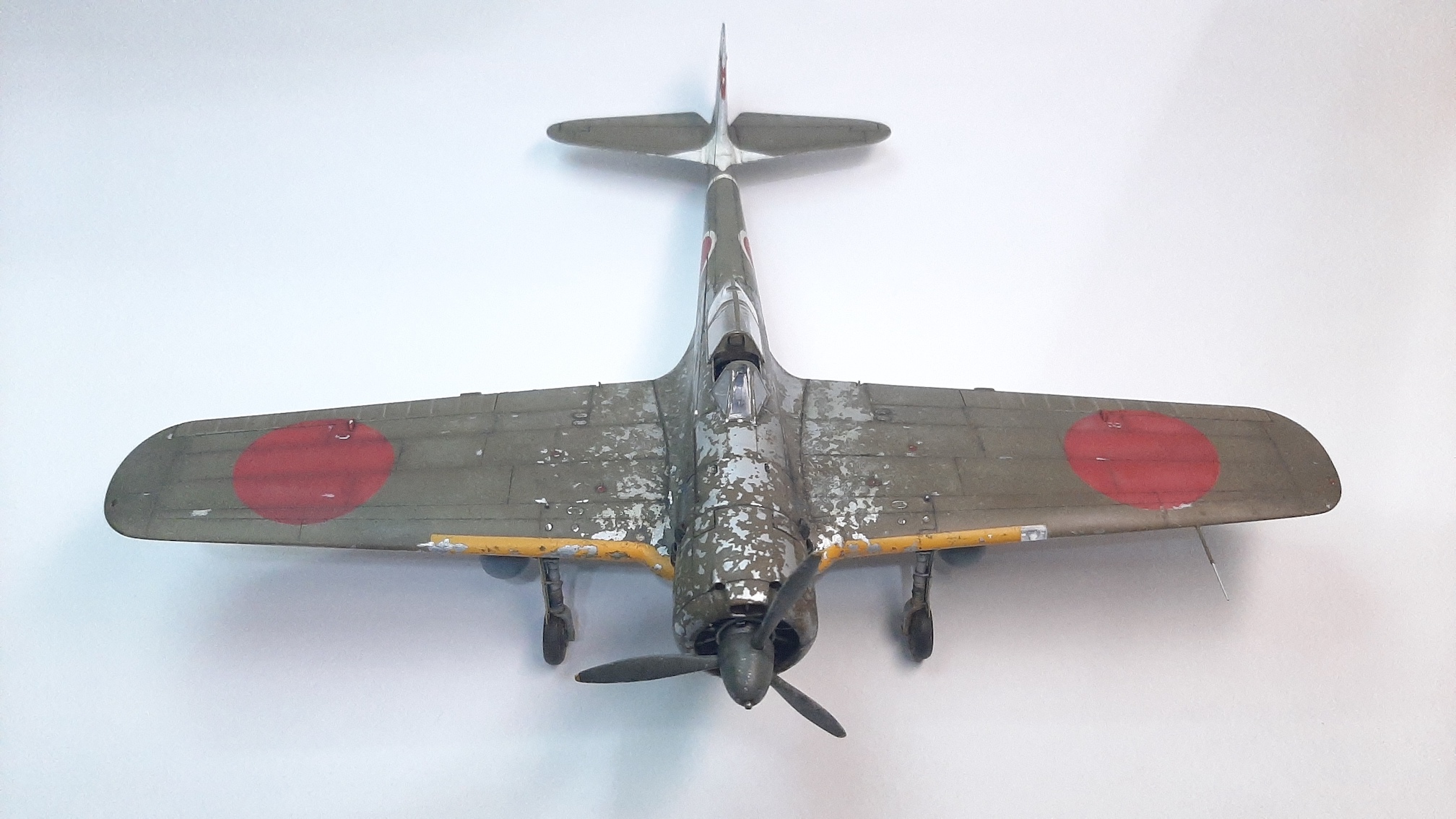
Dario Risso has very kindly shared these images and details of his fine representation of the Ki-43-II Hayabusa flown by Hiko Dai 25 Sentai commander Maj Toshio Sakegawa in China during 1943-44 and made from the classic 1/48 scale Otaki kit of 1972 (now available from Arii).  

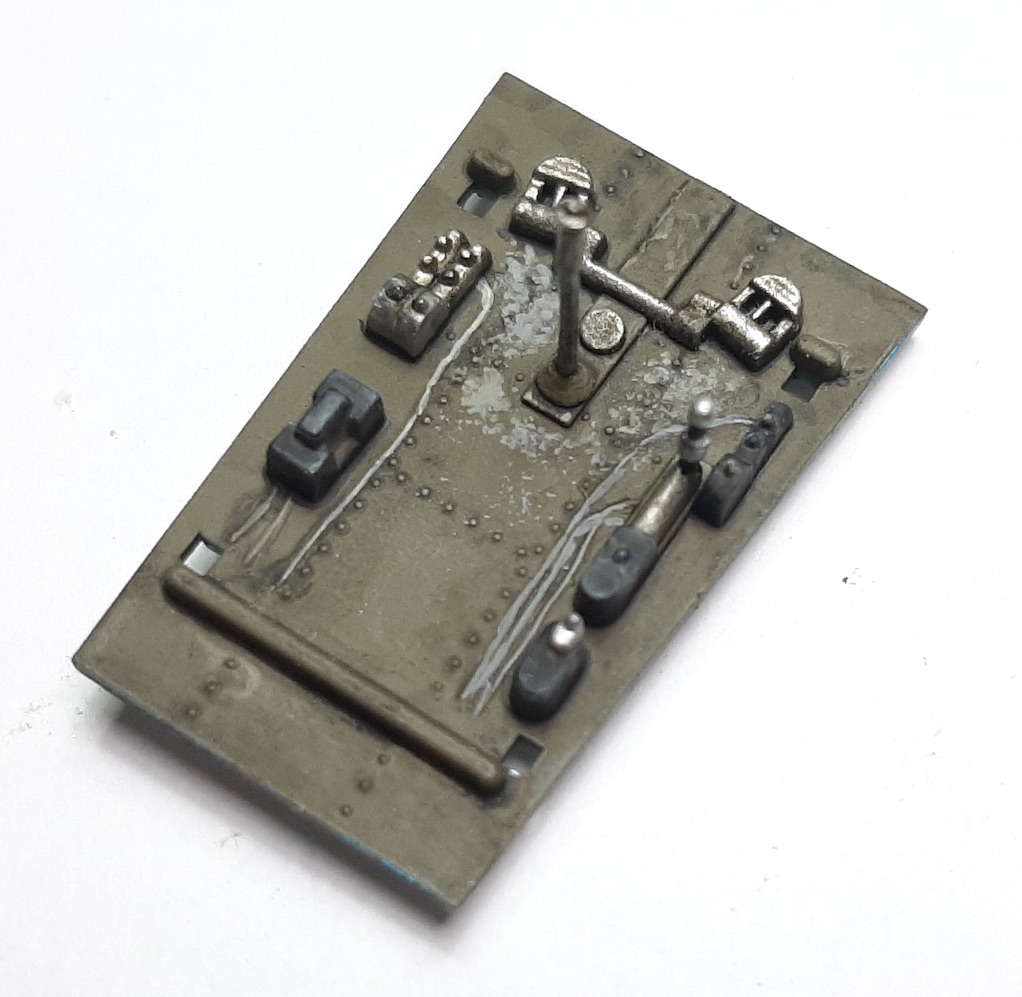
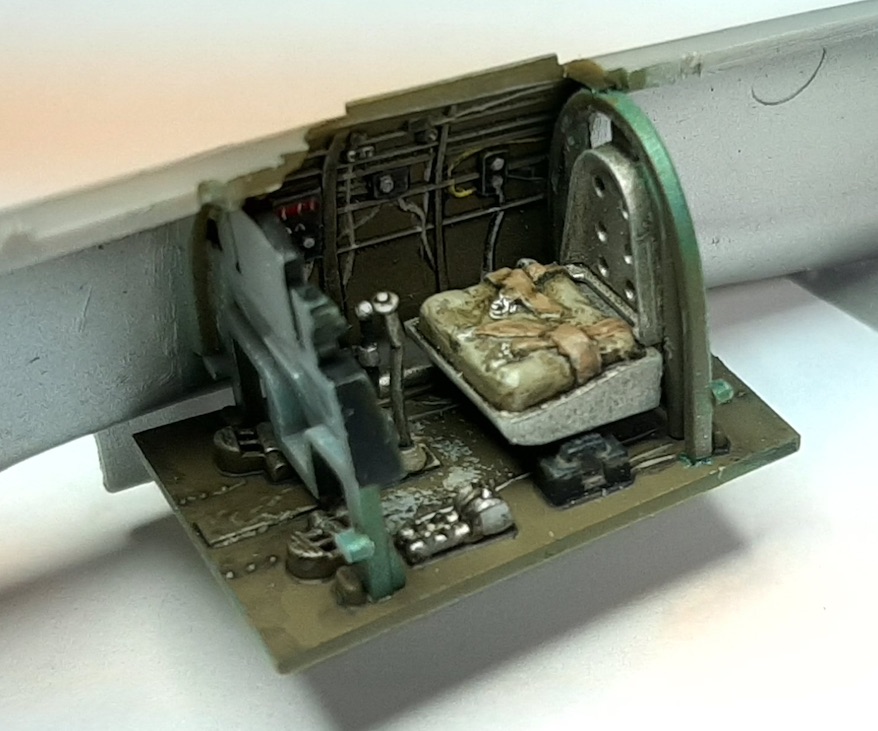
Dario added some detail to the cockpit, cutting away part of the main instrument panel and adding a more accurate replacement made from styrene sheet. He also added instruments decals and photo-etch bezels. A new seat was made using styrene sheet with seat belts represented by masking tape.

The kit's gunsight was modified too, cutting some parts and adding a pair of clear acetate rectangles for the glass reflectors. Following observations on this blog and the box art, Dario removed the pilot's headrest and drilled some 0.3 mm holes to simulate its fastening points.

The engine was detailed by adding copper wires (heated with a lighter to make it softer and less duller) to simulate the ignition wires. Other details added were the pitot tube made from hypodermic needle, a landing light on the port wing, starter lug on the spinner, hydraulic lines on the landing gear from 0.3 mm soldering wire, a metal screen inside the oil filter, filler caps on the droptanks and a pair of styrene sheet discs to cover the wheel rims. Dario also inserted a tiny loop of copper wire on top of the fin and then added aerial rigging.

To complete the model Dario airbrushed on a black acrylic primer coat followed by a coat of Vallejo Model Air Aluminium. He decided to paint the aircraft as depicted on the Otaki box art by Rikyû Watanabe with a dense green mottle over natural metal and airbrushed Tamiya XF-13 J.A. Green diluted 50/50 with IPA, then applied the white bands on the rear fuselage and fin. After two coats of Blem floor polish (equivalent to Future/Pledge) he applied the kit decals with Gunze Mr Setter, avoiding using Mr Softener as the decals were so old. Some of the hinomaru wrinkled, so he added more setter and pressed down with a flat brush until to get an acceptable finish. After applying the decals he airbrushed two more coats of floor polish, allowed that to dry for a day and then applied Testors Satin coat overall. The paint chipping was represented with a silver Prismacolor pencil and some sponge-applied Vallejo Aluminium acrylic.

Maj Sakagawa was a 43rd intake graduate from the Army Air Academy in 1931 and after Chutai commands in the 11th Rentai and 24th Sentai, as well as a brief period serving as a flying instructor at Akeno, was promoted to Major in August 1941 at the age of 31. He was then given command of the 47th Independent Flying Squadron when it took the pre-production Ki-44 into combat at the beginning of the Pacific War. He was known in the 25th for personally leading missions, claiming the bombing leader of a B-24 formation over Hankow on 21 August 1943 and three P-51s on 6 May 1944. On 17 July 1944 he went to the Akeno Flying School to become the deputy commander of the 200th Sentai for service in the Philippines from October of that year and on 1 December he took command of the 22nd Sentai there, to inspire a unit which had suffered badly in casualties and morale. He was killed on 19 December 1944 during a night take-off when the transport plane he and other Sentai personnel were being evacuated back to Japan in crashed.  
Toshio Sakegawa's Camouflage and Markings

Both the markings and camouflage of this aircraft have been variously depicted over the years, with the rear half of the spinner depicted as both red and brown. A single diagonal tail band in Chutai colours was introduced as the Sentai insignia when the unit began operating the Ki-43-II from May 1943, chosen from a design submitted by Cpl Kennosuke Seshimo. The best photographs of Maj Sakagawa's Ki-43-II do suggest a two-tone mottle camouflage, although that might just be the effect of overspray and/or re-spray. Rikyû Watanabe illustrated two versions of box art for the Otaki kit, both shown above, as well as a splendid fold-out profile for an illuminating article on the 25th Sentai by Dr Yasuho Izawa in a 1973 issue of Aireview magazine. 


In the article Dr Izawa stated that :- 'Sakagawa's plane had broader (white) band on the rear fuselage and the Sentai mark of 3 different colours'. However all three illustrations by Watanabe-san depict white and blue tail bands (blue being the typical colour distinction for aircraft flown by Sentai HQ flights) whilst his Aireview profile depicts a very dense, almost solid, two-tone green mottle. The fold-out profile is too large to scan so only a portion is shown above. An interesting detail on this profile is the masked around c/n 5640 - a Ki-43-II manufactured in July 1943, whilst Sakagawa commanded the Sentai from November 1942 to July 1944, so undoubtedly flew other aircraft.


The box art by Shigeo Koike for the original release of the Hasegawa 1/32 scale kit of the Ki-43-II shown above also depicted the blue and white tail bands.


More recently the mottle has been depicted as green and tan with tail bands in white, red and yellow from front to rear. But even Model Art No.395* appeared undecided on the camouflage as the profile in the book shown above depicts a dense green mottle over brown (or vice versa) whilst the caption to a photograph of the actual aircraft on page 83 states:-

'Renowned as the leader of the cream of the Army fighter squadrons, Toshio Sakagawa of the 25th is shown here ready for take-off at Hankow airfield in the spring of 1944, sitting in his II Otsu '00'. The main body is differently camouflaged from normal; on top of green and brown dense speckling, even darker green fine spots have been added  This is seen well on the covers of the wheel legs. The hinomaru white border is slightly ragged due to the overlapping of the camouflage. The spinner is white in front, brown behind and the recognition band at the rear of the fuselage is white with a fine red border. The squadron marking from fore to after is white, red and gold (yellow) with the aircraft number 00 stencilled on. The underwing racks are retained but the pilot's rollover pylon has been removed.' 


If the overpainting was true then it is quite possible the aircraft went through a succession of camouflage appearances during its service life and more than one aircraft might have been flown by the commander. Prolific Japanese artist Fuku illustrated the white and blue tail band colours of Maj Sakagawa whilst depicting a heavy green mottle over natural metal, as shown above. The solid, medium green finishes of other Ki-43-II aircraft delivered to the Sentai were quite possibly modified or added to when worn or in order to better suit local conditions in China as with other fighter Sentai, but a mix of solid and mottled aircraft were flown, the mottled '15' of Sgt Kyushiro Ohtake of 2nd Chutai being well known. 1st Chutai 19-victory ace 2Lt Moritsugu Kanai flew Ki-43-II '05' c/n 6925 (manufactured in March 1944) with a solid dark green upper surface and the original white senchi hiyoshiki so-called 'combat stripe' painted over, reportedly in brown. The variance of solid and mottled finishes was not chronological but related more to the urgency of replacement and the resources of time and paint available at Army depots.   


The LS 1/72 Ki-43-II kit's 1983 box art by Kihachiro Ueda also depicts white and blue tail bands with an apparently solid medium green upper surface scheme, but the Arii release of the kit with the same box art now includes white, red and yellow tail band decals with a frank and refreshing note on the instruction sheet schematic (above) about the uncertainty of colours - 'Note: 8, 9 and 10 stripes can be confirmed in photographs, etc., but since there are many unclear points such as colours, I made this for the time being. If anyone knows about this stripe, please let us know.'  


From the photograph there is the merest hint of the mottle camouflage continuing up between the first and third band, suggesting that perhaps there were only two bands as depicted by Watanabe-san, and the tone of the central part does not seem quite as dark as the border of the fuselage band (which also seems to have a lighter border next to the red (?).  Can a firm conclusion be drawn? Probably not. Which leaves the subject open to an enjoyable interpretation based on personal belief or preference. Any one of the various depictions might inspire the completion of a model from one of the several Hayabusa kits available and both versions of the tail markings are splendid, so let it be so. 

With very special thanks to Dario for sharing his excellent modelling here. It is a delight to see and show another classic kit so skilfully improved and presented. 

* 'Camouflage & Markings of type 1 fighter HAYABUSA', Model Art No.395 (Model Art Co. Ltd., 1992)

Image credit: All model photos © 2021 Dario Risso; Otaki box art © 1973 & 1975 Otaki Model Toy Mfg Co.; Aireview profile © 1973 Rikyû Watanabe & Aireview magazine; Model Art profile and photo detail © 1992 Model Art Co., Ltd; Fuku profile © 2020 Fuku; LS box art © 1983 L&S Co.,Ltd.