Friday, 12 February 2010

Exquisite Fine Molds A6M2 Zero

There are not many images of built-up models of the superlative Fine Molds 1/72nd scale Mitsubishi A6M2 Zero (perhaps because of the odd way it was sold and the price!) - so it is a real pleasure to be able to show these pictures of Joe Youngerman's beautiful creation. Hard to believe that this is not in a larger scale but doubly impressive is the fact that Joe chose the more unusual dark green rather than more common grey option from the kit.

Joe used White Ensign Models paints to create his replica of a 263rd Ku machine, with the exception of the cowling which was finished with Model Master Gun Metal Acrylic.

For those visitors who may not have had the opportunity to appreciate the beauty and detail of this kit a couple of in box reviews may be found here and here.

Image credit: ©2010 Joe Youngerman

Sunday, 7 February 2010

Gilding The Lily ~ Extra


These additional images show the method by which master modeller Hisao Saitoh paints the markings - they are not decals - on his Ki-48 and other models. The stencils are hand-made by Saitoh-san.

Image credits: ©2010 Hisao Saitoh

Saturday, 6 February 2010

Aotake ~ Part Two - The IWM Zero

These splendid photographs of the Imperial War Museum's surviving A6M5 Zero centre section were taken by Ken Francella in the 1980's and come from him via Ken Glass. They need very little commentary, other than to note the difference between the bright, glossy appearance of the Aotake where it was protected from the elements on the original airframe and the areas of exposure and much use, like the wheel wells, where it has deteriorated.

Other paint colours and details on this airframe will be explored in due course - with a few surprises along the way.

By the way, if you are a lurker and plan to take these images to post on another website - with whatever points you wish to make there - the very least you might do, on the grounds of simple courtesy, (and if you cannot bring yourself to ask first for permission for whatever reason) is to mention where they came from and to provide a link. That way we won't have to jump to harsh conclusions about your character which might be quite unjustified. However, even better would be to comment and contribute something here, at the source. One doesn't remove a painting from the walls of an art gallery without permission (at least I hope not) and take it off to the nearest pub for a very public discussion about it with your mates. Imagine how the artist would feel, let alone the gallery owners? But then I suppose, in the wonderful 21st Century, consideration for the feelings of others is not as high on the personal agenda as it once was.

Image credits: ©2010 Ken Francella via Ken Glass


Thursday, 4 February 2010

Gilding The Lily ~ Part One


Hot on the heels of Gary Wenko's review of the new AZ 1/48th Kawasaki Ki-48 Lily kit in the IPMS UK JASIG Corner Bulletin #4 come these stunning images of the model as built by Japanese master modeller, researcher and artist Hisao Saitoh. Details to note and enjoy are the overall Hairyokushoku (ash green colour), olive green "snake weave" mottle, the prop colour (and lustre), engine details and the interior colour which is just visible. Superbly achieved and absolutely convincing - as well as a very interesting table top companion for Hasegawa's Kawasaki Ki-45 Toryu.

The aircraft depicted is from the 8th Sentai in action over Burma from bases in Thailand with the unit's distinctive "Octopus Eight" tail insignia. All the markings are painted, not decals, using hand-crafted stencils. What a beauty!

More "Gilding the Lily" posts on large scale Ki-48 details to follow.

Image credit: ©2010 Hisao Saitoh via Ken Glass

Tuesday, 2 February 2010

Aotake - Part One


What Is It?

Following on from previous articles exploring interior colours is this brief diversion, hopefully of interest. There are several proprietory hobby paints available which purport to represent the translucent blueish-green protective coating seen on the interiors of both Army and Navy aircraft which has become well known as 'Aotake' (or aodake, 青竹). However, being essentially opaque metallic colours these paints can only create an approximate impression of the appearance and are often quite garish. Most modern translations describe Aotake as "green bamboo", the Nihon Kokugo Dai Jiten of 1972 defining it principally as "the trunk of raw, green bamboo", but the word "Ao" can be problematic in terms of meaning blue or green.

The niceties of the language were explored in depth in a superb article in the late and lamented Asahi Journal Vol.2 No.4 where two uses of the term were identified and explored, distinguishing between its use to describe a coating and its use to describe a colour. In the article Model Art 272 (Camouflage & Markings of the Imperial Japanese Navy Fighters in WWII) was reported to describe a green-yellow paint colour chip on page 109 in the following terms:-

"Ordinarily it's called aodake colour but actually it is a coating from a family of transparent zabon enamels. There are two branches to it, a blue one and a green one."

This chip is approximately similar in hue to FS 34258 but a little lighter and "metallic" in finish.

Model Art Special 329 (Camouflage & Markings of Imperial Japanese Army Fighters, 1989) went further:-

"Aodake is a crystal that dissolves in alcohol and is used in coatings when assembling steel and the like. (The aodake) used for interior colours was a transparent blue colour of zabon enamel but sometimes there were green ones too. When applied in coats it becomes an ordinary dark blue colour."

The strong dark blue pigment Prussian Blue (sRGB 0, 49, 83, very close to FS 15050 @ 1.14) was used in a similar way and was often referred to as "engineers blue". Aha, that is a rather deep, navy blue.

In Model Art Special 406 (Camouflage & Markings of Imperial Japanese Navy Bombers in WWII, 1993) the two apparent uses of the term were clarified:-

"Aodake used to be considered very similar to the zinc chromate (paint) on American and other military planes but the coatings were not of one type (only). There were Aodake Number One, Aodake Number Two and some other kinds. This light green colour of aodake was widely employed."

Many years ago Don Thorpe was adamant that the term aodake originally referred to the various opaque yellow-green interior paints. In a letter published in 1980 he stated:-

"Now, as to the transparent colors; aoitake is NOT a generic application for the bare metal primers. Aoitake was only referring to the opaque paints. The bare metal primer coating was usually applied at the point of fabrication of the sheet of metal or sub-assembly and was only intended to protect the rather rich mixture of aluminium alloy from the elements until such time as permanent coatings could be applied.

"I have mixed feelings on the subject of colors in this area, although I have encountered both blues and greens. I have also encountered samples of aircraft which had other pieces of metal attached, which when separated showed a bright blue in the previously covered area, and bright green in the previously exposed areas. One theory of this phenomenon is that when exposed to sunlight, fumes, salt air and water, etc., that the colors become fugitive and change hues. I have seen many examples of this in other Japanese aircraft so the theory is not without precedent."

This appraisal is strengthened by the impression of colour given by the term aodake shoku (green bamboo colour) to the Japanese layman, as demonstrated in the Asahi Journal article by the choice of green-yellow and green-olive hues to represent it. Thus was concluded a distinction between aodake as a coating, and aodake shoku as a colour.

In his seminal works on Japanese colours, Don Thorpe gave Munsell 2.5B 4/6 as the colour value for Navy/Army 'Translucent Blue' N16/A18, equating to sRGB 0, 108, 125 and FS 15125 @ 5.37 (so not very close - the FS value is insufficiently green in appearance). And for 'Translucent Green' as Munsell 5BG 3/6, equating to sRGB 0, 84, 82 and FS 34058 @ 10.0 (a poor match, too dark and not green enough).

In his most recent profile on the Ki-44 Shoki fighter, leading Japanese researcher and author Shigeru Nohara comments that:-

"This interior paint commonly called "Aotake" for the corrosion prevention was applied on the Ki-44 production aircraft until mid-1943. The paint was used by the Army and Navy but the name Clear Pale Blue was from the Navy. There are variations for this paint existed such as #1 and #2. Since the colour being translucent the tone after painting also depends on the repetitions of the coating."

The printed chip provided in the book is approximately similar to FS 34241.

Hobby Paints

As mentioned the aodake coating has been represented by a number of opaque metallic hobby paints. The GSI Creos (known as 'Gunze') Aqueous paint represents this coating with H63 'Metallic Blue-Green' which strongly emphasises a bright blue rather than green. The corresponding 'Mr Color' lacquer paint is C57. In Xtracolor the coating is represented by X355 'Japanese WWII Interior Blue' . Recent tins of this paint appear to be slightly lighter and more silvery than earlier examples. White Ensign Models Colourcoats paint ACJ15 'Aotake' is almost identical in appearance to the Xtracolor paint, perhaps chromatically just a little stronger. In the old AeroMaster Warbird acrylic colours was 1084 'Aotake', very similar to the GSI Creos paints. Lifecolor market an airbrush paint called "Blue Aotake" which has an advertised RGB value of 0, 144, 121 and is a very bright turquoise blue-green with no comparable Munsell or FS equivalents.

Representing Aotake

Correspondent "No Parachute" kindly contributed these images of his 1/32nd scale Hasegawa Ki-44 Shoki (above) painted using his own technique for representing this elusive finish. He begins with a base coat of Mr Color #159 'Super Silver' as "an excellent metallic color having the appearance and durability of actual metal". Then he mixes his own version of the 'green/blue' using Vallejo paints AV #70938 'Transparent Blue' and AV #70937 'Transparent Yellow' (FS 38907) to achieve the very pleasing result shown here. The finish is shown under various lighting conditions but at the time the photographs were taken was not clear coated. "No Parachute" welcomes comments on this finish - as do I.

To be continued . . .

Image credits: ©2010 "No Parachute"; Relics courtesy of Mr. Honma Hiroshi, Hokkaido Museum of Climate, Kutchan.

Monday, 4 January 2010

JASIG Corner Bulletin # 4


I’d like to wish you a very Happy New Year! Thank you for taking the time to complete your JASIG membership form and sending it in. We are well subscribed for 2010 and ready for the show season. There are a number of new kits on the horizon and I’m sure you are anticipating them as eagerly as I.

Absent Friends:

It is with great sadness that I share with you news of the death of one of our strongest supporters, Dennis Earth. Dennis suffered a stroke some time ago and was recovering in a nursing home in Spalding when he was taken to hospital only to have died on Christmas Eve. He was a strong supporter of IPMS (UK), a founding member of the Spalding Model Club, which evolved into IPMS Fenland and a staunch supporter of our own Japanese Aviation Special Interest Group. He has been a keen modeller for many, many years and has served as a judge at the IPMS Nationals. He was personable and always willing to share his insight into modelling and competition and corresponded with anyone who expressed an interest.

2010 Model Show Circuit:

ModelKraft 2010, Milton Keynes, Sunday, 7 February, Stantonbury Leisure Centre
Huddersfield 2010, Sunday, 21 February, Huddersfield Sports Centre
East of England Model Show, Saturday, 6 March, Peterborough Town Hall
Shropshire Model Show, Sunday, 11 April, RAF Museum Cosford
Hendon Scale Model Show, Sunday, 23 May, RAF Museum London
IPMS Salisbury Show, Saturday, 29 May, Wyvern College, Laverstock

I look forward to seeing you there, if you can make it. Be sure to stop by and say hello if you can't participate.

Kit Reviews: AZ Models New Lilys

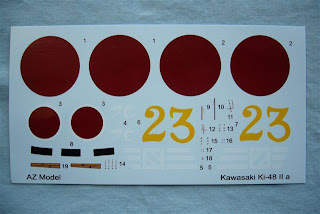
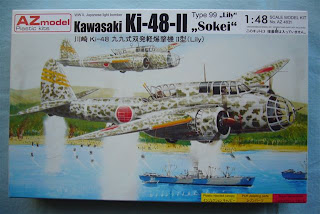
AZ Models released of two kits of the Kawasaki Ki-48 Type 99 Lily bomber in 1/48 scale. The plastic contents of both kits are identical each offering a common instruction pamphlet, three sprues of injected moulded parts in grey, a clear sprue of transparencies, and a bag of resin bits for the engines and some fuselage internals. The kits differ in their box art and decal options. Strangely enough, the Ki-48-I kit decals are marked Ki-48-IIa and the Ki-48-II kit decals are marked Ki-48-I. The kit box bottom carries the relevant artwork for paint schemes and decal placement. Additional paint schemes are provided in the Osprey AirCam of the Lily. No paint scheme for the interior is provided and Nick and I think it would be the IJA dark grey-blue.

AZ4833 is the kit number for the Kawasaki Ki-48-I Type 99 Sokei, which allows for three decal options: a machine of the 34th Sentai, Thailand, 1943; 75th Sentai, China, 1941; and one of the 90th Sentai, Thailand, 1942.

AZ4831 is the kit number for the Kawasaki Ki-48-II Type 99 Sokei, which provides markings for two aircraft of the 34th Sentai, a China theatre machine of the 1st Chutai from 1943-1944, a 2nd Chutai machine from New Guinea, 1944, and a Hikota Flying School machine.

AZ Model produces an additional photo-etched fret number A4001 to augment their Lily kits. The kits are £59 each from Hannants and the PE fret is a tenner.

Images of the box art, kit sprues, decal sheets and photo-etch are shown above.

Gary