Wednesday, 14 September 2011

Hasegawa New 1/32nd scale Mitsubishi J2M3 Raiden "Jack"


A review of the new Hasegawa 1/32nd kit of the Imperial Japanese Navy's interceptor fighter the Mitsubishi J2M3 Raiden "Jack" can be found here at Scale Plastic and Rail. The first issue kit, a special edition, contains as a bonus a comic book 'Young Bloods on Lightning Bolt' by Seiho Takizawa.


Raiden is sometimes translated as 'Lightning Bolt' and sometimes as 'Thunderbolt'Raijin is the god of thunder and lightning in Japanese mythology. The name Raijin comes from the Japanese words rai (雷, thunder) and shin (神, god). Raijin is sometimes depicted as a muscular man surrounded by drums, from which come the rumbling of thunder. Raijin also sometimes appears as an Oni (demon) as below. A Buddhist legend tells of Raijin as an evil demon who confronted Buddha. Buddha deployed a heavenly army to capture Raijin together with the demon who became the god of the wind (see Osprey's Ki-44 Aces!). Raijin is sometimes referred to as Raiden, from the words rai (雷, thunder) and den (電, lightning.) According to a Japanese legend, Raiden saved Japan from an invading Mongolian fleet in 1274 by sitting on a cloud and hurling bolts of lightning against the ships.


Model Art in Japan have also published a new profile on Raiden which is now available from Hobby Link Japan.


A previous 1/32nd scale kit of the J2M3 Raiden originated from Revell (possibly with Takara, Japan co-operation) in 1972. Always difficult to find it is now a rare and sought after kit but it will be interesting to see how many of these appear on the second hand market from the stashed hoards now that Hasegawa have released their new version!
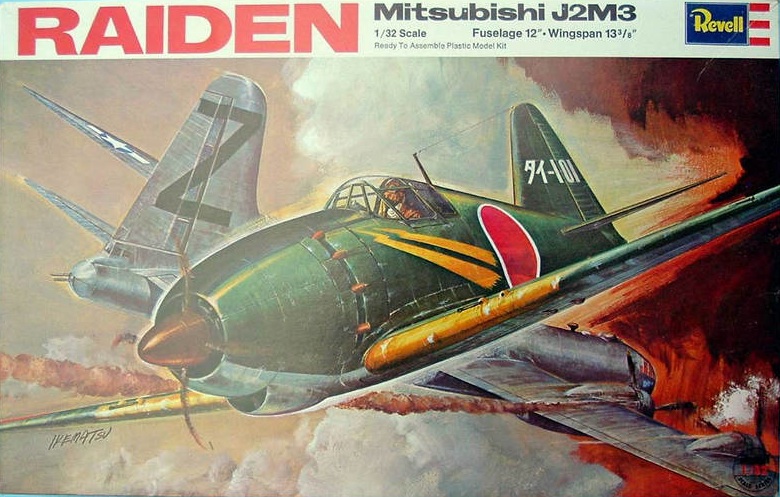

Reviews of the Revell kit may be found here at Large Scale Planes and here at Aeroscale.


The same kit was re-issued in Japan in 1976 in the usual distinctive Revell-Japan strong cardboard box. This edition, even rarer now than the original Revell, had new box art and a decal sheet with no less than five options.

No doubt many models of Hasegawa's new Raiden will appear with cockpit interiors resplendent in RAF grey-green and much forum waffle will be expended on the subject by those who worship at the temple of Tamiya paint. Here are some clues.


Image credits: Box art, comic & model images © Hasegawa 2011; Model Art # 11 cover © Model Art 2011; Box art © Revell 1972 & Revell-Japan 1976; rendered colour chips © 2011 'Straggler' 


Monday, 5 September 2011

Kit Trivia ~ Zeros New and Old ~ Airfix and Matchbox


It looks like Airfix have attempted to neatly side-step colour controversy with the single option boxing of their new Mitsubishi A6M2 Zero kit in 1/72nd scale. Or maybe not. The unusual undulating demarcation between the dark green and grey (or should it be orange yellow?) might give novice modellers a few headaches. The box art is splendid although I'm not sure what a Tsukuba Air Group Zero is doing mixing it up with New Guinea era Thunderbolts!  It will be interesting to see the painting suggestions in the future Pearl Harbor gift-set combo of P-40 and A6M2. No doubt the release of this kit will trigger the usual forum cycle of questions, answers and arguments. I'm looking forward to what I like to term the "Celebrity Novice" questions where the clueless and/or mischievous hold court as the experts and pundits desperately attempt to assert the supremacy of their advice and opinions in order to influence the painting of one individual's little plastic model. Aw, shucks.


In their time the British manufacturer Matchbox (part of the Lesney Group which came to prominence selling inexpensive die-cast cars under the Matchbox logo) released a number of unique and very good kits. Jean-Cristophe Carbonel celebrates them all in a new and very interesting book about the marque published by Histoire & Collections in English. Unfortunately the Matchbox Zero of 1973 (amongst the first batch of kits) was not one of them, bearing an unfortunate similarity to a T-6 film mock-up. It was surprising therefore to read that Matchbox's Zero was apparently designed with input from Mitsubishi Industries in Japan. One can only surmise that whoever was contacted to provide information had a well developed sense of humour.


The kit itself appeared over the years with two different versions of box art, both the fine work of the artist Roy Huxley. The fire-spitting original succumbed to a more sedate version in 1986 dictated by the marriage of marketing and political correctness. Both versions depicted the classic pale grey - almost off-white - of contemporary convention and belief; the painting instructions even suggesting Humbrol Hu.11 'Airframe White' (FS 37875) from their Authentics US Air Force Vietnam set.


Two markings options were offered in the kit, an aircraft from the carrier Akagi AI-113 at the time of the Pearl Harbor attack and one from the Tsukuba Air Group, a stablemate of the future Airfix kit - Tsu-102 - identified only as a 'Naval Air Corps Operational Training Unit' in dark green with orange yellow under surfaces. When the box art and packaging were revised these options and the painting instructions did not change.


After the demise of Matchbox the brand rights were purchased temporarily by Revell and a number of their kits - and others - were released under the Matchbox logo. The book asserts that the Mitsubishi Zero issued under this logo in 1996 (Kit # 40002 shown above) was "definitely from Matchbox pedigree". Mais non, M. Carbonel, not in the example I own it isn't! Lurking in the box ready to surprise and disappoint the unwary was most definitely the old Frog kit!  Joël Falconnet is quoted as remembering "huge errors concerning box contents" at this time which makes me wonder if any of the re-issued boxes did contain genuine Matchbox Zero kits? Despite its long run from 1973 to circa 1991 the Matchbox Zero kit is something of a rarity these days and the marque has a strong nostalgic following amongst collectors and retro-builders.

Image credits: © 2011 Airfix; © 2011 Histoire & Collections; © 1973 & 1986 Matchbox; © 1996 Revell

Friday, 2 September 2011

Recent Kit & Decal Releases

Amodel have released two 1/72nd kits of the Japanese Dakota - the "Tabby" - in L2D2 and L2D3/D4 variants. The kits sell for about £30 each in the UK. I haven't seen them yet and cannot provide any further details so comments are welcome from those who have.


Hasegawa have issued a 'Pearl Harbor Combo' of their 1/72nd Mitsubishi A6M2 Zero - two old kits in a new box with new decals. The Hasegawa kit was and is very presentable but £30 for two? There is a review of this kit here.


Finally,  Techmod have released a set of decals for A6M2 Zero named pilots in 1/48th scale. Two aircraft flown by Tetsuzo Iwamoto are included but all are well known old favourites.


All these new items are available by mail order from Hannants.

Image credits: © Amodel, Hasegawa & Techmod 2011

Saturday, 20 August 2011

Contact Request

Could Glenn, who sent me images of an absolutely magnificent ATAIU-SEA Zero model, please get in touch, as I have lost your email address! Thanks!

Friday, 19 August 2011

Osprey Aircraft of the Aces 100 ~ Ki-44 'Tojo' Aces of World War 2


An advance copy of this Osprey title has just arrived with publication due in October. The cover art, 32 profile illustrations, two colour plan views and monochrome plans have all been created by the talented and accomplished 3D digital artist Ronnie Olsthoorn.

Currently in preparation is 'Ki-27 Aces' for which Ronnie is also creating all the artwork.

Image credit: © 2011 Osprey & Ronnie Olsthoorn

Wednesday, 3 August 2011

The Eagles of Manchukuo 1932-1945


Arawasi have announced the publication of their new book The Eagles of Manchukuo, 1932-1945: An Illustrated History of the Civilian and Military Aviation by George Eleftheriou and Kiri Domoto-Eleftheriou. This ground breaking book is the result of more than 10 years of research and includes hundreds of newly discovered photographs, most of high quality, and material never before covered in any publication.

This 224 page book has English text, 341 photos (31 of which are in colour), 73 colour illustrations, 36 monochrome illustrations and retails for $US 45.00 (approx. £27.60) which includes postage and packing. It covers pre-Manchukuo aviation in brief, the Manchukuo Airline, the Manchukuoan Air Force, the Manchukuo Maritime Police Air Unit and Gliding in Manchukuo. The sample pages look both excellent and intriguing, promising a cornucopia of revelations about a fascinating but previously little-known subject and reflect the same high quality of presentation and reproduction achieved by Arawasi magazine. Amongst the repeated cycle of the same questions, the same replies and the same endless arguments about Japanese-related subjects this book announcement is a breath of fresh, invigorating air. Heartiest congatulations to the Arawasi team!

Image credit: Book cover © 2011 Arawasi, courtesy of Arawasi