Friday, 25 November 2022

More Hayate - Dario Risso's 1/48 Ki-84


This 1/48 scale Ki-84 Hayate model was built by Dario Risso from the Arii (former Otaki) kit. The model was built mainly out of the box but Dario added cockpit, engine and other details using plastic card, stretched sprue and copper wire.  


Dario detailed the cockpit (shown below) by adding some wiring made out of copper wire and stretched sprue, added some control boxes, and a seat cushion made from styrene sheet. He made the seat belts using tin sheet with copper wire buckles. 


The engine was detailed by making .3 mm holes for the spark wires. Dario used copper wire again, this time heated to make them softer and dull looking. More styrene sheet and plastic wrapped wire was used to detail the engine. (shown below).


Dario added the fuel tanks caps and the warning buzzer with small styrene discs Some putty was applied in the small gaps between fuselage halves, then sanded. After cleaning the model with dish soap and rinsing well he applied a coat of primer and after it dried, a couple of coats of Gaia Duraluminum.
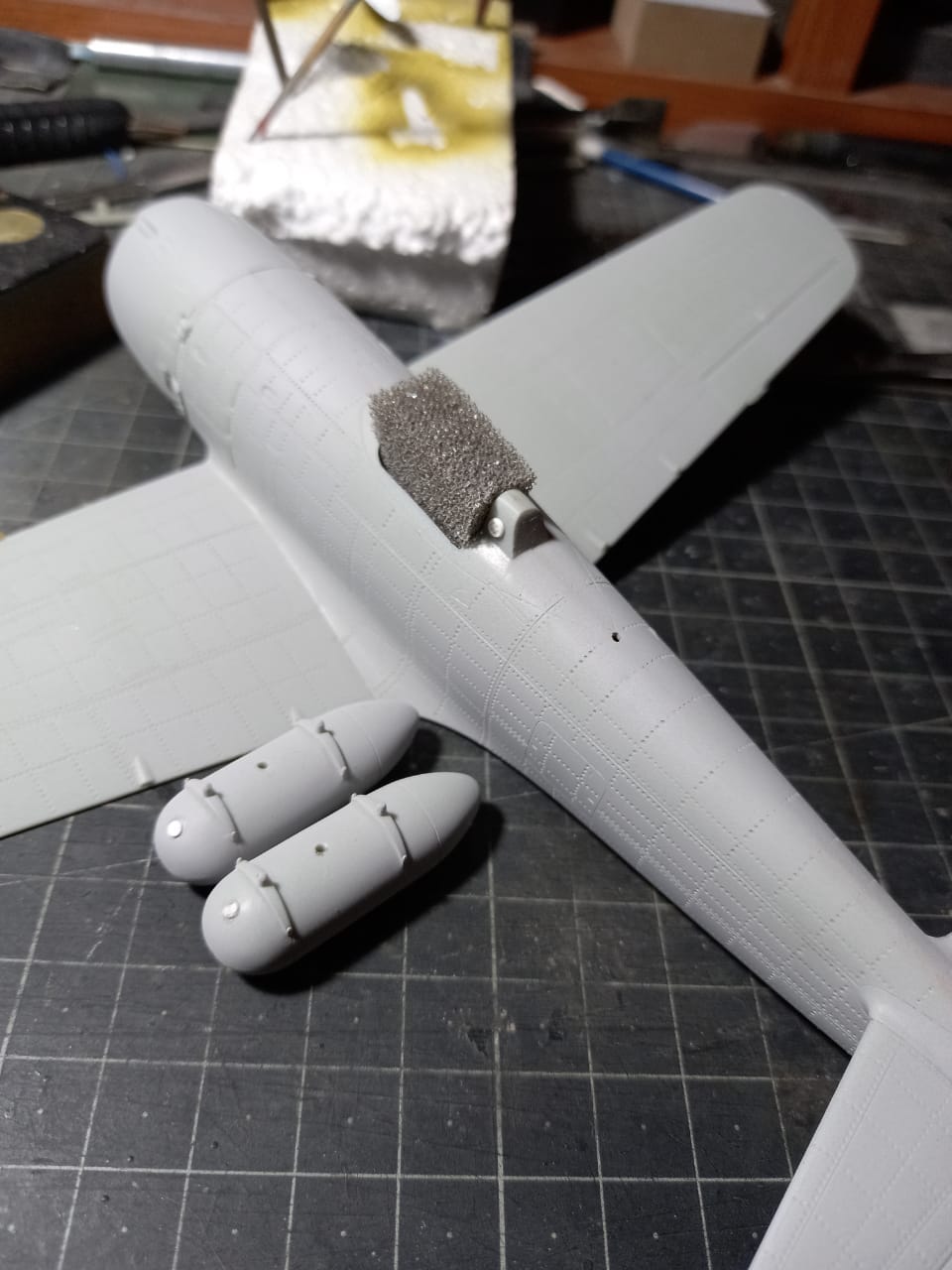

Dario masked off the model undersides with masking tape and applied a coat of  hairspray, direct from the can. Then a coat of Tamiya JA Green was applied and after 10-15 minutes he used a brush to wet the surface, applying water in zones and rubbing with a short bristle brush and a toothpick. Following that he masked off the wings and fuselage to paint the white Home Defence bands, followed by masking and painting the hinomaru. Then the orange-yellow markings, so more masking, hairspray, painting and paint chipping. 


The next step was to apply two coats of acrylic floor polish and the unit decals to represent an aircraft of the Hiko Dai 47 Sentai's 2nd Chutai, one of the subjects of the original kit. That was followed by painting the almost black antiglare zone. The final step was to apply oil washes, black on green painted surfaces, grey-brown on other surfaces.  The paints used were:-
  • Interior green: a Tamiya mix Dario already had in a jar - possibly XF-26 and XF-4 
  • Primer: Tamiya Liquid Surface Primer diluted with Tamiya Lacquer Thinner 
  • Aluminum base: Gaia 123 
  • Green camo: Tamiya XF-13 J.A. Green 
  • Underside: A Mix of Tamiya XF-14 J.A. Grey and X-2 White (4:1 ratio) 
  • Propeller: Tamiya Mix: XF-26 Deep Green, XF-62 Olive Dran and X-8 Lemon Yellow (10:3:3) 
  • Yellow markings: X-8 Lemmon Yellow and XF-7 Flat Red (20:1) 
  • Black antiglare surface: XF-1 Flat Black and XF-57 Buff (18:1) 


With special thanks to Dario for sharing these images and details of his excellent Hayate build. The representation of wear over panel lines is especially well done. The Arii ex-Otaki kit was first released in 1973 so is approaching its fiftieth year of long service and good conduct. It is still in stock at HLJ at a sale price of only £6.77 (usually £8.46), remarkably good value in this day and age. 


Image credits: All photos © 2022 Dario Risso

Wednesday, 2 November 2022

ICM Ki-21 'Sally' Step By Step Construction

Hat tip to Peter Zanella for the heads up to this step by step construction video for the new ICM 1/72 Ki-21-I 'Sally'. Nice details. Interior colour should be the dark blue-grey throughout. 

Image credit: © 2022 ICM via YouTube

Tuesday, 1 November 2022

Rob's 1/72 scale Franks - No, Not That One!


A delight to share this collection of excellently realised and photographed 1/72 Hayate models by Rob Ronconi. All made from the 1982 vintage Hasegawa kit. This long serving kit was first announced as 'N1' in Hasegawa's 1978 kit catalogue with a photograph of the surviving Hayate in flight, but like its companion Ki-43-II in the same scale was not released until 1982 (and not 1987 as suggested by Scalemates) as kit # B18 in the 'blue flash' type box. The original box art by Shigeo Koike depicted a 29th Hiko Sentai example but alternative decals were included for '327' of the 73rd Hiko Sentai in 1944 in the factory-applied olive drab scheme with a colour profile of that aircraft on the side of the box. Since then it has been re-released many times in both standard and special editions and is still available from HLJ in the standard, now 'orange flash', edition box with the original art for the princely sum of £4.47.

Rob comments that the Hasegawa kit can still produce a decent effort, as his photographs more than show, if enhanced with pencils and shading to off-set the raised detail and lack of other features. Above images are the 'blue bird' of Hiko Dai 102 Sentai. Relatively short-lived as a fully operational unit it was established in July at Kita-ise as part of the 100th Air Brigade and after working up with many problems moved to Miyakonojo West airfield in March 1945. On 6 April 1945 the 102nd contributed 20 aircraft to the 40 aircraft despatched by the Brigade for special attack escort but many aircraft made forced or emergency landings on return after becoming lost. After participation and heavy losses in the Okinawa campaign during which a cadre of pilots volunteered for special attack sorties, its surviving aircraft and personnel were re-assigned to the two other 100th Air Brigade units Hiko Dai 101 and 103 Sentai from June 1945. The commander of Hiko Dai 103 Sentai Maj Michiaki Tojo has commented in interview that his unit had only two or three veteran pilots out of about 50 and the rest were inexperienced and straight from training.

Next, (above,) a Brigade-mate of the 102nd bird, a Hayate from Hiko Dai 101 Sentai. The unit also participated in the Okinawa campaign, notably conducting a low-level strafing attack against enemy ground forces on 15 April 1945. One of the participants in this attack, Lieutenant Masami Kodama made an emergency landing and fought on with Japanese ground forces. Between April and June the unit lost 21 pilots including the Sentai commander and Hikotai leader. This particular Hayate was flown by Sgt Noburo Saito as part of the 1st Special Shimbu-tai, one of 10 special attack volunteers drawn from the 101st and 102nd. Sgt Saito was lost with 2nd Lt Jiro Ito during attacks against US vessels on 12 April 1945.


This Hayate (above) is believed to be the aircraft of the leader of the 184th Shimbu-tai although the tail marking is also said to represent '182'. It was one of 50-60 Hayate concentrated in 19 Shimbu-tai at Tatebayashi airfield for special attack sorties and photographed there in August 1945 minus its propeller. 


Above is a Hayate from the 57th Shimbu-tai flown by Staff Sgt Takayuki Yamashita. The eagle and bomb was a personal marking. 


The 57th Shimbu-tai was one of four special attack units formed at Akeno on 29 March 1945 and equipped with Hayate, the others being 7th, 58th, 59th and 60th. The majority of pilots for the 57th were drawn from the 14th and 15th intakes of boy airmen who were under instruction with the 1st Training Squadron at Sagami. On 30 March the unit moved to Shimodate Airfield in Ibaraki Prefecture, and on 10 April received Type 4 fighters (Hayate) and began flight training, including taxi, takeoff and landing, familiarisation flights, and taking off and landing on short fields. After this basic training, navigation practice, formation flying, taking off and landing with heavy loads, and dive to low attack training were conducted, followed by special attack training against single ships. This strikingly marked Hayate (above) was flown by Cpl Tokuo Takano and was one of 11 aircraft led by Ensign Kitoku Ito which sortied from Miyakonojo East airfield on the early morning of 25 May 1945 to attack US vessels off Okinawa. 

With special thanks to Rob for sharing these images of his excellent Hayate models.

Image credit: All © 2022 Rob Ronconi

Wednesday, 12 October 2022

Marusan 1/50 Hayate


With the very kind permission of the eBay seller an opportunity to share these images of a well made model of the Nakajima Ki-84 Hayate from the rare original Marusan 1/50 scale kit of 1961. The kit was re-released twice with new box art by Marusan and subsequently by UPC in 1966 and RSL Classic Models (a New Zealand based re-seller) in the mid-1960s (the various box arts are shown at the bottom of this feature). At the time of its release the engine and cockpit detail were considered noteworthy and the overall appearance commendable. This feature segues neatly from the subject of old Japanese kits of the 1960s to an autumnal season of single-engined Army fighter models including the latest Hayate kit to be offered in 1/72 scale.

Marusan pioneered plastic model kits in Japan with the release of the Nautilus nuclear submarine in 1958, subsequently releasing an extensive range of aircraft kits in various scales including a series of 1/100 kits and 1/50 scale classics such as the Ki-46, Ki-15, Navy Type 10 triplane torpedo bomber and Aichi 'Jake', all later released by UPC. The company was not without controversy in Japan with a lawsuit following their attempt to copyright the term 'plastic model' and accusations of copying foreign-made kits. The company ceased the plastic kit business in 1967 as a result of bankruptcy.  


With very special thanks to li_lit for permission to share these images. For those wondering what might have inspired the camouflage scheme on the UPC box art by Andrew 'Scottie' Scott Eidson (shown below) watch this space! 


Image credit: Model images © 2022 li_lit via eBay; Box art via web


Saturday, 8 October 2022

Nichimo Super-Micro 'Samurai' Kits


In response and follow-up to the blog post about the tiny Nichimo E7K2 kit from their 1/.300 scale Super-Micro 'Samurai' series, correspondent Mike Driskill has very kindly shared these images of his own collection of other IJN aircraft types in that range together with the rather splendid display base he created for them. On the display base (shown below) a 1/144 scale F-Toys N1K1-J provides a scale reference.

Initially attracted to the floatplanes Mike went on to acquire as many of the kits as he could find. He considers them to be remarkably nice considering their age and size, and the instructions even make suggestions for detail additions as shown below (note extra Jake struts in dashed lines) and for conversions (Rex prototype). 

Mike managed to assemble most, added a few details, hollowed out radial cowls, etc., but never got the overall project finished as he was stymied by the biplanes! Seeing the models and the display base here it is a project that deserves completion.

The images reveal that the subjects are well-shaped and pleasing given the limitations of the scale. In another comment Mike has speculated about the full extent of the range as 'Rufe', 'Jack', 'Grace', and a radial-engine 'Judy' are conspicuously absent from this otherwise impressive selection of major IJNAF single-engined wartime types. The range did extend beyond Japanese types as this website explores, with images of some of the models painted with decals applied, including 'George', 'Rex, 'Pete' and 'Jake'.  The site also provides details of other manufacturers 1/300 and near scale aircraft kits. 

Nichimo or Nichimoco as they became gave up the plastic model kits business in 2013 after 62 years but this blog's retrospective on the company's aircraft kits failed to include these 1/300 scale kits. Sadly none of the Nichimo moulds seem to have re-surfaced under other brand names. 

With very special thanks to Mike for extending knowledge about this range of kits and for sharing these images.

Image credit: All photos © 2022 Mike Driskill

Monday, 3 October 2022

Another Plastic E7K2 Kit!


Hat tip to Kevin Bade for alerting me to another injection moulded kit of the Kawanishi E7K2 variant of 'Alf'. This kit is to 1/300 scale and released by Nichimo circa 1981 in their 'Super Micro Series - Samurai'. Each kit contained two different IJN aircraft. Kevin's kit (above) shows pairing with an A5M whereas the box shown at Scalemates (below) pairs 'Alf' with a Zero. 

The moulding looks remarkable for the scale and the kits came with decal sheets offering alternative subjects. With special thanks to Kevin for sharing the image of the kit box and parts.

Image credit: © 1981 Nichimo via Kevin Bade and Scalemates.