Saturday, 9 November 2013

Hasegawa 1/32nd Kawanishi N1K2-J Shidenkai


Courtesy of Daniel Cox and his superlative photographic skills here is a comprehensive selection of sprue shots from the new Hasegawa 1/32nd scale Kawanishi N1K2-J Shidenkai kit that should whet the appetite of anyone considering investing in it. Daniel has also very kindly provided his first impressions of the kit.


"Upon opening the box (which is a little longer and taller though not as deep as the Tamiya Spitfire and Zero kit boxes), I was met with what has become a typical Hasegawa plastic kit. In other words a nice modern kit in grey plastic with no flash to speak of except upon the cowl and even that is insignificant. As usual different sprues are bagged together resulting in the usual minor scratches upon some parts, fortunately Hasegawa bags the transparent parts separately.


The parts count according to the side of the box is 148 pieces (I’m not going to check that one) I presume this includes the poly caps as well, of these  four parts aren’t required. The box also states the wing span is 375 mm with the model length being  292 mm. 


The kit has fairly restrained detailing upon exterior surfaces with plenty of recessed panel lines and limited fastener and rivet detail. The detail isn’t as delicate as that seen on the Tamiya 1/32nd scale F4U-1 and Zero series, that said it is quite nice and should look great beneath a coat of paint. The instructions are typical and perfectly adequate for the task being at the better end for manufacturers instructions.


Of note with the colour call outs is three options for arriving at the top side colour, the first recommendation is to use Gunze Mr. Hobby Lacquer C15 IJN Green (Nakajima) (Acrylic H36 Dark Green). The second is to use 90% Lacquer C124 Dark Green Mitsubishi (No acrylic option) with 10% Lacquer C65 Bright Blue (Acrylic H15), with the third being Lacquer C383 Dark Green Kawanishi.


It is also worth noting that the access panels on the empennage beneath the tail planes parts E1 and E2 appear to be a little too long. That said I am looking at pictures of N1K2-Ja aircraft so the panels may indeed be correct, if they’re not it is easy to fix by scribing a new panel line and  making new fastener points. The rib tapes as represented on both elevators, ailerons and rudder are a little too prominent and are not faithful to the real thing, although it’s not that bad. Unsurprisingly some of the drain pipes beneath the aircraft are omitted something that is readily fixed and of no concern. As a nice touch the flaps can be positioned up or down while the lower aircrew steps are provided the recesses are not although the area is represented as closed. No fuselage handholds or steps are provided.


The front cowl ring of the cowling piece T1 appears as if it might be subtly too shallow in terms of panel line placement.  The cowl flaps are offered only as closed in this kit while the inside of the cowls have no internal details present. The rendering of the Nakajima Homare 21 engine and it’s accessories are quite nice even without plumbing and should look terrific inside the kits cowling when finished.


The cockpit is nice out of the box with the rear of the cockpit being particularly impressive, the seat is adequate and represents the lightening holes albeit shallowly while the seat sides are too thick yet should look fine especially with that pilot placed upon his throne. The undercarriage and their bays aren’t bad either excempting some subtle ejection pin marks and the limitations of injected plastics ability to represent springs. The wings are also detailed nicely especially around the gun bays. Another notable touch is the inclusion of a window piece represented by part R16 for the fuselage spine behind the antenna mast.


The kit offers two types of gun sights and mounts through part S2 which is not used and represents a Type 4 Gun/Bomb Sight Model 1 1944 (pictured). While part S18 which is for use in this kit, represents a Type 98 Gun Sight Model 1. The pilot figure represents well a Japanese Navy aviator wearing winter flying clothing which includes a Type 2 fur-lined flight helmet, or alternatively (spare head) the Type 3 hard earphone flight helmet. The flight suit appears to be a Type O Model 1 item while the parachute and harness appears to be the Type 0 Model 1 fighter pilot parachute with harness  (back type).


Considering the presence of the Type 4 Gun/Bomb Sight Model 1, and the inclusion of separate underwing panel inserts which would allow later kitting of bomb racks. Plus the engineering of a separate tail assembly, it is likely that Hasegawa will also release a kit the N1K2-Ja Shiden Model 21 Ko at some point in the future.


On first inspection the decals appear to be comprehensive and offer two aircraft options from the 343rd Kokutai, the first being 343-15 ( (Lieutenant Naoshi Kanno), 301st Hikotai and the second 343-03 (Warrant Officer Kouji Ohara) from the 407th Hikotai. In addition to a range of aircraft stencils a nice selection of aircrew rank and identification insignias are also provided.


Overall I am happy with this kit and am looking forward to building it very soon and hope that it will be a nice counterpoint to my Tamiya A6M5 kit in the same scale."


With special thanks to Daniel for sharing these images and his in-box review of the kit.

Image credits: All © 2013 Daniel Cox at Studiocox


Friday, 8 November 2013

IJAAF Paint Colour Standard # 21


This comparison table for IJAAF paint colour standard # 21 (green colour - midori iro 緑色) with hobby paints for the classic "Nakajima Dark Green" or "IJA Green" (sic), was prepared from measurements taken as a piece of consultancy work but might prove of wider interest and use to modellers - although somewhat pre-empting a much more detailed study. The original paint colours were measured in L*a*b* using a Hunter Lab 45°/0° Miniscan EZ Spectrophotometer and the analysis comparisons calculated using colour translation and analysis software. Difference quantifications were calculated using the DE2000 formula. This formula is recommended by the Commission International de l’Éclairage (CIE). The lower the number the closer the match - a difference calculation of 2.0 or less usually indicates a close match - but the figure is drawn from cumulative values so the direction of shift must be quantified by description and/or observation. Whilst wartime paint batch differences of up to (and even beyond) 5 were not unusual, for precise matching and visualisation purposes across standards any calculation more than 3 can be considered of limited value. The full working table that provides the measured and calculated L*a*b*, sRGB, actual Munsell, closest Munsell, closest FS595b, closest RAL values is available on request.


The most obvious conclusion is the lack of sufficient green chroma in many of the hobby paints purporting to be IJA Dark or Army Greens - most being generally more greyish or olive and somewhat darker. Although # 21 has the appearance of quite a bright green - it certainly has a strong green chroma - its olive characteristic is subtle but nevertheless present and can be better appreciated in juxtaposition against true bright or viridian (bluish) greens. 

The Humbrol A3 and Thorpe A2 colours were quite possibly based on samples of IJAAF # 7 (the late war olive brown - Ohryoku nana go shoku 黄緑七号色) rather than # 21, but it is apparent that for many years the two colours have been conflated  in references to produce something of a hybrid. However, at least two Japanese veterans have mentioned the dark green colour on early Hayabusa aircraft turning "reddish" with exposure - more towards olive or brown - which is a characteristic of chrome green pigment. Although chrome green pigment was often referred to and used interchangeably for chromium oxide (green) pigment during the war years it is an "artificial" green made from chrome yellow and prussian blue pigments. Over time the chrome yellow attacks the blue pigment and decomposes it, shifting the colour appearance towards the yellow pigment and any reddish or brown pigments contained in the mix. This chemical phenomena has been recorded even on quite recently applied military green paints where chrome green has substituted for chromium oxide (green). British  and German technical documents from the 1939-45 period make it apparent that the distinction between the two pigments was confused (or their interchangeability accepted), for example by the Ministry of Aircraft Production (MAP), aircraft manufacturers and even paint manufacturers. There was a world wide shortage of  chromium oxide (green) during the war so it would be no surprise if the interchangeability of the two pigments occurred more widely. The significant aspect for modellers is that camouflage greens made with these pigments degrade in different directions. Chromium oxide (green) pigments have been tested to show a gradual deterioration (over relatively long periods of exposure) towards a more "pea green" appearance.


Thorpe's A3 Medium Green is a lighter, brighter medium green that might have been based on degraded samples of paint made with chromium oxide (green). However, the Japanese paint colour standard 1-5 from the February 1945 document 8609 reconciliation of IJN and IJAAF paint standards, which replaced # 21 and was described as "grass colour" (kusa iro -草色), is also quite a bright looking and lighter green which was reported to approximate Munsell 2.5 G (Green) 4/4 by one Japanese researcher in 2005. However, a facsimile chip for colour 1-5 provided by the Koku Fan magazine editor and assessed in 1975 was compared to approximately 7.5 GY (Green Yellow) 3/4 or FS 34128 as shown above. The IJN colour D4 was also replaced by 1-5 so there might have been some compromise over its agreed appearance.

Image credits: Table and rendered colour chips © 2013 Straggler

Thursday, 7 November 2013

Riding The East Wind


'Riding the East Wind' is a novel by Otohiko Kaga based on the real life personalities of Japanese diplomat Saburo Kurusu, his American wife Alice Jay Little and his son Ryu who became a test pilot at the Army Air Test Centre at Fussa (now Yokota). Photographs of the real Ryu and his American mother appear  on the cover of the book. The author was himself a cadet at the Junior Army Academy and writes with some insight to the activities of the IJAAF, covering the testing and service introduction of the Hayate (Ki-84) in the book, together with the evaluation of foreign aircraft types including the captured P-51 Mustang. For diehard  IJAAF aficionados it is worth hunting down a copy. There is an excellent and comprehensive review of the book here and other reviews here.

A commemorative photograph of Capt Ryu Kurusu in Army Air uniform at the Yushukan in the Yasakuni Shrine

Ryo Kurusu joined Kawanishi Aircraft in 1940, aged 21, after graduating from Yokohama Industrial College where he played rugby, but was immediately called into the army as a technical officer cadet. He began flight training in 1941, was commissioned as a 2nd Lieutenant in July and was appointed as an aviation technical officer. A reportedly natural and excellent pilot, he tested various experimental, prototype and adopted fighter aircraft from Tama airfield, Fussa as well as participating in interception sorties during the air defence of Japan, attaining the rank of Captain. He also translated American flight and technical manuals into Japanese. Throughout his Army career he had apparently faced prejudice and discrimination because of his Caucasian appearance. When he was accidentally killed on 16th February, 1945 an official account was released which described him dying of wounds received in air combat. This stated that despite his fatal wounds, he managed to fly his damaged aircraft back to a safe landing and stagger bleeding to report the results of his sortie to his commander before falling dead.

Ryu Kurusu in the cockpit of a Ki-51

In fact he had already returned unharmed from an air defence sortie in a Ki-84, claiming a kill, and was making his way back to his re-fuelled and re-armed aircraft when he was hit by the taxying Ki-43 Hayabusa of Lt Ryozaburo Umekawa and killed, his headless body continuing to run a few paces before collapsing according to eyewitnesses. Because of the circumstances his death was treated as occurring in action. Lt Umekawa was one of two pilots (the other being his commander Major Yoshitsugu Aramaki) who, as a  Warrant Officer, had attempted to intercept the Doolittle raiders in the second and third prototype Ki-61 Hien aircraft, 6102 and 6103, flying from Mito. Lt Umekawa was a test pilot with more than 14 years flying experience but Capt Kurusu had been running in front of his aircraft's blind spot as he prepared to take off. A visibly shocked and pale Lt Umekawa reported the circumstances of Kurusu's death to Maj Aramaki but no action was taken against him and the incident was treated as an unavoidable accident. 

Alice Kurusu reportedly stated that she was proud that her son was able to die "for his Emperor and his country." His father Saburo chose an English inscription for his headstone:- "In peace, sons bury their fathers. In war, fathers bury their sons".  Ryu's two sisters both married Americans and had moved to the USA.

Image credits: Book cover © 1999 Kodansha International; Photos via net 

Wednesday, 6 November 2013

Armour Plate on the Ki-61 Hien


One of the enduring myths of the Pacific War is that Japanese pilots were not protected by armour plate. In fact the Army Air Technical Research Laboratory at Tachikawa began investigating the practicality of armour protection during the Sino-Japanese war of 1937 and began making serious efforts to develop it during the Russo-Japanese conflict of 1939 when downed Russian aircraft were found to be equipped with pilot protection in the form of armour plate. With the outbreak of the Pacific War the requirement for pilot protection was deemed urgent following examination of the installations in captured B-17s. The Laboratory was charged with pursuing these requirements on the following basis:-

  1. To develop special steels for armour, especially substitute alloys for nickel and molybdenum which were in critical supply;
  2. To develop superior heat treatments;
  3. To develop composite armour sheet with double or triple layers of steel arranged at optimum distances;
  4. To develop new and improved methods of surface hardening; and
  5. To develop armour sheet that could defeat explosive (cannon) shells.

At the beginning of the war the Japanese used combinations of nickel, chromium and molybdenum, manganese,  chromium and molybdenum, chromate and molybdenum, or silicon, manganese and chromium but a shortage of nickel forced them to resort to silicon, manganese and chromium exclusively later in the war. They were unable to develop effective lightweight duralumin-based armour plate because of the increasing shortage of aluminium.

Ki-61 armour plate (red) as shown in the aircraft maintenance manual

In the Ki-61 Hien the armour (shown above from the maintenance manual) consisted of two plates to protect the head and back of the pilot. In the manual it is described as "resisting (or defending against) bullets steel plate" (防弾鋼板) rather than the expected "armour plate" (甲鉄板 - kabuto teppan). One approximately triangular-shaped sheet was bolted to the inverted 'T' of the rollover pylon behind the pilot's head and a larger rectangular plate to the back of the seat. The plates were usually painted matt black but degraded to a dark grey appearance over time. In some cases the armour plate was removed (for example in Shinten Seikutai air-to-air ramming aircraft) and as a salvageable commodity was usually cannibalised from wrecked or abandoned aircraft. It is therefore not always immediately recognisable in photographs of preserved or wrecked aircraft. It is presumed from the photogrphic evidence that the pilot's head cushion could be incorporated with or without the armour plate but the exact details of installation are obscure.

Ki-61 with head armour installed


The armour plates were of 10mm thickness on the Ki-61-I Ko, installed from aircraft S/N 113 onwards (August 1942).  With the Ki-61-I Otsu the plate behind the seat was increased to 12mm thickness from S/N 542 and from S/N 578 the head protection was increased to 16mm thickness (October 1943). This remained the standard installation to the end of the line.

Ki-61 without head armour - this is a Shinten Seikutai aircraft of the 244th Sentai showing a ramming victory

American intelligence documents stated that the armour on Hien tended to shatter if subjected to more than one .50 calibre hit. It might be that the quality of manufacture was inconsistent but Tachikawa tested the silicon, manganese and chromium 16mm sheet as proof against 13mm to a velocity of 710 m/s and against 20mm to a velocity of 520 m/s and to 37mm explosive shells at a velocity of 740 m/s, presumably using Japanese weapons. 


Model kits of Hien have approached the details in different ways but they are perhaps more pertinent to the larger scale models. The Hasegawa 1/32nd scale kit (above) has the armour plate as a separate piece K10, so that it is possible to depict an aircraft without the head armour installed, although versions of this kit where that is likely do not make the distinction. In this kit it is suggested to paint the armour plate in the cockpit colour. The Hasegawa 1/48th kit (below) has the inverted 'T' pylon and armour plate as one piece C13 so some adjustment will be needed to depict an aircraft with armour removed - although it is correctly called out as being matt black. 


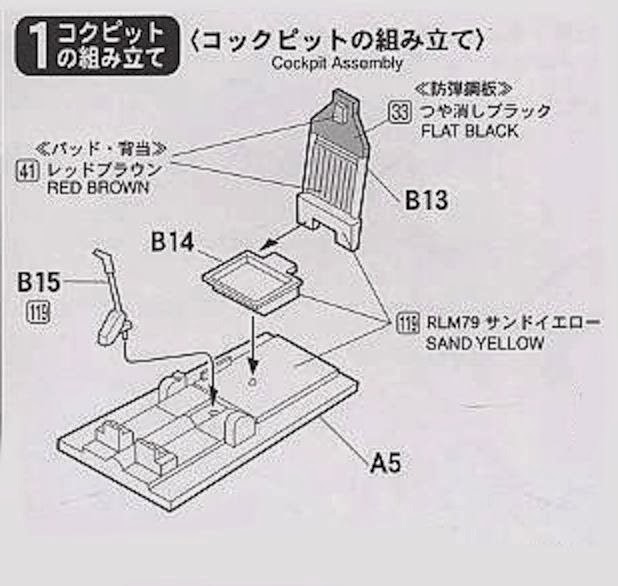
The Fine Molds 1/72nd kit (below) also has the inverted 'T' pylon and armour plate as one piece, this time incorporating the whole seat back as part B13 but is correctly called out as matt black.


When building a model of Hien, especially in the larger scales, it is a detail worth checking whether the subject aircraft had the head armour fitted, if known, and to represent it accordingly.

References:- 
'Armour of Japanese Aeroplanes', BIOS/JAP/PR/894, which reproduces the 31 October 1945 report prepared by Cdr Sheldon W Brown of the USN ATIG from the information of Maj Taneo Koinumaru of Army Air Technical Research Laboratory, Tachikawa.
Type 3 Fighter Maintenance Manual.
'Ki-61/Ki-100 Serial Numbers, Dates of Assembly & Characteristics' by James I Long, Airtell Publications & Research Service, 1999.

Image credits: Heading diagram from Performance and Characteristics Data Japanese Aircraft ATAD # T-1 of May 1944 OP-16-V-T Revised Edition, Air Intelligence Group Division of Naval Intelligence, Office of the Chief of Naval Operations, Navy  Department; Ki-61 Maintenance Manual diagram re-traced by author; Photos from 'I J Army Kawasaki Type 3 & 5 Fighter', Model Art # 428 (© 1996); Kit instructions © Hasegawa Corporation and Fine Molds Co. Ltd.

Wednesday, 30 October 2013

Nichimo Co.Ltd. 1951 to 2013 ~ A Retrospective


The news that Nichimo - or Nichimoco as they branded themselves recently - is leaving the plastic model kit business after 62 years is rather sad. There must be the possibility that some of their moulds, unique despite their age, will be bought and released by another manufacturer. Let's  hope so. Nichimo's  classic 1/48th scale Ki-43-I Hayabusa 'Oscar' is arguably a better model if not a better kit than the more recent Hasegawa version and has graced many a competition table since it first appeared in the 1970s with that strange brown Shoki-like scheme on the box art.


Their Mitsubishi Ki-51 'Sonia' remains unique in 1/48th scale and is another ever popular kit in its much debated blue colour scheme. The box art (as with most other Nichimo aircraft kits) was by Mr. R Nakanishi (b.1934). There is a fine advanced build article of the Ki-51 by Tetsuya Inoue here, honouring his grandfather who was a test pilot on the type for Mitsubishi Heavy Industries. 


The floatplane Aichi E13A1-B 'Jake' is another unique 1/48th kit and it was recently the subject of an improved aftermarket resin interior set from Lone Star Models (sadly no longer available). 


Then there is the Tachikawa Ki-9 'Spruce' (Army Type 95-1 Medium Grade Trainer), another so far unduplicated model of the Army training biplane in 1/48th scale not to be confused with Otaki's 'Willow'. The Ki-9 is a lovely, delicately moulded kit, definitely worth re-issue, which includes an impressive interior, brass wire for rigging, nicely moulded standing and seated crewmen and decals for four flying schools - Kumagaya, Army Air Academy, Tachiarai and the seldom represented Mito. Let's hope we can see this one available again.


The Nichimo Nakajima B5N2 'Kate' and Kawasaki Ki-45 Toryu 'Nick' although also long standing as unique and popular show table entries have now both been eclipsed by more modern Hasegawa reproductions.


Seldom seen these days is Nichimo's 1/48th Mitsubishi A6M5, long rendered obsolete by better and more modern versions.


Nichimo's 1/70th scale Ki-61-II Hien from the 1960s has been covered previously here and here and deservedly praised in the context of its time and technology. Their A6M2 Zero and A6M5 to the same scale were available until quite recently in attractive boxes to lure the unwary. The A6M2 is probably better in many respects than some other Zero kits of the same era, certainly besting the very strange looking Aoshima and rather poor Fujimi examples. Although the  evocative A6M2 box art depicts a Hiryu carrier fighter cruising with the canopy open and the pilot watching contrails the decal sheet curiously offers markings only for the well-known Saburo Sakai  machine V-103 of the Tainan Ku. 


The 1/70th scale Mitsubishi JM2 Raiden with classic K Hashimoto box art was a similarly workmanlike but unappreciated kit, perhaps overshadowed by the 1964 Tamiya example and later by the greatly improved Hasegawa issue. The two unusual markings options in this kit (the other being Yo-J2-34) remain, as far as I know, unique.


For many years until Fujimi embarked on a new family series of 'Claude' the Nichimo A5M4 was the only game in town for this nimble IJN fighter and has appeared over the years in various boxes, deservedly earning the title of 'classic'. It is last but not least here. 

Farewell Nichimo and thank you for your valuable contributions to the genre of Japanese aviation models, maybe gone now but certainly not to be forgotten. 

Image credits: All box art from author's collection © Nichimo Co. Ltd., various dates. 

Friday, 25 October 2013

Ki-54 of 10th Dokuritsu Hikodan Shireibu


Bob Alford has very kindly sent these additional photographs of the 10th Dokuritsu Hikodan Shireibu Ki-54 'Hickory" used to transport Lieutenant General Masao Baba's surrender delegation and of General Baba himself. 


Major Gen. Shozo Mitsunari commanded the 10th Dokuritsu Hikodan which had the 83rd Sentai under command and operated within the 37th Air Sector of 3rd Air Army. The Hikodan Shireibu (Air Brigade HQ) was usually responsible for directing the flying operations of units under command as well as overseeing ground support administration, usually under the auspices of the Air Army in which it served. The relationship of the  Dokuritsu Hikodan within IJAAF organisation is a little more obscure and in this case rather than just being independent of Air Army command it was directly engaged under local ground forces command - e.g. 37th Army for (mainly) direct co-operation and support duties. Other IJAAF units operating in the 37th Sector and which illustrate the logistical and support elements (often overlooked in the study of this subject for preferential interest in the 'teeth' arms) were the 100th, 110th, 111th Airfield Battalions, the 113th Airfield Construction Unit, the 4th Detached Depot, the 16th Field Air Depot. the 1st Branch of the 20th Field Air Supply and Repair Depot, the 1st Branch of the 25th Field Air Supply and Repair Depot, the Borneo Section of Southern Air Ways Department, the North-Australia Air Ways Department, a detachment from the 13th Field Meteorological Regiment, a detachment from the 14th Field Meteorological Regiment, the 4th Air Communication Unit, the 5th Company of the 2nd Meteorological Regiment and the Borneo Detached Party of  the 11th Air Communication Regiment.

According to Minoru Akimoto the 10th Dokuritsu Hikodan Shireibu was redesignated from a former 10th Dokuritsu Hikodan Shireibu on 23rd October 1944. The original HQ unit had been established in Manchuria on 1st December 1940 and served in Thailand, Burma, the Philippines and Borneo. The transport section operated the Army Type 1 Transport Model Hei (Tachikawa Ki-54c) and evidently the Mitsubishi Ki-51 'Sonia', probably as liaison and command aircraft, the flying units under command being predominantly equipped with this type.

The 83rd Sentai has one of the most complex and confusing genealogies of IJAAF units, originally established in March 1941 as a mixed unit from the three Chutai of the 10th Sentai with the Type 97 light bomber (Mitsubishi Ki-30 'Ann') and Type 98 Direct Co-operation Aircraft (Tachikawa Ki-36 'Ida'). In July 1941 it was re-designated Independent 38 Air Group (Dokuritsu No.38 Hikotai) bringing under command a HQ unit, and the Dokuritsu Hiko Chutai (Independent Air Squadrons - DHC) 71st, 73rd and 89th to operate over Indo-China, Burma and the Dutch East Indies. In April 1944 it was reconstituted as the 83rd Sentai. The 71st DHC originally operated the Ki-51 but in December 1943 returned to Japan and re-equipped with the Type 1 fighter  (Nakajima Ki-43 Hayabusa 'Oscar'), operating that type in air defence duties over Sumatra and later forming a special attack (suicide) unit the 'Shichisho Shoken Tai' in Formosa. The 73rd and 89th DHC both operated the Ki-51 as principal equipment mainly in the convoy escort and anti-submarine role but Akimoto-san reports that the latter unit also operated the Type 2 two-seater fighter (Kawasaki Ki-45 Toryu 'Nick') in the anti-shipping role.

Lieutenant General Baba was Supreme Commander of Japanese Forces in Borneo and commanded the 37th Japanese Army. He formally surrendered to Allied forces during a ceremony at the Headquarters of 9th Division on Labuan Island. General Baba was subsequently found guilty of war crimes in relation to the Sandakan Death Marches, sentenced to death and hanged at Rabaul on 7 August 1947.

Image credits: © 2013 Bob Alford