Tuesday, 15 September 2020

The 15th September 1940


A digression from blog focus if not from the subject of aviation to commemorate today as Battle of Britain Day (in the UK) and the 80th anniversary of the great battle in the skies over south-east England from July to October 1940 which culminated on the 15th of September. The scale of public commemoration has diminished in recent years but I shall always believe it to be a true turning point in the fortunes of the Second World War when RAF Fighter Command defeated the Luftwaffe attempt to secure aerial supremacy over this island and a vital haven and springboard to the subsequent liberation of Europe was protected and preserved. 

The RAF officially records 2,937 pilots as having fought in the Battle, average age just 20 years, and they came together from 16 nations including the Commonwealth. This is not to forget all those men and women who contributed so much to the Luftwaffe defeat, from the ever-toiling RAF groundcrew to the civilian boffins who pioneered the radar network, from the observers on the ground to the personnel in the plotting stations and control rooms, and many, many more.

The victorious RAF pilots came from:-
  • The United Kingdom
  • Poland
  • New Zealand
  • Canada
  • Czechoslovakia (now the Czech Republic and Slovakia)
  • Belgium
  • Australia
  • South Africa
  • France
  • Ireland
  • United States of America
  • Southern and Northern Rhodesia (now Zimbabwe)
  • Barbados
  • Jamaica
  • Newfoundland

522 RAF pilots were killed during the battle and many more were injured, disfigured with burns or permanently disabled. Today they are all remembered and commemorated on behalf of this nation with gratitude and respect for their effort, endurance and sacrifice. 

Monday, 14 September 2020

Yet More Shoki! ~ Rising Decals 47th Hiko Sentai


The latest Rising Decals sets feature aircraft of Hiko Dai 47 Sentai in 1/72 and 1/48 scales. RD72093 contains markings for six natural metal finish Ki-44 'Shoki' and three factory camouflaged  Ki-84 'Hayate' in 1/72 scale.


The individual subjects are as follows:-

  • Ki-44-II Otsu s/n 1435 at Narimatsu airfield during 1944 with a blue fuselage band and bold red blaze from the cowling and along the forward fuselage. As a Shintent Seikutai 'escort' this aircraft may have displayed a small winged 'Yamada' drum emblem on the left side of the fuselage beneath the cockpit. It is identified as a Ko in the recent FAOW pictorial history but that does not tally with the serial number.   
  • Ki-44-II Ko s/n 1120 with a white fuselage band. Captioned as a Fuji squadron (2nd hikotai) aircraft flown by 1Lt Yasuro Masaki the spinner is depicted red but the photo of this aircraft suggests a light painted spinner, possibly yellow (see heading image above).  
  • Ki-44-II Hei s/n 1862 flown by Capt Yasuro Masaki. The tail insignia, fin tip and forward half of the spinner are depicted as light blue. Unusually the wheel fairings bear a three digit number indicating another '62' serial numbered aircraft on strength. This aircraft carries Ta-dan air-to-air bomb containers beneath each wing. Training and trials with this weapon were conducted from March to May 1944 and Capt Masaki (promoted in March) was the first to use the weapon in combat. The FAOW pictorial history identifies this aircraft as Sakura squadron (3rd hikotai) which reportedly displayed squadron markings in yellow but Masaki was the Fuji squadron leader.
  • Ki-44-II Otsu '71' at Chofu in late 1944. Captioned as flown by the Sentai commander Maj Noburo Okuda it has a yellow painted spinner and yellow tail insignia. The red tail fin tip possibly identifies the Shotai (flight) and it has a white stripe bordered in red beneath the cowling. The gunsight is of the reflector type rather than optical.     
  • Ki-44-II Otsu '35' of the Shinten Seikutai in January 1945. Captioned as a former Asahi squadron (1st hikotai) aircraft with blue tail insignia and flown by M/Sgt Isamu Sakamoto of the Shinten Seikutai for a ramming attack against a B-29 on 27 January 1945. Sakamoto was thrown from the cockpit but survived to be awared the Bukosho 2nd Class. Previously depicted with an all red tail this aircraft is the subject of Ronnie Olsthoorn's corrected profile.
  • Ki-44-II Hei of the Sakura squadron with large 'bomb' insignia painted on the fuselage. According to the FAOW pictorial history this aircraft was flown by Capt Tei-ichi Hatano the Sakura squadron leader. The 'bomb' insignia has been previously depicted in kit box art as red and without the 'fins'.   
  • Ki-84 Ko '69' of Sakura squadron. Captioned as flown by Capt Tei-ich Hatano the squadron leader it is depicted with two blue fuselage bands in accordance with a profile in the FAOW pictorial history. The photos in the book suggest that badly worn paintwork has been interpreted as an incomplete forward band. 
  • Ki-84 Ko '16' of Asahi squadron with red spinner and blue tail insignia. 
  • Ki-84 Ko '45' of Sakura squadron with two yellow fuselage bands, tail insignia and forward half of spinner. 


    A splendidly colourful sheet of markings to suit the Hasegawa or Sword Ki-44 and Ki-84 kits in 1/72 scale. The convention for the hikotai colour sequence of this unit is usually blue (1st Asahi ), red (2nd Fuji) and yellow (3rd Sakura). but some references depict aircraft with white insignia bordered in blue, whilst HIS* states the sequence as white, red and yellow. Unfortunately the tonal appearance of the markings of aircraft in photos with their attributed squadron identity are sometimes inconsistent. Tonal interpretation is fraught with uncertainty and it might be that very dark blues, very faded blues and/or distinctly orange or faded reds were being photographed. Then there is the pundit's delight of film type and filters! Fortunately the provision of the tail insignia in this set should allow modellers to make changes to suit their own preferences or favourite gurus.


      RD48031 (shown above) appears to be a similar sheet in 1/48 scale with a reduced number of identical Ki-44 subjects as shown, but to be confirmed.

      With special thanks to Mirek Kárník of Rising Decals for providing the review sample of RD72093.

      * 'Japanese Army Air Force Fighter Units and their Aces 1931-1945' by Ikuhiko Hata, Yasuho Izawa and Christopher Shores (Grub Street 2002)

      Tuesday, 8 September 2020

      More Shoki! A Big Scale Ki-44 by Kevin Burke


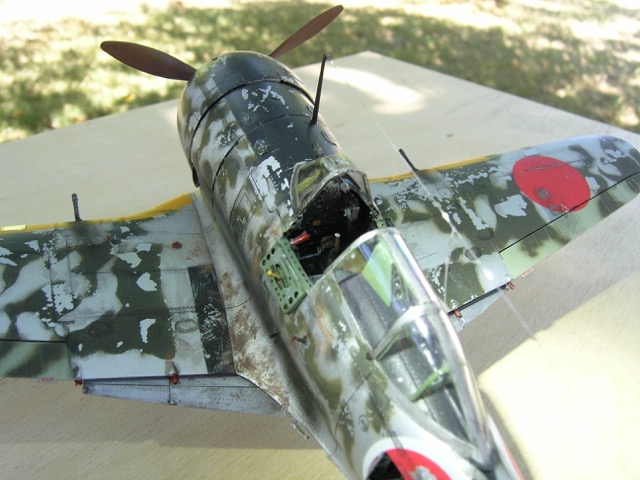
      Kevin Burke has very kindly shared these images and build details of his impressive Nakajima Ki-44-I 'Shoki' model built from the Hasegawa 1/32 scale kit and representing a well-used fighter-trainer in classic Akeno Army Flying School scheme. This is Kevin's first model after a 30 year absence from modelling!  Over to Kevin then:-


      'Beautiful clean, flash free hard plastic moldings secured on bagged trees. This model had the telescopic sight so the front windscreen would be unique to this model. Straight forward construction was enhanced with the Eduard interior and exterior sets for the Ki-44. These are beautiful and the interior kit is worth the cost just for the pilot seat itself.


      'Vallejo paints were used for the interior colours and exterior mottling. I added the shoulder harness from the Eduard interior set, some say the IJA did not have shoulder harness, I say, why not, and added it anyway. Seat is very accurate and in scale. Most interior parts were broken into sub-assemblies and added in time. Engine was constructed and wiring was added from Eduard, after closing the fuselage up, it is not viewable.


      'Both side entry doors were sawn open and Eduard parts added and painted, but the doors left off until all painting was completed. I decided to open the radio compartment and add radio detail. I cut the opening but really ruined the hatch so I heated up sheet plastic and draped it over the fuselage area involved, trimmed to the proper shape for the hatch and added panel detail. Radio information was gathered on line and a  scale transmitter/receiver was scratch-built from plastic bits and a Waldron Punch-set.. The interior was painted and cockpit components added along with radio, wiring and frame work. The mating of the fuselage to the wing section was amazing, almost not needing any cement as it was so accurately tight.


      'Very little putty was needed  on the exterior of the model. Once most parts were attached and smoothed out a primer coat was applied. I used, believe it or not, Model Master 'non buffing' aluminum out of their spray can and found it an excellent cover. Why use this?  I knew it would set up hard and allow me to lift paint chips off the model, retaining the aluminum base. Following the painting instructions mottling was added. This took several tries with my older Paasche H single stage airbrush. Old doesn’t mean bad - just old.


      'Once painting was complete, (Micro-Gloss, decaling),  I chipped the model using painting tape and applying it then lifting off, forming actual removal of paint chips. That was the reason for the Model Master lacquer base and it worked. Scrapes and muddy boot prints were added to the wing areas. Hand/foot grabs added along with canopy handles. Aerials were stretched sprue with white glue insulators. Micro-Flat sprayed overall. Exhaust was black Tamiya, diluted with white and then a light gray overspray. Chalks were brushed on.


      'Aber wing machine guns were added and residue brushed on. Oil and panel lines were Tamiya panel line accent.  Much enjoyment in those boxes. The only problem I encountered was the weak tail wheel breaking twice - my fault - and that crazy two-piece telescopic sight through the windscreen. My first kit after 30 years but it won’t be my last. Hasegawa has made an excellent kit!'


      With very special thanks to Kevin for sharing these images and details of his stunning Shoki model.

      Image credit: All model photos © 2020 Kevin Burke; radio photograph via Kevin Burke

      Thursday, 3 September 2020

      Shoki # 32 Hiko Dai 47 Sentai


      Aviation Artist Ronnie Olsthoorn has recently updated Profile # 22 In Osprey's Aircraft of the Aces 100 on the Ki-44 'Tojo' Aces of World War 2 in light of a newly revealed reference and very kindly shares the revised illustration above. For many years this aircraft, attributed to the Shinten Seikutai (Heaven Shaking Air Superiority Unit) air-to-air ramming flight of Hiko Dai 47 Sentai, was depicted in profiles and on box art with an all red tail based on a single and inconclusive photograph. However a photograph published in Bunrindo's Famous Aircraft of the World Special Edition Vol.8 'Pictorial History of Japanese Army 47th Flying-Sentai' reveals the full right hand side of this aircraft revealing a dark painted rudder with the lighter sentai insignia still apparent. The aircraft is captioned as belonging to the Asahi (1st) Chutai and therefore the insignia colours are presumed blue - or 'cobalt blue' as often described. 
         
      With special thanks to Ronnie for providing the revised profile. And worry not - decals for this aircraft and other 47th Sentai 'spectaculars' will shortly be available! 

      Image credit: © 2020 Ronnie Olsthoorn.

      Wednesday, 2 September 2020

      Roberto Zambon's IJN Floatplane Trio in 1/48 Scale ~ # 3 Nakajima A6M2-N 'Rufe'


      Roberto Zambon's third and last floatplane model completed during lockdown is the Nakajima A6M2-N 'Rufe' built from the classic Tamiya kit and representing an aircraft in the post-war hands of the Allied Technical Air Intelligence Unit - ATAIU - with the original Japanese hinomaru crudely over-painted with RAF roundels. 


      The antecedence of this particular Rufe is variously reported as being either a former 934 Ku aircraft found at Surabaya and flown to Singapore or an aircraft of 381 Hikotai found at Seletar, Singapore. From there it journeyed to Tebrau in Malaya for evaluation as part of a large collection of former Japanese aircraft intended for shipment to Britain as war booty. However Admiral Mountbatten interceded and refused permission for the aircraft to take up returning ship cargo space and most were destroyed. The Rufe was reportedly flown to Cat Lai seaplane base near Saigon in Indo-China and handed over to the French to be operated by 8S Escadrille. It crashed on 19 February 1942 near Rach Ba Sang on its first sortie.


      With special thanks to Roberto for sharing images of his lockdown floatplane trio. 


      Image credit: All photos © 20209 Roberto Zambon


      Tuesday, 1 September 2020

      Roberto Zambon's IJN Floatplane Trio in 1/48 Scale ~ # 2 Kawanishi N1K1 Kyofu 'Rex'


      Roberto Zambon's second floatplane model is the Kawanishi N1K1 Kyofu 'Rex' built from the Tamiya kit and representing an aircraft of the Ohtsu (オツ) Kokutai based on Lake Biwa, Japan, from May 1945.


      Roberto again mixed Humbrol enamel paints to represent Thorpe's IJN N2 Dark Green using 5 parts 91 Matt Black Green + 1 part 116 Matt US Dark Green + 1 part 3 Gloss Brunswick Green. The undersurface grey was mixed to represent Thorpe's N10 Light Grey using 8 parts 34 Matt White + 2 parts 156 Satin Dark Camouflage Grey + 1 part 28 Matt Camouflage Grey. The Kawanishi green interior was mixed with 2 parts 30 Matt Dark Green + 2 parts 24 Matt Trainer Yellow + 1 part 90 Matt Beige Green.   


      The Ohtsu Ku was originally a floatplane training unit formed at Ohtsu on the shore of Lake Biwa in October 1941 with a detachment from Kashima Ku. Initial equipment was the Yokosuka K5Y2 'Willow' trainer, Kawanishi E7K2 'Alf' and Nakajima E8N1 'Dave' but the Mitsubishi F1M2 'Pete' and Aichi E13A 'Jake' were also later operated.  In April 1942 it was formally established as Ohtsu Ku and then in May 1945 converted to a floatplane fighter unit with the Kyofu.     


      With special thanks to Roberto for sharing images and details of another of his lockdown models.

      Image credit: All photos © 2020 Roberto Zambon