Friday, 16 July 2021

1/72 Shiden-kai by Francesco Borraccino


Another Shiden-kai model to admire, this time built from the 1/72 Aoshima kit by Francesco Borraccino and representing A-343-37, a less modelled aircraft of 301 Hikotai of the famous 343 Ku. 

From his build Francesco assessed this kit as double-faced; with well moulded detail generally and especially for the cockpit and engine, but a challenging fit of parts to say the least.  

Francesco noted a poor fit of the wing and tailplane to fuselage joints with large gaps to fill, mostly on the underside, and a different level between the wings and fairings. Also an inexplicable upper fuselage joint where two bulges are formed resulting in a nightmare to fill and sand (see pics).  The pin for mounting the engine is too large and crooked requiring remedial work. 

In addition the undercarriage gear legs and doors are marred by ejector pin marks with the doors lacking the opening and closing mechanism which Francesco fabricated from plastic card and copper wire. He found the instructions for assembling the undercarriage parts were poor which contributed to an error in direction which required extra work to rectify. The undercarriage proved a loose fit so Francesco resorted to cyanoacrylic cement to achieve a strong bond.


The cockpit interior was finished with a mixture of AK Real Colors RC306 Mitsubishi Interior Green and RC330 Ohryoku Nana Go Shoku.

After final assembly Francesco finished the model with a variety of paints. For the natural metal under surface he applied AK Xtreme Metals with Matt Aluminium as a base coat, and panels of different shades such as Dark Aluminium, Polished Aluminium,  etc. Without a clear reference to the under surface Francesco represented the panels arbitrarily. The upper surfaces and spinner were painted with AK Real Colors RC304 D1 Deep Green Black, whilst the prop was finished with a mix of Gunze H-462 Black Brown, H-463 Red Brown and H-84 Mahogany. 

Francesco painted the upper and lower wing hinomaru but had problems with masking so for the fuselage applied Techmod decals. He chose '37' rather than the usual '15' or '03' but had to hand paint the numeral on the fuselage and the tail code using Winsor & Newton yellow gouache, not perfect but he hopes acceptable. Undercarriage gear legs were painted dull aluminium with the inside faces of the main doors satin black. The drop tank was painted with Real Colors RC302 J3 Hai iro. 

Finally weathering was accomplished with an oil wash and some fading using oils, pastels and pigments, bearing in mind that photographs suggest the aircraft were not so worn and had a relatively short operational life.   

Shiden-kai 343-37 was flown by WO Shoji Shibata, leading the 1st Kutai of the 1st Chutai's 2nd Shotai during the 12 April 1945 intercept mission; by WO Isamu Miyazaki leading the 2nd Kutai of the 3rd Chutai's 2nd Shotai on the 16 April sortie; by PO2/c Ken Okimoto of the 3rd Kutai of the 3rd Chutai's 1st Shotai on the 21 April sortie; and finally by Lt Masaji Matsumura leading the 2nd Kutai of the 1st Chutai's 2nd Shotai for an aborted sortie against B-29s on 22 April. In the 343rd the term Kutai referred to a Division of four aircraft deployed in pairs for which the English term 'pair' was used. A Shotai consisted of one to three Kutai from four to 12 aircraft. A Chutai was a tactical formation of usually two Shotai. The purpose of the numbers painted within the hinomaru, whether for training or maintenance, are disputed even by former members of the unit, and it is uncertain whether they were removed by all squadrons before combat operations began. Former 301 maintenance PO Wakashige Kondo stated that they were applied "with a solution of lime and water with a little amount of adhesive agent so that they could be easily erased" and that they were ordered to be removed after combat on 19 March 1945.*

With very special thanks to Francesco for kindly sharing these images and details of his excellent build, and for his patience in waiting for them to appear here.


*'Genda's Blade - Japan's Squadron of Aces 343 Kokutai' by Henry Sakaida and Koji Takaki (Classic Publications, 2003)

Image credit: All photographs © 2021 Francesco Borraccino


Saturday, 3 July 2021

Dennis McCone's 1/32 Shiden-kai


With this splendid Shiden-kai built from the 1/32 Hasegawa kit Dennis McCone has completed and kindly shared here an impressive trio of large scale Japanese aircraft including his very fine Frank in 2019 and resplendent  Raiden in 2020.

Describing Hasegawa's N1K2-J as a finely engineered and easy to build kit which was a pleasure to work on, Dennis constructed it mainly from the box with the exception of the RB Productions fantastic but difficult to assemble seat belts and Montex masks for painting on the markings instead of applying decals. The masks had Dennis scratching his head a few times to work out the correct order for applying paint.

As usual Dennis applied all enamel paints to the model - Humbrol for the details with Xtracolor and Sovereign Colourcoats for the main finish and painted markings.   

Dennis' model represents an aircraft of the redoubtable Hikotai 301 Shinsen-Gumi of 343 Ku as flown by several notable pilots including CPO Shoichi Sugita, Lt Masaji Matsumura and Lt Naoshi Kanno the Hikotai commander when his own personal aircraft 343-15 was undergoing maintenance. The victory markings were said to be applied as a morale boosting exercise.    

With very special thanks to Dennis for sharing these images of a superb model and for his patience in waiting for them to appear here.  

Image credit: All © 2021 Dennis McCone

Tuesday, 29 June 2021

Bernard's 1/72 A6M3 Model 32 Zeros


Bernard from Poland returned to modelling during the Covid lockdown after a 20 year absence and completed two 1/72 Mitsubishi A6M3 Model 32 'Hamp' models from the excellent Tamiya kit, the images of which he has kindly shared with AoJ.

Q-102, a Houkoku presentation aircraft of 2 Ku at Buna, was painted overall with Tamiya XF-76 Gray Green (IJN). The kit decals were used but Bernard found them rather thick and believes he had over-weathered the finish. 

Bernard's second A6M3 model represents T2-190 an aircraft of 204 Ku at Rabaul in 1943. For this model Bernard used the ROP o.s. decal sheet MNFD 72012 and followed its painting suggestions in good faith. ROP interpreted the field-applied 'marbled' camouflage as solid dark green and the rudder as painted red. He found the decals were thinner than the kit decals and produced a better result. The model was painted with Tamiya XF-70 Dark Green 2 on the upper surface with XF-76 beneath. 

Bernard has continued his building models of Japanese subjects with excellent results, some of which will also be shown here in due course.

With very special thanks to Bernard for his kindness in sharing these and for his patience in waiting for them to be show.

Sunday, 27 June 2021

Notice: American Aircraft for the RAF Blog


The 'Amair4raf' blog was closed in 2018 for various reasons but the content is still extant and I have just blogged a short article there about a well-known P-40K. There is a lot more previously unpublished  content on the subject of US export and RAF colours, including SEAC, which I plan to continue to post  albeit infrequently. As before access to the blog will be by invitation and sign-in but on a very limited basis - verified and trusted friendlies only! 

Please email me with a request as I no longer have email addresses for all previous members, thanks. 

Saturday, 26 June 2021

Pat Donahue's 1/48 Model 22 Zero

Another very fine Zero model, this time an A6M3 Model 22 built by Pat Donahue from the superlative 1/48 scale Tamiya kit to represent a field camouflaged aircraft of 251 Ku, often attributed as flown by leading ace Hiroyoshi Nishizawa and as seen in a series of well known photographs taken by Hajime Yoshida, a Nichiei journalist who visited Rabaul, Lae, Buin and Ballale during 1942-43. Pat has described his painting and detailing of the build as follows:-

'I have always been fascinated by this colour scheme and when Tamiya released their beautiful A6M3 model 22 I decided to try to replicate it. With the help of Nick Millman and Ryan Toews I was able to pin down some of the questions I had about the basic aircraft and its colours.  I used circle masks for the red painted Hinomaru areas and then gave the model a base coat of Sovereign Hobbies Colourcoats ACJ 12 which I feel has a nice scale effect appearance for the Mitsubishi gray.  

'The model was overcoated with Future after the base coat of 'olive gray'  then the stencil decals were applied and given several coats of Future overcoat.  Those were polished down with # 12000 Micro Mesh to smooth out the decal ridges. The camouflage was then applied freehand with a Paasche V Jr. using enlarged photos of the actual A/C and the Tamiya painting chart which I felt they did a nice job on. I used Xtracolor IJNAF Dark green for this color after consulting Nick's PDF on Japanese Navy dark greens.   Panel line washing and weathering was done with  Payne's Gray and raw and burnt umber oil paints. The model was then overcoated with Testors Dullcote and more weathering and usage marks applied with pastels and a Prisma color silver pencil.


'The engine has Detail Master .012 red wire for the spark plug wires and white wire with the metal core stripped out for the spark  plug bodies. Additional structure was added to the cowl interior and the flap wells. The brake lines are Detail Master .012 gray wire. The cockpit was painted with Colourcoats Mitsubishi Interior Green, with added details from stretched sprue and Eduard photo etch. Eduard masks were used to mask the canopy (all 25 individual pieces of them)!

'Again my appreciation to both Nick and Ryan for their great help in my building of this kit.'


With very special thanks to Pat for very kindly sharing these images of his superb and brilliantly realised model with such an excellent replication of that tricky to apply field camouflage. Thanks also for his patience in waiting for them to appear here on the blog. Below some additional close-ups to enjoy. 


And not forgetting the cockpit details!


Image credit: All © 2021 Pat Donahue


Wednesday, 23 June 2021

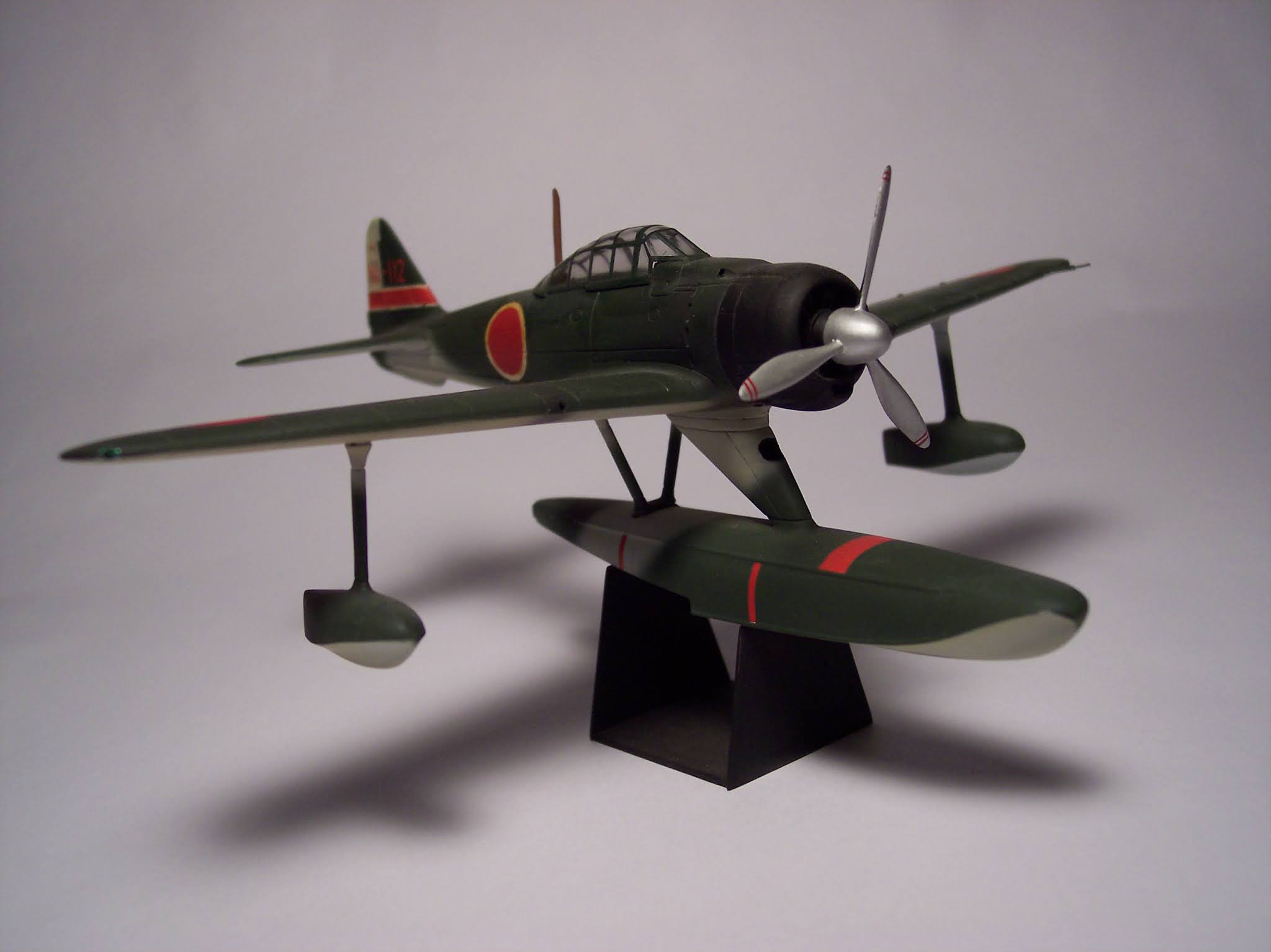
Steve Nelson's 1/72 Jo-Han Rufe

Still on the Zero theme and further to the feature on the Jo-Han A6M kit last month, Steve Nelson has very kindly shared these images of his own Rufe model made from the 1/72 Jo-Han kit, a bargain basement purchase for a single dollar and completed about 25 years ago.  

Steve scratch built a basic cockpit and replaced the kit canopy parts with a Squadron vacform. He also replaced the pitot with brass tube and wire. The neat display stand was also scratch built, intended only as temporary and to be replaced by a beaching dolly which Steve never got around to building. 

Steve painted the model with the then relatively new but now defunct Polly Scale acrylic paints and as the kit decals were unusable he sourced replacements from spares to represent an aircraft from 802 Ku in the Solomons in January 1943 as profiled in the centre spread of Squadron Signal 'Zero in Action' book. He thinks the hinomaru came from an old IPMS Spruce Goose sheet which he had collected over the years, although he now prefers to mask and paint them on.  

The antenna wire went missing at some point over the years and washing the model to remove dust affected the clear coat. Steve observes that the panel lines are on the heavy side but his model shows that this classic kit scrubs up rather well and certainly looks the part. 

With very special thanks to Steve for kindly sharing these images of his Jo-Han model.

Image credit: All © 2021 Steve Nelson