Monday, 29 April 2024

Book Review - Mitsubishi Babs vol.II by Giuseppe Picarella


The second volume of Mitsubishi Babs - The world's first high-speed strategic reconnaissance aircraft - by Giuseppe 'Joe' Picarella MRAeS, published by Stratus s.j., (Poland) as MMP Books in 2023, continues his superlative analysis of the Ki-15 - Type 97 Command Reconnaissance Plane (Kyu-Nana Shiki Shireibu Teisatsu-ki -九七式司令部偵察機 or Kyu-Nana Shi-tei -九七司偵) from the first volume reviewed here in August 2022. It is a technical tour de force. That might sound dry. It isn't, thanks to the author's distinct and impressive presentation of informative text, vintage photographs and new colour schematics, including his superlative and meticulous cutaways. 

Vol.II is a hard cover book of 246 pages (the first volume has 192 pages) with printed board covers and no separate dust jacket. The paper is of a quality which benefits the photographs, clear and to a useful size. The contents are as follows:-

  • Introduction and Acknowledgements
  • Notes (this covers aircraft nomenclature, aircrew terminology and addenda for Vol.1)
  • Chapter 1: Brothers in arms (detailed coverage of IJN procurement, development and deployment, including earlier types)
  • Chapter 2: Western intelligence reports
  • Chapter 3: Soviet intelligence reports
  • Chapter 4: Technical description:
      • Mitsubishi Ki-15-I, 
      • Kamikaze
      • Karigane-I 
      • Ki-15-II
      • Karigane-II
      • C5M1
      • C5M2
      • Ki-15-III
  • Chapter 5: Pilot's operating manual
  • Chapter 6: Dimensions and Performance figures
  • Chapter 7: Production figures and construction numbers
  • Chapter 8: Models, memorabilia and memorials

This second volume explores the aircraft in unparalleled detail for the first time, with more than 140 photographs, 77 original full-colour artworks in 1/72, 1/48, and 1/32 scales, including 38 full-page illustrations, five cutaways and 55 original blueprints, spread across the eight chapters. These cover the history of the C5M within 19 operational units and higher organisations of the Imperial Japanese Navy (IJN), an especially interesting exposition given its deployment by the IJN as an air-to-air bomber; the inaccurate and confusing coverage by Allied intelligence and the Western press; the unique and overlooked Soviet field report with photographs of a captured Ki-15-I airframe; highly detailed technical description of each variant's complete structure, powerplants, systems and cockpit layouts; a complete pilot’s operating manual and cockpit layout;  reappraisal of actual dimensions and performance figures, correcting and expanding upon the basic performance capabilities of this ground breaking aircraft; a detailed overview of production figures and construction numbers, which reveals new production totals; a short overview of post-war Babs models, kits, memorabilia and memorials. All the very attractively presented artwork is new, based on the original engineering drawings, dimensions and cross-referenced against every known photograph. These two volumes should become the only source needed for historians or modellers, whether they are investigating a specific unit, researching performance details for war gaming or air combat flight simulations, or building models. 

The author spent almost a decade researching, reviewing and correcting every detail of this aircraft, and in doing so challenging every aspect, from the general layout to the smallest items. He has essentially reverse engineered the whole aircraft based on all surviving engineering drawings, manuals, documents and photos. From the modelling point of view, panel line layouts on many post-war drawings were found to be incorrect, especially on the wing, and even the wingspan was found to be previously quoted incorrectly as demonstrated in Chapter 6.  This means that all of the existing kits fall short in accuracy  to one extent or another, including the recent and much heralded 1/48 scale kits by Fine Molds - in wingtip panel details of all Babs variants, the sliding canopy details and support structure, roll-over pylon on the C5M2, etc., plus many other items. All of the engineering details in the book which correct those errors are supported by new drawings of exceptional fidelity, photographs and original engineering drawings. The performance details are also expanded upon for the first time, with actual data on range, etc. Babs production is also clarified, including a revised production total, all of which is supported by carefully documented evidence in Chapter 7.  


The author was motivated in this exacting depth of analysis because historically this aircraft has been lost to history, largely forgotten because of the amazing aircraft that followed such as the Ki-46 'Dinah' and A6M Zero. Babs really deserves more popular recognition, as many of its aerodynamic refinements and structural details were later adopted for the Mitsubishi aircraft which followed it. This book will allow modellers to modify, correct and complete Babs models with cockpit fitting details, antenna layouts and even which construction numbers (c/n) series decals should be applied to which specific sub-variant.  The information is seminal and as far as I know no Maru Mechanic, FAOW or other monograph has ever been published on the type, which means this two volume set in the English language is even more commendable and valuable.  The extensive data should facilitate the manufacture of kits in the larger scales of 1/32 and 1/24 - or even 1/35 - let's hope so and for something more varied than the perennial Pearl Harbor trio!


A review like this cannot do full justice to the wealth of information and illustration in this book which has to be in possession to be appreciated and is therefore very highly recommended. Vol.II has a RRP of  £40 but can be purchased from Amazon for £30.91 - and is exceptional value for money at both prices. With special thanks to the author for kindly providing the sample pages and for his permission to show them here. Also for arranging a review copy of the book from Stratus/MMP Books which has proven such a delight to both browse through and read in detail. I hope that both kit and decal manufacturers will take full advantage of the data therein and that Babs might become elevated in modelling circles to something more deserving of its fascinating development and place in history. Now where are those Mania/Hasegawa and LS/Arii kits! An AoJ kitography of 1/72 scale Kamikaze and Babs kits is to follow shortly. 

Image credit: All © 2023 Giuseppe 'Joe' Picarella MRAeS and Stratus s.j., as MMP Books

Tuesday, 16 April 2024

Lifelike Decals 1/48 Zero Fighter Update


Lifelike Decals have advised that they have now received Hinomaru decals I and K omitted from their Zero sheet 48-SP-01 and a corrected victory marking for subject # 2 on sheet 48-061 reviewed here.


The correction sheets will be sent to all Lifelike Decals distributors and modellers are advised to approach those from which they originally bought the sheets to request the replacements. Future sales of sheet 48-SP-01 will now include the correct decals.  

With thanks to Keishiro Nagao of Lifelike for this update and for their attention to accuracy and customer service. 

Image credit: © 2024 Lifelike Decals

Tuesday, 26 March 2024

Kamikaze's Return

Giuseppe 'Joe' Picarella MRAeS has very kindly provided this fascinating and beautifully presented news story to the Aviation of Japan blog.

Screen shot from Asahi.com news website

Kamikaze’s return

by Giuseppe 'Joe' Picarella

On 15 March this year, Ayami Koh of the Asahi Shimbun (Asahi Press) website made the surprise announcement that the Mitsubishi Heavy Industries Historic Archives had placed an aviation artefact of national importance back on display for the Japanese people. The item in question is a skin panel (as shown in the heading image above, screen shot from Asahi.com news website) that it has identified as belonging to the Mitsubishi Karigane aircraft Kamikaze, which in 1937 undertook the gruelling (15,357km) flight from Tokyo to London (6th to 10th of April), to celebrate the coronation of King George VI.

Kamikaze at Croydon Airport 9 April 1937 (Author collection)

The exploits of Kamikaze and its daring crew (Masaaki Iinuma and Kenji Tsukagoshi) during the spring of 1937 are well known for capturing the imagination of the Japanese people during a period of economic turmoil and political insecurity. The whole concept of the coronation flight was initiated by the Aviation Department of Asahi Shimbun in the hope that such an event would raise the national pride of the country and they would of course report on the unfolding events. Kamikaze certainly achieved this aim and in doing so also gaining Japan’s first Fédération Aéronautique Internationale record for the flight from Tokyo to London with a duration of 94 hours. 17 minutes and 56 seconds, achieving an average speed of 162.854 kilometres per hour.

Kamikaze was in fact the second prototype (c/n 1502) of the Ki-15, (Type 97 Command Reconnaissance Plane - Kyu-Nana Shiki Shireibu Teisatsu-ki  - 九七式司令部偵察機 or Kyu-Nana Shi-tei - 九七司偵) the world’s first high-speed strategic reconnaissance aircraft, an Army aircraft specifically designed to undertake its highly specialised (and at that time unique) photographic missions deep inside enemy territory, being immune from interception by virtue of its high performance.

Kamikaze in its first military scheme (James F Lansdale via Author)

After returning to Japan on May 21st, Kamikaze, in its striking silver and blue paint scheme, became a national icon and drew crowds wherever it appeared. But following the start of the second Sino-Japanese war in July 1937, Kamikaze was recalled into service for the Army in order to perform reconnaissance duties and assist in the training of reconnaissance crews as production of new Ki-15 airframes was slowly increased. In this role the aircraft received a hastily applied camouflage paint scheme, painted over and around the Kamikaze and Asahi markings, giving the impression that a silver coloured banner had been applied behind them.

Kamikaze first accident (Henry Sakaida via Author)

On 6 November disaster struck when the aircraft was badly damaged at Tachiarai Army Airfield following an engine failure during take-off, forcing Iinuma and Tsukagoshi to attempt a landing on muddy turf, which resulted in the aircraft flipping over onto its back.  Both men were dazed but escaped with only minor injuries. However Kamikaze did not fare so well and the damage was deemed almost beyond economic repair, as the engine, forward fuselage, cockpit, rear fuselage, empennage and outer wings were all badly damaged. However, Asahi Shimbun realized that the value of this specific aircraft was important to their image and decided to have the aircraft restored back to airworthy condition regardless of the cost.

Kamikaze in second military scheme (Author collection)

On 3 March 1938, Kamikaze was rolled out for a second time complete with new camouflage markings, but its renewed stint in the military would be brief and the aircraft was soon repainted in civilian markings for a second time, before resuming its role as the Asahi Shimbun flagship for another 18 months. While almost identical to its first civilian paint scheme there were subtle changes, most notably a larger name and Asahi Shimbun logo.

Kamikaze in second civilian paint scheme (JAA via Author)

On 6 October 1939, while performing a courier mission from Taipei Airport to Hakata Airport, the crew of the day became lost in bad weather and crashed into the sea 100 meters off the coast of southern Formosa (Taiwan). The pilot narrowly escaped death, but the navigator’s body was never found. Once again the aircraft was returned to Mitsubishi for restoration, but this time, the damage and saltwater corrosion rendered the airframe unsafe and it was decided to proceed with a static restoration only.  That resulted in a miss-match of various Ki-15 production parts being fitted to the aircraft. Once completed the aircraft was placed on display at the Yasukuni Shrine for a few months, before being moved to the TouGou Shrine at Harajuku, Tokyo.  Finally, on 20 October 1940, the aircraft was placed on display in the Kamikaze Memorial Hall, which had been built on Mt. Ikoma, between Osaka and Nara Prefectures. 

Kamikaze's second accident (Henry Sakaida via Author)

Kamikaze Memorial Hall. Note high canopy enclosure, prop and smaller spinner (Ron Cole via Author)

The aircraft survived the Pacific War with only minor damage sustained during Allied bombing, but under the terms of the occupation, all activities concerning aviation were prohibited and during the autumn of 1945, Kamikaze was removed from display and burned by US soldiers in the road. However it appears that the destruction of the aircraft was not as thorough as intended, as according to Mitsubishi the panel was cut from the burnt wreckage by a member of the US military and subsequently taken back to the US as a war trophy. Luckily, the family of this serviceman were able to identify this unusual item and, recognising its potential importance to Japan, donated it to Mitsubishi in 2021. 

Skin panel location © 2024 G Picarella

The 60cm x 40cm skin panel is from the port (left) side of the fuselage in the region of fuselage frame station FS.4 and FS.6. The exterior face carries the Asahi Shimbun flag motif, which has survived surprisingly well, given that the aircraft was set alight, but there is evidence of burning around the edges. The photo also reveals that final restoration of Kamikaze was not finished to the same standard as the original 19 March 1937 roll-out, which had (for aerodynamic purposes) received so many coats of lacquer that it was difficult to discern rivets heads and even some panel lines. A question that will concern Japanese aviation circles is that of the internal paint application; is it Aotake blue or possibly a light grey interior application that was often applied to Army aircraft of the period? Interestingly, the right-hand side of the photo reveals the edge of fuselage frame FS.7, which seems to show a dark blue finish. But, given that Kamikaze was rebuilt on two occasions, with the second time being a total rebuild, it is likely that the original 1937 interior finish was completely removed and a later Aotake application was applied. Discussions are already underway with the archive to investigate this issue, so watch this space.

Kamikaze markings and colour schemes © 2024 G Picarella

The whole story of the Mitsubishi Ki-15 family of aircraft, including the 1937 coronation flight of Kamikaze, is coved by the author in two volumes: “Mitsubishi Babs – the world’s first high-speed strategic reconnaissance aircraft” – published by MMP Books – Vol. I published in 2023, Vol. II published in 2024.

© 2024 G. Picarella 

With very special thanks to Joe for sharing this news story and images with Aviation of Japan. Volume II of Joe's ground breaking treatise on the Ki-15 to be reviewed here shortly.

Image credit: Per captions

Thursday, 21 March 2024

Marabu Design Photo-Etch Sets - Japanese Subjects in 1/72 Scale

Other Japanese subject 1/72 photo-etch sets available from Marabu Design include:-

  • M72013 A6M2 Zero (for Airfix kit)
  • M72020 Yokosuka D4Y1-3 Judy (for AZ model kit)
  • M72028 Nakajima Ki-44 I Shoki (for Sword kit)
  • M72033 Nakajima B5N2 Kate (for Airfix kit)
  • M72040 Kawasaki Ki-61 I-Tei (for Tamiya kit)
  • M72041 Kawasaki Ki-61 I-Otsu or Hei (for Fine Molds kit )
  • M72052 Nakajima Type 91 (for AZ model kit)
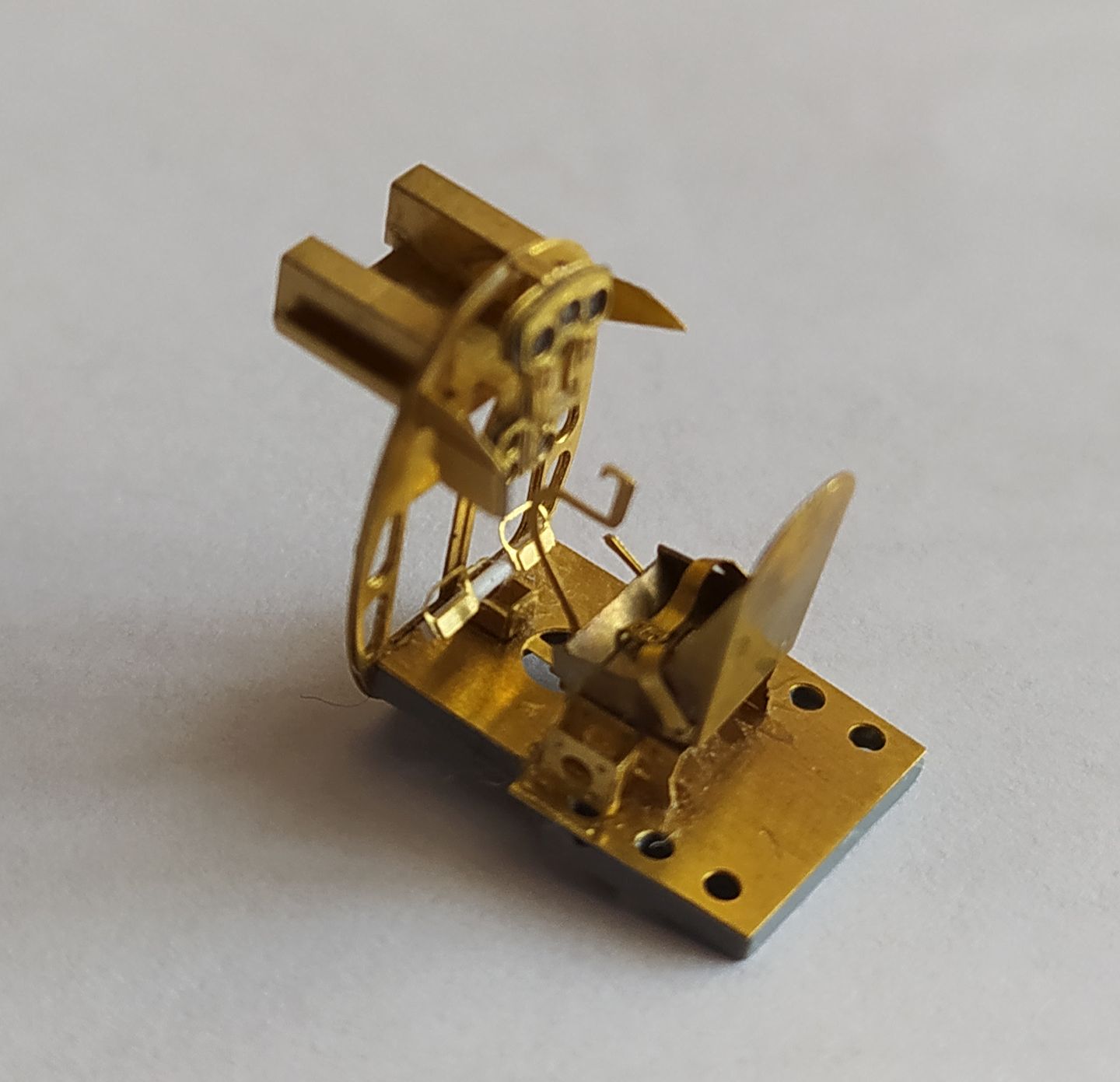
  • Shown in the heading image and below is the impressive set M72052 for the Nakajima Type 91 kit, of possible interest to both Japanese and Chinese aircraft enthusiasts. 


    Another excellent set is M72028 designed for the Sword Nakajima Ki-44-I Shoki 'Tojo' and shown in situ below. The annular oil cooler matrix made up from five separate laminates is especially impressive. Cockpit door flaps are included for both sides of the fuselage.


    Set M72013 for the Airfix Mitsubishi A6M2 Zero is equally impressive.


    And the superlative set M72020 for the AZ Model Yokosuka D4Y1-3 'Judy'.


    This set includes the Navigator's Compass Model 1 mounted on the port side fairing between cockpits and visible even beneath the canopy, an instrument which is often either missing or crudely represented in some kits. This compass had a reflector glass and mirror between the pivot frames, not included in the set, so that it could be read horizontally by the navigator. 

    Two sets M72040 and M72041 for the Tei, Otsu and Hei variants of the Ki-61 Hien 'Tony' designed for the Tamiya and Fine Molds kits. Both contain film layers for the instrument panels.


    And finally set M72033 designed for the Airfix Nakajima B5N2 'Kate'.


    All the sets are well presented with clear schematic instructions for assembly. They can probably be adapted in whole or in part for other kits of the intended types, for example the Fujimi 'Judy'.

    With thanks to Radek of Marabu Design for providing these images of the sets.

    Image credit: All © 2024 Marabu Design