Showing posts sorted by relevance for query vallejo. Sort by date Show all posts

Saturday, 8 April 2017

Vallejo IJA Colors Set ~ A Visual Appraisal & Commentary


The Spanish hobby paint manufacturer Acrylicos Vallejo, S.L. have recently released two sets of acrylic paints in their Air War Color Series intended for Japanese aircraft. Art.71152 is a set of 8 paints for 'Imperial Japanese Army (IJA) Colours Pre-War to 1945' consisting of the following colours:-
  1. IJA Dark Green AV71285
  2. IJA Olive Green AV71286
  3. IJA Khaki Brown AV71287
  4. IJA Dark Beige AV71416
  5. IJA Grey Green AV71326
  6. IJA Light Grey Green AV71321
  7. AOTAKE Trans.Green AV71417
  8. Aluminium AV71062
The paints are reportedly intended for airbrush use but have a surprisingly thick viscosity. They come in Vallejo's familiar plastic 'eye-dropper' bottles in an attractive carton featuring a colour photograph of a restored Ki-43 Hayabusa in flight over chips of each paint colour which apart from the aotake are pretty close to their actual appearance, a guide with profiles (shown below) and a brief explanation of the usage of each colour with FS 595 equivalents. Inside the box is a folded leaflet showing the Vallejo paint range.


The first point to note is that some of the Vallejo colour descriptions do not correspond to any official paint colour designations in the IJA KôKaku 39 colour standards. This makes it more difficult to reconcile them without direct comparisons and tends to perpetuate the imprecise understanding of the colours fostered by previous hobby paint ranges.  The second point to note is that this is a preliminary visual and subjective appraisal of painted out samples which have not yet been measured for their precise colour values and it does not take into account any long term curing and colour shift of the paints. There may be updates! A commentary on each paint colour follows.

IJA Dark Green AV71285 - This is similar to the generic IJA Greens in other paint ranges and is compared by Vallejo to FS 34082 which appears lighter and greener. It is a dark, dull olive green and not typical of the stronger greens offered in other paint ranges to represent the so-called 'Nakajima Green' for example.  It approximates # 22 Noh Ryoku Shoku (濃緑色 - deep green colour), but is a little lighter. Probably more useful as a variant of the late war IJA # 7 as applied to some Kawasaki types. 

IJA Olive Green AV71286 - This is meant to represent the late war # 7 olive drab colour and is compared to FS 33070. It is darker and slightly more brownish than the Dark Green AV71285 but slightly greener than FS 33070. It has a good richness of hue.

IJA Khaki Brown AV71287 - This is described as another late-war colour and compared to FS 30118, although it is slightly darker and more greenish. It is similar to the late-war factory paint, a variant of # 7, recorded by Noboru Shimoune as applied to Mitsubishi aircraft like the Ki-67 and Ki-46-III.

IJA Dark Beige AV71416 - This is described as a camouflage colour used in conjunction with Dark Green or as a single upper surface colour and is compared to FS 30215. It is close in appearance to the seventh chip in the Model Art 329* colour chart and described there as cha iro (茶色 - 'tea' colour, light brown or tawny):-

"This colour was used in conjunction with deep-green as a camouflage scheme at the beginning of WWII. Many of the Nakajima Ki-43 "Hayabusa" (Oscar) and Nakajima Ki-44 "Shoki" (Tojo) were camouflaged in this two tone scheme or simply spotted with the deep green over the brown." 

and

"This colour was used on aircraft over the China front. It resembles the colour of the ground surrounding the Yellow River in northern China. It was yellow tinged with tea colour."

Not really typical of the official IJA colour standards for browns which do not use the term "beige" (katakana: ベージュ beeju), dark or otherwise, but similar to many artistic depictions. It has an appearance between the 'orange-brown' of  # 33 Kaki iro (柿色 - persimmon or shingle colour) and the dark earth of # 31 Cha Kasshoku (茶褐色 - ‘tea’ brown colour, dark reddish-brown or liver colour), closer to the former than the latter. Therefore it perhaps has a certain hybrid/generic usefulness as a simplification to avoid head scratching when pondering black and white images to decide which brown! "More tea, vicar?"

IJA Grey Green AV71326 - This is a distinctly creamy or brownish grey which is compared to FS 36405 and is similar to the late-war factory applied under surface paint on types like the Tachikawa-built Ki-43-III Ko and Nakajima Hayate. It would also be useful to represent the creamy grey reported on some Ki-27 training aircraft. The Vallejo paint is just slightly more brownish than 36405. 

IJA Light Grey Green AV71321 - This is similar to generic IJA Grey Greens in other paint ranges and is compared to FS 34424. It is close to the first paint chip in Model Art 329 which is described as hai ryoku shoku (灰緑色 ash green colour), but more greenish than the # 1 colour standard for that colour and as the FS equivalent suggests, similar to the RAF colour Sky. The IJA colour standard sits more typically between the two Vallejo colours so there is an opportunity to mix them to achieve different effects.

Neither of the grey greens in the set represents the more blueish-grey colour seen on some Army types.

AOTAKE Translucent Green AV71417 - This is a surprisingly bright emerald green colour and not typical of the more subtle blue or blue-green hues of real aotake. No FS equivalent is given but it is similar in appearance to FS 14193. It is the only colour which does not look similar to the chip shown on the box. Probably the least useful colour in the set.

Aluminium AV71062 - This is a bright aluminium somewhat between a polished and oxidised natural metal finish.  Impressive for an acrylic paint.

Vallejo IJA paint colours shown by their cited FS equivalents ~ the actual paint colours vary slightly

Like the curate's egg this paint set is good in parts and worth considering for those who like to use acrylics and find Vallejo paints suited to their use. I found it potentially more useful than expected after seeing the colour descriptions and before being able to examine the actual paints. The colours have an attractively subtle and sombre "military" quality that should look good on models in contrast to the brighter national and unit insignia. It is a pity that the designers strayed from official designations and that the aotake and aluminium colours were included in preference to some arguably more useful camouflage colours such as # 21 or # 30. In the UK the cost of the set works out at about £2.30 per paint bottle but I don't know if the paints are yet available separately or will be. The appraisal set was purchased from Everything Airbrush (The Spraygun Company Ltd) in Poole, Dorset.   

Appraisals of the Vallejo IJN and AK Interactive IJN sets to follow. . .

Update: In respect to issues of viscosity and application Ken Glass has since kindly provided the helpful advice that Vallejo Thinned Medium VJ70.524 will ease brush painting and improve levelling. 

* Camouflage & Markings of Imperial Japanese Army Fighters, Model Art No.329 (1989)

Image credit: All © 2017 Acrylicos Vallejo, S.L.


Friday, 14 April 2017

Vallejo IJN Colors Set ~ A Visual Appraisal & Commentary


Following on from the appraisal of the Acrylicos Vallejo, S.L. IJA paint colours set, Art.71169 is a set of 8 paints for 'Imperial Japanese Navy (IJN) Colours Pre-War to 1945' consisting of the following colours:-
  1. IJN Dark Black Green AV71325
  2. IJN Black Green AV71322
  3. IJN Deep Dark Green AV71310
  4. IJN Ash Grey AV71311
  5. IJN Medium Grey AV71312 
  6. IJN Medium Brown AV71418
  7. AOTAKE Translucent Blue AV71419
  8. Aluminium AV71062
These are also in plastic 'eye-dropper' bottles in an attractive carton featuring a colour photograph of an A6M5 Zero in flight over chips of each paint colour which are fairly close to their actual appearance, a guide with profiles (shown below) and a brief explanation of the usage of each colour with FS 595 equivalents. Inside the box is a folded leaflet showing the Vallejo paint range.


Again the Vallejo colour descriptions do not fully correspond to IJN paint colour designations. This makes it more difficult to reconcile them without direct comparisons and tends to perpetuate the imprecise understanding of the colours fostered by previous hobby paint ranges. A commentary on each paint colour follows. 

IJN Dark Black Green AV71325 - this is described as a one coat upper surface colour as applied by Mitsubishi over ash grey/medium grey or natural metal and compared to FS 34052. It is approximately similar to D1 Deep Black Green but lacks blue-green chroma and is more greyish.

IJN Black Green AV71322 - this is described as representing the upper surface paint of Nakajima-built Zeros and "all kinds of aircraft of other manufacturers", being compared to FS 34077. It is greener than the FS value but duller than D2 Black Green, lacking the blue-green undertone of the original colour. 

IJN Deep Dark Green AV71310 - on the way into green garden shed territory with this one which is described as the upper surface paint applied by Kawanishi and Aichi, being compared to FS 34058. That FS value is the closest to Thorpe's N2 Dark Green but not that close @ 3.99 (where < 2.0 = a close match), being more vibrant and blueish. The difference is shown below.


The two Vallejo Black Greens seem more typical of weathered and aged paint, described the wrong way round, with the colour attributed to Mitsubishi rather more typical of Nakajima and vice versa, although sources do differ on those assertions. The subject is explored in more detail in the AoJ  IJN Greens PDF. The Vallejo colours dry matt which adds to this perception, but they do become slightly richer in appearance with a gloss coat.  The Deep Dark Green is dodgy for reasons beyond the scope of this blog feature but Kawanishi Shiden and Shiden-kai colours were explored here in February and May, 2010, including interiors, but the subject is by no means as straightforward as any confidence in hobby paint sets might suggest! A Shiden colours PDF is scheduled for the AoJ Key Data colour series.

IJN Ash Grey AV71311 - described as the colour for "most embarked aircraft" and in use until 1942/43 it is compared to FS 36350, therefore close to the Mitsubishi Zero early factory colour, albeit just a little darker and browner than the FS value. It lacks the olive undertone of the original paint.

IJN Medium Grey AV71312 - this is compared to FS 36375 and described as used for lower and fabric surfaces. The actual paint is nothing like the FS value which is a slightly violet tinged light blue-grey but is a warmer, more neutral grey closer to FS 36357, so I suspect a typo or something lost in translation here.

IJN Medium Brown AV71418 - this colour is compared to FS 30122 and is similar to many depictions of the pre-war brown applied as camouflage together with dark green to the upper surfaces of IJN aircraft, particularly in the China theatre, but surviving into the Pacific War on types such as the G4M and some floatplanes. The precise hue of this brown is still a matter of conjecture and Japanese researchers have attributed it as H2 more by deduction than proof. The Vallejo paint is a medium to dark reddish brown but not as dark as the prop colour or as reddish as the primer paint.

AOTAKE Translucent Blue AV71419 - more typically blueish-green than the aotake paint included in the IJA set but still more towards green than blue. Although not compared to a FS value, it is similar to Thorpe's N17 Translucent Green.

Aluminium AV71062 - this is the same colour included in the IJA set.

 Vallejo IJA paint colours shown by their cited FS equivalents ~ the actual paint colours vary slightly 

Again something of a mixed bag. The two Black Greens both lack blue-green chroma and tend towards olive greens, which some might prefer but which are more representative of weathered and aged paints. The greys are uncontroversial unless you still believe in 'white' Zeros, but the so-called Ash Grey lacks the distinctive olive undertone of the original paint and the Medium Grey is closer to FS 36357 than FS 36307 which is associated with J3, 2-6 and the fabric dope. The Medium Brown is a catch all and will probably look good with Dark Green on the pre-war types whilst the aotake is more representative than that included in the IJA set. Colours aside, useability appears a matter of preference with some concerns expressed, but seemed to be of more interest than the colours themselves judging by the comments about the IJA set (!). This set was also purchased from Everything Airbrush (The Spraygun Company Ltd) in Poole, Dorset and is the same price as the IJA set.

Image credit: All © 2017 Acrylicos Vallejo, S.L.


Saturday, 11 March 2023

Guillermo's 1/48 Fine Molds Hayabusa III Ko


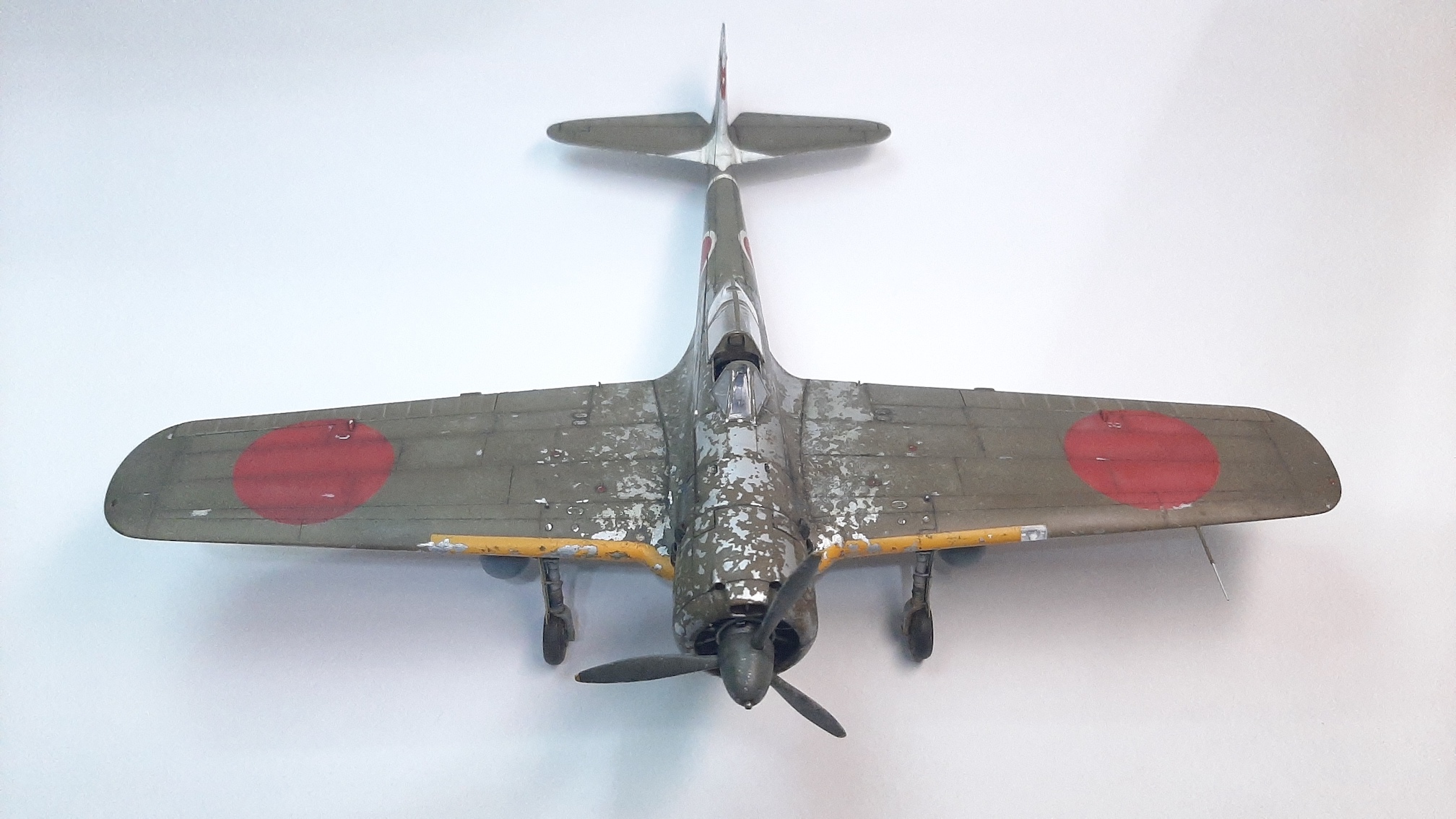
Another splendid Fine Molds 1/48 Ki-43-III Ko, this time Guillermo kindly sharing images of his build of the kit to represent a rather battered aircraft of Hiko Dai 204 Sentai  as photographed at Matsuyama airfield on the island of Formosa (now Taiwan) in August 1945. The tail number '01' has led to speculation that this aircraft was perhaps flown by 1st Chutai leader Lt Tatsukichi Nishimoto or even the Hikotai leader Capt Wataru Takahashi. Although no other obvious command markings are visible instructions were given during mid-1945 for formation leaders to avoid the display of garish identity markings which might lead to them being singled out in combat, instructions which were not always followed.


The 204th, which had been re-designated a Hiko Sentai from its previous Kyôdô (教導 - instructional) Hiko Sentai status in February 1944, lost all Ki-43-II aircraft sent to the Philippines campaign, with 17 pilots including all Chutai leaders being killed there. The surviving flying personnel returned to Mito, Japan, by transport plane in December 1944. At Mito the unit re-equipped with the III Ko before moving to Saigon, Indo-China in February 1945.  In April part of the unit moved to Formosa and was assigned to special attack duties as the Makoto (誠 - honesty or sincerity) 204 Sentai to participate in the Okinawa campaign and in July 1945 the main force of the unit joined it there. At the end of the war surviving  personnel of the unit still in Saigon were transferred into the 126th Airfield Battalion and Dai 64 Hiko Sentai. A 204th Hayabusa II in Burma displaying the previous form of unit insignia  is shown here.  It is now known that the white 'Chinzei Hachiro' arrow flight unit insignia on the fuselage, white painted fin tip, wingtips and possibly forward part of the spinner on that Ki-43-II aircraft denoted the 1st Chutai, with the 2nd and 3rd Chutai markings applied in red and yellow respectively.

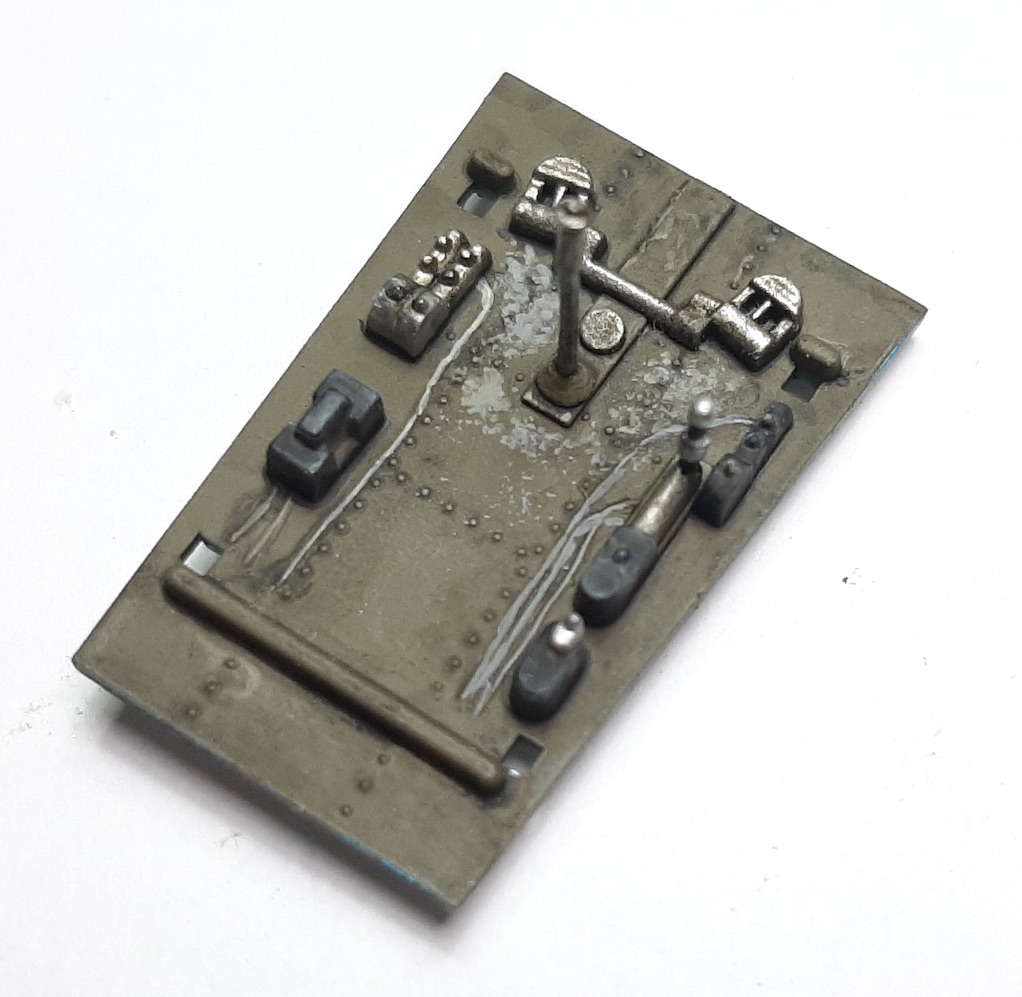
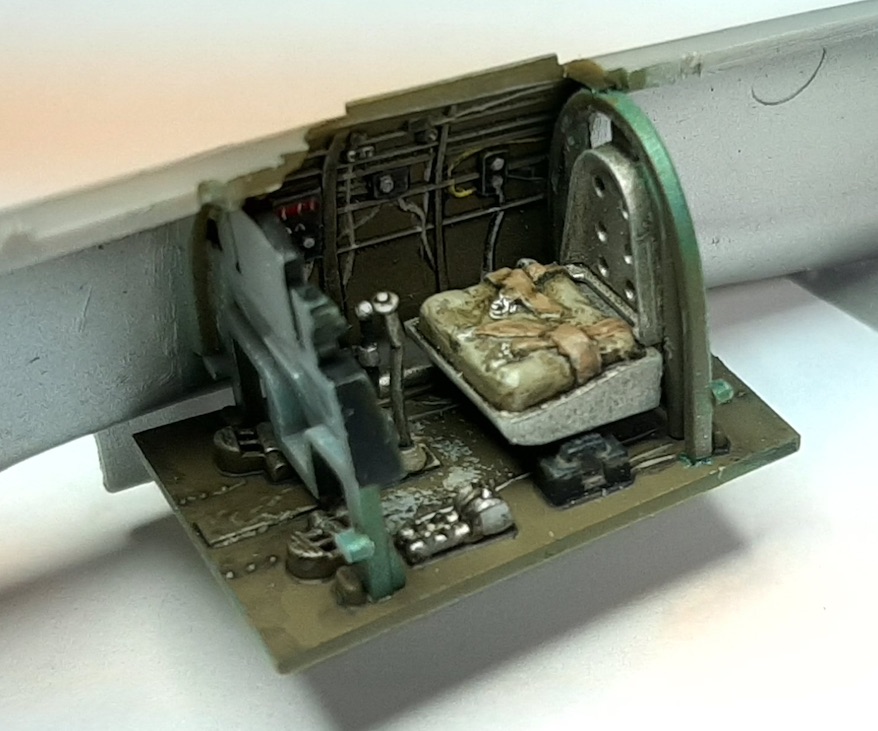
After first painting the cockpit aotake Gulllermo re-painted it using Vallejo  Model Air 71.016 FS 34088 to represent the late war olive drab colour which was also applied to the exterior upper surfaces. The seat was finished aluminium and other details painted in accordance with the Aero Detail # 29 book on Hayabusa, For the under surface Guillermo used Vallejo Model Air 71.326 IJA Grey Green (which despite the name is a warm, slightly brownish grey not to be confused with 71.321 IJA Light Grey Green). Revell Lufthansa Yellow was used for the wing leading edge IFF strips and Vallejo 70.830  WWII German Green for the propeller. The drop tanks were painted with a mix of Medium Sea Grey and Medium Blue with their data markings hand-painted using Vallejo paints.


Guillermo carefully replicated the weathering and chipping indicated in the photographs of '01' by first applying two aluminium paints, Vallejo for the fuselage and Tamiya XF-16 enamel for the wings, together with some pre-shading of panel lines. Vallejo liquid masking was then applied with a sponge. Afterwards some areas of chipping were repaired and improved, painting some irregular spots and re-touching them with Vallejo aluminium. The hinomaru and other markings were applied by paint using Colourcoats RAF Roundel Red and Tamiya XF-2 Flat White, with only the decals for '01' and minor markings used. Weathering was achieved Winsor and Newton oil paints with some pigments for soil and dust effects on the tyres. Note how the fin leading edge marking extends a point along the fuselage spine and 'wings' onto the tailplanes, a detail not always captured in illustrations or decal sheets. In some depictions the red flash is shown with a narrow yellow border.  


Guillermo's primed model tellingly reveals how the basic Hayabusa airframe remained relatively unchanged throughout production. 


And compels a repeat reiteration against the use of Ko and Otsu designations applied to the Ki-43-II as they persist in the modelosphere and with kit and decal manufacturers. The Ko, Otsu, etc., suffix designations, sometimes rendered as a, b, c, etc., in English sources, were most usually used by IJAAF to denote armament variations in fighters which do not apply to the Ki-43. The detail differences in the II series were production changes to the airframe and engine/cowling and in Japanese references these sub-types are often divided by their features into early, mid and late production types with the II Kai as the final Nakajima-built type, all using the character ki (期) which means period but is sometimes given as 'production' in English. Thus:-

初期 - (hatsu ki) = first period (Ki-43-II with annular oil cooler and long Ki-43-I wingspan)
中期 - (naka ki) = middle period (Ki-43-II with enlarged under cowling cooler and shortened wingspan)
後期 - (nachi ki) = later period (Ki-43-II with rearwards thrust exhaust stacks and landing light in port wing leading edge)
末期 - (matsu ki) = end or final period (this is the Ki-43-II Kai with individual thrust exhaust stacks but note that a further refinement was the provision of water-methanol boost to the Kai)

Only the main features of each sub-type are noted above but not all the additional detail changes, especially of armament, armour and other protective equipment/enhancements. The official IJAAF table of aircraft designations ('Table of Aircraft Desgnations and Armament, Army Air Headquarters Secret' # 16979 of 9 December 1943) makes no such distinctions as it does for other fighter types, whilst the official report 'Study of Increase of Armor, Bullet-Proofing, Fire Extinguishing Equipment and Armament on Various Aircraft; Aircraft Section; Supply Depot (Luzon)' of 22 March 1944  lists various upgrades to the II as production changes, detailing dates and first change serial numbers but no Ko or Otsu suffix are tabled. The incremental improvements in Hayabusa fuel and armour protection also counter that other persistent belief in the aircraft's inherent vulnerability. In a report on combat in Burma on 20 January 1944 the Japanese command expressed satisfaction with the improvement in fuel and armour protection for the Type 1 fighter (Hayabusa) from serial # 5800, noting that one aircraft had returned safely with 39 hits and no doubt that was one of the 23 Oscars of 50 and 204 Sentai's  47 sortied that were claimed as destroyed, probable or damaged on that day. The two Spitfire squadrons involved, 136 and 607, claimed 7 Oscars destroyed, 8 probables and 8 damaged. The Japanese reported one 'self destroyed' and two failed to return for a total of three lost. They also claimed 9 Spitfires (or 'P-40s') destroyed and 6 uncertain, whereas only two were lost. Three Spitfires returned damaged, one from a head-on attack by another Spitfire which was admitted, with two of their pilots wounded. After that digression onwards with Guillermo's excellent interior details.


With special thanks to Guillermo for sharing these images and details of his build. 

Image credit: All model photos © 2023 Guillermo; Photo via Guillermo

Tuesday, 9 June 2020

Dan Salamone's Torpedo Toting TX 40 Truck in 1/48 scale


Hot on the heels of his superlative Ki-15-II model Dan Salamone has kindly shared these images and build notes on his latest Hasegawa 1/48 TX 40 truck project. In his own words then:-

"Hi all, here is my recently completed Isuzu TX40 project in 1/48 scale. The base kit comes from Hasegawa, and is my fourth project using this kit. The vehicle itself is a narrow cab cargo truck, with a cargo bed that was both wider, and longer, than the standard TX40. I have two different images of this rare variant of the vehicle, one carrying a Type 91 torpedo at an airfield where Betty bombers were based, and another immediately post-war.


"I started the process by making drawings of the parts which needed to be changed: fenders, cab, canvas roof, running boards, and the entire cargo bed. In essence, the kit parts used were the chassis, wheels and tires, and the hood and interior (which was heavily modified). I used Evergreen plastic, as well as some brass strips and rod. The spare tire carrier under the rear chassis was created by using brass strips, and a photo etched bending tool. 


"The cargo bed is totally scratch built, and also features detail which even though cannot be seen, was needed to be able to align and attach the finished bed to the chassis. I also had to add to the length of the chassis as well. I used two layers of Evergreen plastic sheet, cut to size. Then I scribed the panel lines in, and then used a metal wore brush to ass wood grain effect to the plastic.


"The torpedo was robbed from a Hasegawa kit of the Kate, the oil barrels and tool box come from the basic TX40 kit. 


"I used a custom mix of Vallejo acrylics for the IJN dark blue paint, and for the wood cargo bed, used the Vallejo acrylic set for old and new wood effects. Weathering for the truck was from MiG 'Oilbrushers', AK Interactive weathering pencils, and Vallejo washes and paints. Final clear coat is Gunze flat lacquer from a spray can.


"The rope is a product called 'EZ Line' which my local hobby shop carries. It was an exceptional product to use, as it stretches, and accepts super glue very well. Prior to attaching the product, I gave it repeated washes of Vallejo acrylic paints to give it some color and subtle detail.


"This project was about five years in the making, from originally seeing the pictures, to  the drawings, then the actual building and painting to completion."


So many details and techniques to appreciate and enjoy in these images. With special thanks to Dan for sharing them here. Keep on trucking and please keep 'em coming Dan!

Image credit: All © 2020 Dan Salamone