Monday, 18 November 2013

Armour Plate on the Ki-43 Hayabusa


The use of of armour plate on the Ki-43-II Hayabusa was articulated in a tentative plan to install seat back protection from Nakajima-built aircraft # 5520 from June 1943 and Tachikawa-built aircraft # 15150 from December 1943. The preliminary installation of 12mm seat armour actually began with Nakajima aircraft # 5666 in July 1943 and Tachikawa-built aircraft # 15031 in August 1943. In August 1943 a definitive plan required Nakajima to commence installation of additional 12mm head armour from aircraft # 5866 and Tachikawa were instructed to follow suit from aircraft # 15351.  These details were revealed in 'Increase of Armour, Bullet-Proofing, Fire Extinguisher Equipment and Armament on Various Aircraft' issued by the (Japanese Army) Aircraft Section, Supply Department on 22nd March 1944 and subsequently captured on Luzon. 

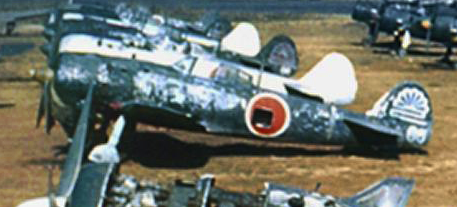
Cannibalised 11th and 1st Sentai Ki-43-I aircraft at Rabaul

An intercepted Japanese report of early 1944 summarising combat lessons after the first clashes between the Ki-43 and RAF Spitfires in Burma mentions that its pilots were pleased with the armour and fuel tank protection in the Type 1 Hayabusa and that one aircraft had returned safely after receiving 39 hits.

Nakajima built aircraft # 5866 was constructed in September 1943 (and the Tachikawa-built  # 15351 in March 1944) but a Crashed Enemy Aircraft Report (CEAR) describing an Oscar Mark 2 # 5764 that crashed 14 miles north-west of Szewui, Kwantung, China on 21 December 1943 revealed evidence of an earlier or perhaps retrospective installation of the head armour. This aircraft had a rectangular piece of ½" (12mm) plate 22¼" x 29" mounted vertically 3" behind the pilot seat and 8" from the cockpit floor together with another ½" (12mm) plate 8½" x 11¾" mounted at a 45°  angle behind the pilot's headrest. The report suggested that this armour gave full protection to the pilot's head and back. This Oscar II had been manufactured in August 1943. Incidentally the Ho-103 12.7mm ammunition type loading on # 5764 was in the order 1 armour-piercing tracer, 1 high explosive and 1 incendiary.


Oscar # 5764 had apparently run out of fuel, crash landed and the pilot had been captured. The markings of the aircraft (shown above) were unusual and in the Pacific Front magazine # 4 of July 1986 Osamu Tagaya penned a neat piece of detective work which concluded that the aircraft was from the 2nd Chutai of the 11th Sentai and the pilot was 2/Lt Kino Kiyoshi who was returned alive, presumably after the war. 2/Lt Kiyoshi had participated in an uneventful fighter sweep over the Kweilin area by 41 fighters of the 11th, 25th and 85th Sentai (see earlier blog Climb and Follow - Defeating the Beehive Part one). The circumstances of his running out of fuel are unknown but he was an experienced ex-NCO pilot who had earned his wings between December 1938 and July 1939.

Remains of a downed Oscar on display at Chungking, China

Of associated interest the wreckage of another Ki-43 was discovered in May this year at Pathum Thani in Thailand.


The above article consolidates data about Oscar # 5764 from several different sources. With acknowledgement and special thanks to Rick Dunn, James L Long and Ken Glass 

Image credits: Heading photo Wiki; Rabaul photo NARA; CEAR drawing USAAF; Chungking photos author collection

Saturday, 16 November 2013

Hayate Thoughts


Although I have somewhat mixed feelings about the Hasegawa Limited Edition 'Combo' series, not least the nearly 200% retail mark up now usual for their kits here in the UK (meaning they are almost three times the price listed in Japan*), it was good to see that the beautiful but unattributed profiles on the box top of the Hayate Combo neatly juxtapose the two most typical schemes for the aircraft. The 51st Sentai subject (top) depicting the late-war factory applied scheme of olive brown with painted under surfaces and the earlier 'Depot' or field-applied scheme of dark green over natural metal for the 22nd Sentai subject, familiar from a well known colour photograph taken at Kimpo in Korea after the end of the war. It is surprising how many modellers still interchange the elements of those two schemes, depicting olive brown over natural metal or dark green over grey-green and whilst those choices could not be refuted absolutely they fall into the categories of 'less  likely' or 'untypical'.  When selecting a subject it is important to try to determine which scheme is most probable given date, unit, location and context but it is not always easy even from photographs and the presence of the anti-glare panel is not a reliable guide.


Hasegawa continue this useful juxtaposition with their painting instructions, suggesting GSI Creos (Gunze) 304 Olive Drab FS 34087 over 128 Gray Green for the 51st Sentai bird and another 101st Sentai markings option offered in the kit, then 129 Dark Green (Nakajima) over 8 Silver for the 22nd Sentai example. Those who have followed the ramblings here will recognise 129 as the approximation of the IJAAF # 21 'green' (midori iro 緑色) paint colour standard. After examining the colour photograph of the 22nd Sentai aircraft a paint more representative of the darker and more bluish hue of # 27 blue green colour (ao midori iro 青緑色) seems probable, but either would be reasonable choices on a model in the absence of any more definitive data.  GSI Creos 128 is a  'traditional' representation of Army Hairyokushoku and not bad, but all indications suggest that the factory under surface paint on Hayate was a warmer, amber-tinted grey which has been described as being like the top surface olive brown lightened with white (and which some assert was exactly that).

Typical late-war factory camouflage for Ki-84 Hayate

When preparations for the final defence of Japan in the Spring of 1945 saw the Hayate units designated for mobile defence duties as part of the Sei-Go plan there was a discussion with Nakajima about finishing Hayate in new paint colours derived from the IJN colours reconciled in the February 1945 '8609' document, deemed more suitable for over-water deployments. That would have seen top surface camouflage of 1-2, which superceded both the IJN 'green black colour' D2 and interestingly the Army colour 27, whilst the under surfaces would be painted 2-6, which superceded the IJN 'ash' or grey colour J3, described as Hairyokushoku - ash-green colour - in the Kari Kikaku 117 Shikibetsu Hyojun" (Provisional Standard 117 Colour Standards) issued with the Hikoki Keikaku Yuryusho Kaitei-an (Proposal for the revision of aircraft planning procedures) in March 1944. The decision was ultimately made to continue with the standard factory painting of 1-1 (which superceded IJAAF 7) over 2-6 (which also superceded IJAAF 1 Hairyokushoku) but it is possible that some trial aircraft might have been painted in the proposed non-standard colours and which found their way into unit operations.


Mark Smith's splendid 1/48th scale Hasegawa Ki-84 model above, which should have been shown here long before now and of which more images are to follow, is convincingly depicted in the late-war factory scheme and represents an aircraft of the 47th Sentai in the late Spring of 1945.

Subsequent Hayate Thoughts will explore some non-standard Ki-84 schemes that do not fall within these two categories. And because it is "buried" under another title this old blog from 2009 about  Army drop tank colours might prove useful linked from here.

* Since blogging this Mark Smith has very kindly provided a link to a very good deal for the Hayate Combo!

Image credits: Box Art © 2012 Hasegawa Corporation; Colour photo Wiki; Colour schematic © 2013 Straggler; Model image © 2013 Mark Smith


Wednesday, 13 November 2013

Model and Movie News

Perhaps unsurprisingly Tamiya are to release a 1/72 A6M3 Model 22 as well as special editions of their 1/72 A6M2 and A6M5 and 1/48 A6M5 to coincide with the release of a new movie on 21st December this year 'The Eternal Zero' (Eien no Zero 永遠の0). The film has been made by Toho, directed by Takashi Yamazaki from a popular 2006 novel by Naoki Hyakuta and tells the story of a young man Kentaro Saeki (Haruma Miura) who after repeatedly  failing his bar test is at a loss as to what to do. His elder sister Keiko is a freelance writer and the two of them begin to research their grandfather Kyuzo Miyabe (Junichi Okada) who died in the Special Attack forces during the war. They discover that their grandfather Kyuzo Miyabe was terrified of death and obsessed with life so why did he volunteer for Special Attack? According to his comrades Kyuzo Miyabe was both a genius and a coward. Kentaro and Keiko then discover the shocking truth which has been sealed for 60 years. . . that the A6M2 Zero was really a very, very, very light grey (might as well call it white).  No, just joking but it looks as if the film is going to perpetuate that myth.


The recent Doyusha 1/72 A6M5 Hei features new art but is the Hobby Boss kit re-boxed. This is not a bad quick-build model reminiscent of the Academy kit. It is useful for practising painting techniques but suffers from wing leading edge inserts for the armament that are difficult to clean up. It is best to remove the gun barrels, locate and cement the inserts, putty and sand to fair them in then replace the barrels afterwards. Markings options are for two aces - Tetsuzo Iwamoto of 252nd Ku and the well-known 203rd Ku victory marked '03-09' of Takeo Tanimizu.


Doyusha have also released the A5M2b in simple build format. This one is another former Hobby Boss kit. The Doyusha issue comes with three options for the 12th Ku including a Hokokou adorned example.


Finally and this is probably old news for most but it has also now been confirmed that the forthcoming Aoshima Ki-100 Ko and Ki-100 Otsu kits are indeed new tool mouldings. 

Image credits: A6M3 heading image © 2013 Tamiya Inc., via HLJ; Eien no Zero logo © 2013 Toho Company Ltd; A6M5c box art and A5M2b presentation © 2013 Doyusha Model Co,.Ltd.

Tuesday, 12 November 2013

Royal Thai Air Force Nates ~ Ki-27 Aces Extra 1


On 14th December 1941, following the Japanese invasion of Thailand, the Thai government was coerced into acceding to a Japanese request to support its war effort by entering into a military alliance with Japan. The Royal Thai Air Force was reluctant but eventually agreed to co-operate with the JAAF by sending units into Northwest Thailand to support the Japanese Army campaign in Burma. As part of this agreement the Japanese undertook to provide Thailand with Type 97 (Ki-27) fighter aircraft and for the JAAF to begin teaching Thai pilots to fly this fighter at Don Muang airfield. An order for 12 Ki-27 Otsu fighters was placed with Mansyu Hikoki Seizo K.K. in Manchuria who were building the aircraft under licence. In Royal Thai Air Force service the Ki-27 was known as the Fighter Type 12 or ‘Ota’, after the Japanese city where the Nakajima plant was located. The new fighters were allocated to Foong Bin 16, the wartime designation of the 3rd Squadron of Kong Bin Noi 1 based at Don Muang, which was also partially equipped with the Curtiss Hawk 75N. 

RTAF Ki-27 photographed post-war. The pre-war rudder stripes have replaced the charging elephant insignia on the tail but the wartime markings remain under the wings (via Edward M Young)

After re-equipment the squadron moved to Lampang to provide escort duties to the two attack squadrons of Kong Bin Noi Phasom 85 equipped with the Mitsubishi Ki-30 light bomber. The first mission of the Otas was flown on 6th February 1942 when all 12 aircraft flew escort to a force of nine Ki-30 bombers bombing Chinese positions at Loi Mwe in the Burma Shan States. Shortly afterwards allied attacks against Thai airfields necessitated a re-organisation to improve air defence and as a result Squadron 16 was re-assigned to patrol duties over Chiang Mai and Chiang Rai. 

RTAF Ki-27 (via Edward M Young)

Most of the Ki-27 service in the Royal Thai Air Force was uneventful and no Thai pilots achieved ace status whilst flying the type. Squadron 16 continuing to fly patrols or escorts to unopposed bombing missions by the Ki-30’s and, following a tacit truce with China, their reconnaissance missions over the Shan States and Southern China. The Ki-27 was also somewhat eclipsed when the Japanese provided the Royal Thai Air Force with the more modern Nakajima Ki-43 Hayabusa “Oscar” Type 1 single seater fighter and a few of these found their way to Squadron 16, replacing the Curtiss Hawk 75N. As the Allied air offensive against the Japanese intensified, targeting airfields and installations in Thailand, the likelihood of encounters with Thai aircraft increased. In most cases the defending fighters, marked with the red flag and white elephant insignia adopted after alliance with Japan, were not distinguished as Thai and were reported as ‘Japanese’. In an encounter with B-24 bomber’s attacking Lampang on 21st December 1943 six Otas of Squadron 16 were reported as holding off from attack and veering away when fired upon by the bomber gunners. 

RTAF Ki-27 in action against P-38's (Wanchai)

On the 11th November 1944 five Otas of Squadron 16 intercepted a force of US fighters conducting an interdiction mission against rail and airfield targets of opportunity in the vicinity of Chiang Mai. The American fighters were from the 51st Fighter Group and consisted of eight P-51 Mustang’s of the 25th Fighter Squadron with four assigned as low strafers and four covering them at a higher altitude, with a top cover of seven P-38 Lightnings from the 449th Fighter Squadron, 16 aircraft in all. The P-51’s had attacked a locomotive and shot up a single black coloured fighter on the airfield at Lampang. Shortly after noon the P-38’s flying at 18,000 feet called out five Japanese fighters. At about the same time 2nd Lt Henry F Minco flying P-51 44-10812 in the middle flight of Mustangs led by 1st Lt Roger R Vadenais called out three Japanese fighters above them and about 5 miles ahead.  “Do you see them Vad?” he called out.  Lt Vadenais spotted the enemy aircraft, ordered his flight to drop their wing tanks and led them in a climb to make a head on pass against the approaching Ki-27’s. The Ki-27’s passed through the P-51 flight and Lt Vadenais turned to pursue, firing at one of them and seeing its propeller break off before it rolled and dived away. This was possibly the aircraft of the Ki-27 leader Flight Lieutenant Chalermkiat who had to force land with a damaged engine. The Ki-27 was then strafed and destroyed on the ground by one of the P-51‘s. During this encounter Lt Minco called out “I see two below, am going after them.” and broke from Vadenais’ right wing in a dive. 1Lt Otto C Miller apparently pursued and shot down Chalermkiat’s wingmen Chief Warrant Officer (CWO) Nat Sunthorn, killing him, whilst Lt Minco might have damaged the aircraft of CWO Thara Kaimuk, wounding him and forcing him to crash land some distance from Lampang. During this combat at low level it appears that Lt Minco’s P-51 was either shot down (perhaps by ground fire), crashed accidentally (perhaps stalling in a turning fight) or was damaged badly enough during air combat for him to bail out. Rumours arose in early 1945 that he had attempted to bail out of his Mustang but had been killed landing in trees and that his body had been buried by local people. Whatever his fate he did not return from the sortie and was listed as missing in action. During the battle the P-38 pilots had heard an unknown pilot, possibly Minco, call out “I’ve got one trapped in the valley down here!”. 

Witness Statement from MACR 10064 (NARA)

The P-38’s had also engaged the Ki-27’s simultaneously, with 1Lt Dale D Desper’s flight claiming one of the Ki-27’s shot down in the first head on pass. This was probably the aircraft flown by CWO Chuladit Detkanchorn who managed to bail out. The P-38 pilots then reported that they were attacked by four more Ki-27‘s from above. Pilot Officer Kamrop Bleangkam  fired at a P-38 flown by 1Lt Richard D Conway, shooting out its port engine and claiming it as destroyed. But Lt Conway egressed safely from the fight and made an emergency landing on an airfield at Simao. PO Kamrop or another Thai pilot also fired at 1Lt Leonard W Flomer’s P-38, setting fire to his wing tip tank. Flomer called excitedly for help, angering Lt Desper who after driving off the Thai Ki-27 admonished Flomer for his lack of radio discipline. Desper then escorted Flomer back to Yunnanyi where both P-38’s landed safely. PO Kamrop’s Ki-27 was badly damaged in the fight, probably by Desper, and he too was forced to crash land. 

Extract of MACR 10064 (NARA)

P-51 43-25244 flown by 1Lt Rudolph C Shaw of 26th FS, 51st FG is also the subject of a Missing Air Crew Report (MACR 10632) on the same day and the loss has sometimes been associated with this incident. However Shaw was on a bombing mission from Nanning to Laipin with four other P-51s and after strafing two sampans on a river east of Tawan, south of Chenglunghu in China, he was not seen again. His companions heard him calling on the radio that he was bailing out due to loss of fuel but his ultimate fate is unknown. 

RTAF Ki-27 in action against P-51's and P-38's (Wanchai)

The P-38 pilots claimed three Ki-27’s destroyed (one each to 1/Lt Robert H Jones, and 2/Lt Grover W Stubbes and one shared by Lts Desper, Flomer and Frederick A Roll Jr) together with three probably destroyed. The P-51 pilots claimed two destroyed by Lts Miller and Vadenais and a quarter share for 1/Lt Clell H McKinney for the Ki-27 claimed jointly by P-38 pilots Lts Desper, Flomer and Roll. 2/Lt Henry F Minco, a 70 mission veteran, was not posthumously awarded any credit for a victory but it is clear that he was in combat with a Ki-27 and that all the Thai aircraft were shot down or forced down.  During the combat two parachutes were seen, presumed both to be Thai pilots. It appears from the evidence that the Thai Ki-27 pilots damaged two P-38’s and possibly shot down one P-51. One of the P-38 pilots involved in this combat reported that the Ki-27‘s were “maneuverable as hell but slow as hell”. Subsequent records reveal that at least one of the Thai aircraft was made airworthy following the combat, possibly the Ota of F/Lt Chalermkiat.

Apart from a possible attack on a 7th BG B-24 flying a low-level railway sweep on 22nd March 1945 there were no other recorded combats for the Thai Otas. By April 1945 Squadron 16 had only four serviceable Otas from a total strength of eight whilst Squadron 15, operating the Ki-43, had a single Ki-27 on strength. By November 1945 only a single  Thai Ota remained operational with Squadron 43 and the Ki-27 fighter had passed into history.

With special thanks to Ronnie Olsthoorn and Edward M Young for their kind contributions and assistance with this article.

References
'Aerial Nationalism - A History of Aviation in Thailand' by Edward M Young (Smithsonian Institution Press, 1995)
'The Forgotten Squadron - The 449th Fighter Squadron in World War II' by Daniel Jackson (Schiffer Military History, 2010)
'Air Power Under His Majesty's Bounty' (Edited RTAF, 2006)
NARA Archives

Image credits: Ki-27 profile © 2013 Ronnie Olsthoorn; Photographs via Edward M Young; Ki-27 paintings 'Wanchai' via RTAF; MACR extracts NARA.

Monday, 11 November 2013

Remembrance


They shall grow not old, as we that are left grow old:
Age shall not weary them, nor the years condemn.
At the going down of the sun and in the morning,
We will remember them.


Sunday, 10 November 2013

Climb and Follow ~ Defeating the Beehive Part One


The facsimile memorandum below is a copy of a document issued by Claire Lee Chennault in the late summer of 1942. Although by that time the China Air Task Force (CATF) had already been formed the memorandum is still headed as being from the Headquarters of the Officer Commanding the First American Volunteer Group. The Japanese aircraft fighter types being engaged over China during 1942 were the Type 97 fighter (Ki-27 'Nate'), Type 1 Fighter (Ki-43 Hayabusa "Oscar'), the latter a relatively recent arrival but increasing in numbers, and to a fairly limited extent the Type 2 two-seater fighter (Ki-45 Toryu 'Nick'). The "beehive" referred to was essentially a multi-tiered Lufberry circle often flown above escorted bomber formations as much to maintain contact with the slower aircraft below as to provide an aggressive-defensive posture towards intercepting aircraft.


The CATF pre-dated the 14th Air Force and existed from July 1942 to March 1943. The nucleus of units under command consisted of the 74th, 75th and 76th Fighter Squadrons of the 23rd Fighter Group  and the 16th Fighter Squadron all equipped with the Curtiss P-40, the 9th Photographic Reconnaissance Squadron (formerly the 9th Photographic Squadron), officially equipped with the F-4 variant of the P-38 but prior to formal deployment operating ad hoc within the CATF with various modified P-40 aircraft including some P-40G variants according to Malcolm Rosholt*, and the 11th Bombardment Squadron equipped with the B-25 Mitchell medium bomber.

Chennault and CATF pilots examine a captured and well-camouflaged IJN Mitsubishi A6M2 (NARA)

Japanese fighter units in China at around the same time consisted of the 10th Dokuritsu Hiko Chutai (DHC - Independent Air Squadron) and 54th Sentai (FR - Flying Regiment), both equipped with the Type 97, and the 24th Sentai equipped with the Type 1. The 10th DHC was expanded to two Chutai strength to become the 25th Sentai in November 1942, at the same time completing a transition to the Type 1 fighter (Ki-43-I) which had begun in May. It was expanded again to full three Chutai strength during the Spring of 1943. The 24th Sentai spent a relatively short time in China, arriving at Canton in July 1942 and leaving for Sumatra in September at the same time as the withdrawn 54th Sentai. The 33rd Sentai arrived the same month, newly equipped with the Type 1 fighter. In addition to these China-based fighter units other Japanese units staged into China throughout this period for specific operations from Indo-China, Thailand and Burma. The table below illustrates the China-based deployments.


* 'Days of the Ching Pao' (Rosholt House, 1978)

Image credits: Colour photo of Chennault from Wiki; Facsimile memo from 14th AF Association Commemorative Tribute © 1983 Malcolm Rosholt; A6M2 photo NARA Archives; Table © 2013 Straggler taken from 'IJAAF Fighter Units in China 1942-1945' (unpublished).