Monday, 8 February 2016

Lan Tien Chang Airfield, Peiping, China


Jacob Terlouw has very kindly shared this aerial image of Lan Tien Chang airfield., presumably taken after or near the end of the war. Lan Tien Chang was just to the north-west of Peiping (Peking, Beijing), not as well known as the main airfield of Nan Yuan to the south of the city. It is now a recently re-built military airfield complex with the remnants of the old airfield slightly to the north-west of the present north-south runway. On the field several different aircraft may be seen including Ki-21 'Sally', Ki-54 'Hickory', Ki-56 'Thalia', Ki-61 'Tony' and Ki-84 'Frank' types, several of which appear to have been cannibalised. There also appears to be a serviceable L2D 'Tabby' with engine covers in place. The identity of the apparently intact biplane at the lower right of the image is more difficult - an engine less Tachikawa (Ishikawajima) KKY-1 or KKY-2 light aircraft perhaps? Suggestions on a postcard please. . .


At the very end of the war Lan Tien Chang was considered to fall within the 5th Air Army sphere of command from Korea, which came directly under the General Air Army (Japan), rather than under the China Expeditionary Army. Identifying the units which operated there is difficult because detachments were being shuttled between bases in response to the exigency of the prevailing military situation and the whole was underpinned by the military transport system and other command level ancillary services. Airfields in North China were being used as rear echelon bases for units in Korea as well as training fields.  All air units north of the Lunghai Railway in China supposedly came under the command of 5th Air Army, but the situation was chaotic and Allied sweeps were attacking the airfields around Shanghai where the 13th Air Division was concentrating forces in expectation of an Allied invasion attempt. 
 
Units transferred from the China Expeditionary Army to 5th Air Army  included the 1st Air Brigade consisting of the 22nd, 25th and 85th Sentai, by that time all equipped with the Ki-84, the 8th Air Brigade consisting of the 16th and 90th Sentai with Ki-48 'Lily', and the 2nd Air Brigade consisting of the 6th (Ki-51 'Sonia), 44th (Ki-36 'Ida' and Ki-51 'Sonia') and 82nd Sentai (Ki-46 'Dinah'). It is possible that some elements from any of these units were at the Peiping airfields at the end of the war but the 25th Sentai was based at Nan Yuan from May to June 1945 and the 9th Sentai (Ki-44 'Tojo' and Ki-84 'Frank') had also been based there from March to May 1945.  
 
After the command changes the furthest northern reach of 13th Air Division's central China control sphere was supposed to be Licheng airfield, which is now Jinan (Tsinan) Yaoqiang International Airport, where the 85th Sentai was transferred in May 1945 before moving to Korea. All of the 'Sagikake' (先 駆け · 魁 - "charging ahead of others") special attack units (each of six aircraft) being concentrated around Shanghai came under 13th Air Division control. They included Ki-44 'Tojo' (Sakigake 1st Hikotai "Spearhead"), Ki-84 'Frank' (2nd Hikotai) and Ki-43 'Oscar' units (11th, 12th & 133rd Hikotai), all formed and training under the auspices of the 9th Sentai which was at Nanking.

With special thanks to Jacob for sharing the photograph here.

Image credit: Lan Tieng Chang photograph © 2016 Jacob Terlouw via 'Straggler'


Wednesday, 3 February 2016

Ida and Tojo at Changi, Singapore


Following up on the blogs about the Gremlin Task Force here and here, Martin Page has very kindly shared this photo showing a Ki-36/55 and Ki-44 at Changi, Singapore in 1946. Martin's father John Page (on the left in the photo) served as an RAF LAC (Leading Aircraftman) MT (Motor Transport) Fitter/Driver attached to the mobile airfield contingent of 121 Wing, 2nd Tactical Air Force in Europe, from D+10 through to the German surrender.  He was then posted back to the UK in 1945 prior to being sent out to the Far East as part of the ground contingent to support ‘Tiger Force’ RAF SEAAF. In August 1945 he arrived in Singapore and was posted to 379MT MU (Maintenance Unit), Detach. 2 RAF SEAAF.  He finally returned home to the UK in April 1946.

The two aircraft are possibly from the 1st Yasen Hôju Hikôtai (Field Reserve Air Unit) which was stationed at Singapore under 3rd Air Army HQ and operated many different aircraft types, although the 17th Rensei Hikotai (Training Transformation Air Unit - sometimes termed Operational Flight Training Unit) also operated Ida, Sonia and Oscar at Singapore. A total of 45 IJAAF aircraft were recorded at Changi in September 1945 - 2 x Ki-21 'Sally', 13 x Ki-36 'Ida', 2 x Ki-43 'Oscar', 3 x Ki-44 'Tojo', 6 x Ki-46 'Dinah', 2 x Ki-49 'Helen', 1 x Ki-51 'Sonia', 3 x Ki-54 'Hickory', 2 x Ki-61 'Tony', 2 x Ki-84 'Frank' found intact and 9 miscellaneous wrecked aircraft. In addition a single IJN G4M 'Betty' was recorded. These aircraft were just a part of the 258 Japanese aircraft recorded on five Singapore airfields, including Kallang, Paya Lebar (a satellite of Kallang), Seletar (mainly IJN) and Sembawang.

With special thanks to Martin for sharing the image and details of his father's service.

Image credits: © 2016 John Page via Martin Page 

Tuesday, 2 February 2016

1/72 IJAAF Re-issues & Ki-61-II

Forthcoming IJAAF re-issues and new kits in 1/72nd scale which may be of interest to blog readers. The Hasegawa Ki-46-II gets another outing, this time in 'Green Cross' surrender guise, and Special Hobby re-release their Ki-43-II as a late production variant (which they call 'Otsu') with lovely box art as one of the Burma presentation aircraft in reticulated camouflage. To my mind the Hasegawa Ki-46 suffers from a slightly humpbacked look to the upper fuselage between the canopies, spoiling the svelte lines of the type. The aged Airfix kit still has the better airframe shape but the Hasegawa kit has finer detail - and better props and spinners!


Previous release of the Hasegawa Dinah was in 2014 as kit # HSG02128 'Mitsubishi Ki46 II/III Type 100 (DINAH) Tiger Unit' (below) which contained parts to build either a Ki-46-II or Ki-46-III (but not both) and decals for three aircraft of the 18th Dokuritsu Hiko Chutai in China. A significant feature of this kit is that it contains completely new engine, nacelle and cowling parts for the Ki-46-III which are different from those in the original CP6 kit of 2000, which used identical sprue frames as the Ki-46-II kit for those parts. Hopefully this 'new' Ki-46-III will also be re-issued in due course.


In April the resurgent Aoshima are also due to release new 1/72nd scale kits of the Kawasaki Ki-61-II in both 'bubbletop' and 'razorback'  versions, which will come complete with ground crew and accessories, including trestles and elevating jacks - a nice touch offering plenty of diorama potential.


Image credits: Box art © 2016 & 2014 Hasegawa (via Hobby Search) & Special Hobby; Ki-61-II prototype model images © 2016 Aoshima (via Hobby Search)

Saturday, 23 January 2016

That Other Shoki ~ Update


Further to the February 2015 blog article on the Fujimi 1/70th scale Ki-44 kit, correspondent Ken Glass has kindly sent this image of another early issue of the kit in the 'Metallic Series' with the same No.5 catalogue number, presumably pre-dating the 'One Hundred Series' issue? Box art is intriguing, perhaps just a poor attempt at representing natural metal but nevertheless reminiscent of the blue-grey dappled 'cloud camouflage' associated with early operations over China, of which more in due course. No unit tail marking in view and no yellow wing leading edge IFF strips shown!

Image credit: Yahoo Japan via Ken Glass

Wednesday, 6 January 2016

Jack Geratic's 1/72nd scale resin Type 95 Trainer


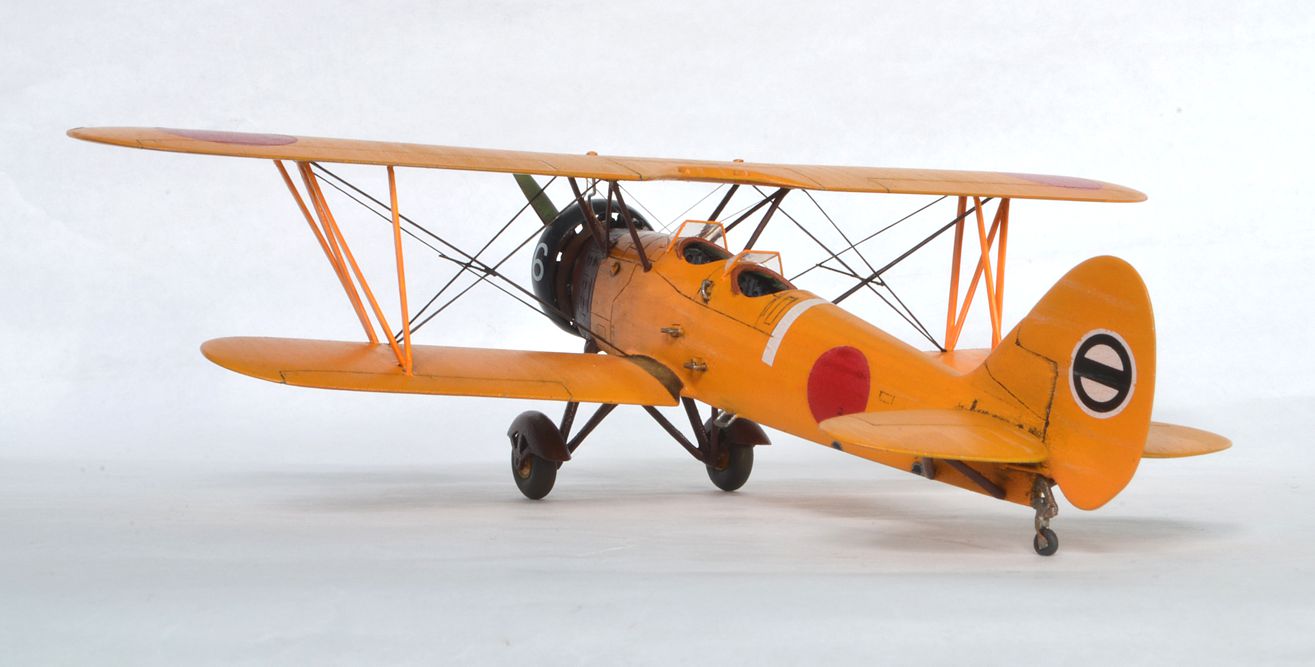
By a happy coincidence Canadian modeller Jack Geratic has also given permission to share here his excellent 1/72nd scale model of the Choroszy Modelbud resin Type 95 (Ki-9)  Trainer kit.


In contrast to Zbyszek's special attacker, Jack's model is finished in the standard orange-yellow trainer scheme and represents an aircraft of the Kumagaya (Bear Valley) Army Flying School (Rikugun Hikô Gakkô) in Saitama Prefecture. 


The Kumagaya Flying School began flying training courses in 1936 for potential NCO pilots and cadet officers from the reserve but once war began in 1937 it gradually expanded, eventually establishing 12 additional branches with multiple satellite fields in Japan. Kumagaya fell within the Kanto Air Defence Sector and later in the war its flying instructors would be organised into Tô Ni Go Butai - secondary provisional units - to fly Ki-43 fighter air defence sorties under the operational control of the 10th Air Division during emergency situations.


The Kumagaya tail marking has usually been depicted as black and white but more recent references have begun showing it as red and white. However it appears to be an adaptation of the mon (crest) of the Minamoto Ashikaga clan which was black and white, Kumagaya city being named after the famous Minamoto samurai Kumagai Naozane. The convincing orange yellow finish was made with a 50/50 mix of Gunze H24 Orange Yellow and Akan BS356 Golden Yellow. 


With special thanks to Jack for sharing these images of his superb model.

Image credits: All © 2015 Jack Geratic


Monday, 4 January 2016

Zbyszek Malicki's Special Attack Type 95 Trainer in 1/72nd scale


Zbyszek Malicki from Poland very kindly shares these images of his special attacker Tachikawa Type 95 Chûren (an abbreviation for intermediate trainer) built from the RS Models kit in 1/72nd scale. 


The model was built straight from the box with two exceptions. The windscreens were scratch built to replace the incorrectly rounded kit parts and the barrel in the rear cockpit was taken from the Hasegawa Isuzu Fuel Truck kit as this item is not provided in the RS Models kit.  The decals are from the kit and represent aircraft # 9 of the 96th Shinbu-tai photographed at a civil flying school - the Kumamoto Local Pilot Training Centre - in 1945. This flying school was established in 1941 at a specially built airfield in the Kikukuchi district of Kumamoto Prefecture about 12 miles from Kumamoto City. It was also close to the Tachiarai Flying School branch airfield at Kuroishibaru on Kyushu. The Japanese characters beneath the five petal cherry blossom insignia on the tail appear to  mean balmy (or summer) breeze (風薫 - kun fu - literally 'fragrant wind').


This aircraft's unit has sometimes been mis-identified in photo captions as the 21st Hikoshidan Shireibu Hikodan (sic). The 21st Hikoshidan (Air Brigade) was the parent formation for this and other units. Shireibu Hikohan (not Hikodan which means Air Division) was the Brigade headquarters flight, usually consisting of multi-engined transport aircraft although HQ staff officers sometimes flew fighter hacks and liaison aircraft like the Ki-51. The 21st Air Brigade had a number of units under command including two Ki-84 units - the 72nd and 73rd Sentai - and after Okinawa presided over the formation of special attack units such as this one in preparation for repelling expected Allied landing attempts on the Japanese mainland. For the paint scheme  Zbyszek pre-shaded the model with black then applied an overall orange before the dark green camouflage. That was then skilfully 'weathered' to reveal glimpses of the underlying orange. Rigging was made using the fine nylon filament from pantyhose attached with superglue but Zbyszek  notes this unusual technique requires a tricky combination of being gentle and fast!  


The gasoline drum in the rear cockpit is presumed to be a makeshift explosive device and it is probable that the aircraft had been prepared for localised defence against Allied landing ships in anticipation of an invasion attempt on the mainland.


The Tachikawa Type 95-1 (九五式一 型練習機 - Kyu Go Shiki Ichi Gata Renshûki - literally 'nine-five type one form practice aircraft) was designed to a 1934 request from Army Air HQ after they had tested - and found too small - that company's private venture R-5 primary flying trainer. It existed in two versions - the Type 95-1 and Type 95-1 Kai, more commonly referred to as Ko and Otsu, the latter an improved version with a strengthened undercarriage, identifiable by the teardrop shared fairing at the intersection of the wheel struts. The Type 95 was operated throughout the war in the Renshū Hikōtai. 


With special thanks to Zbyszek for sharing these images of his excellent model with Aviation of Japan.


Image credits: Model photographs © 2015 Zbyszek Malicki; Box art © 2009 RS Models