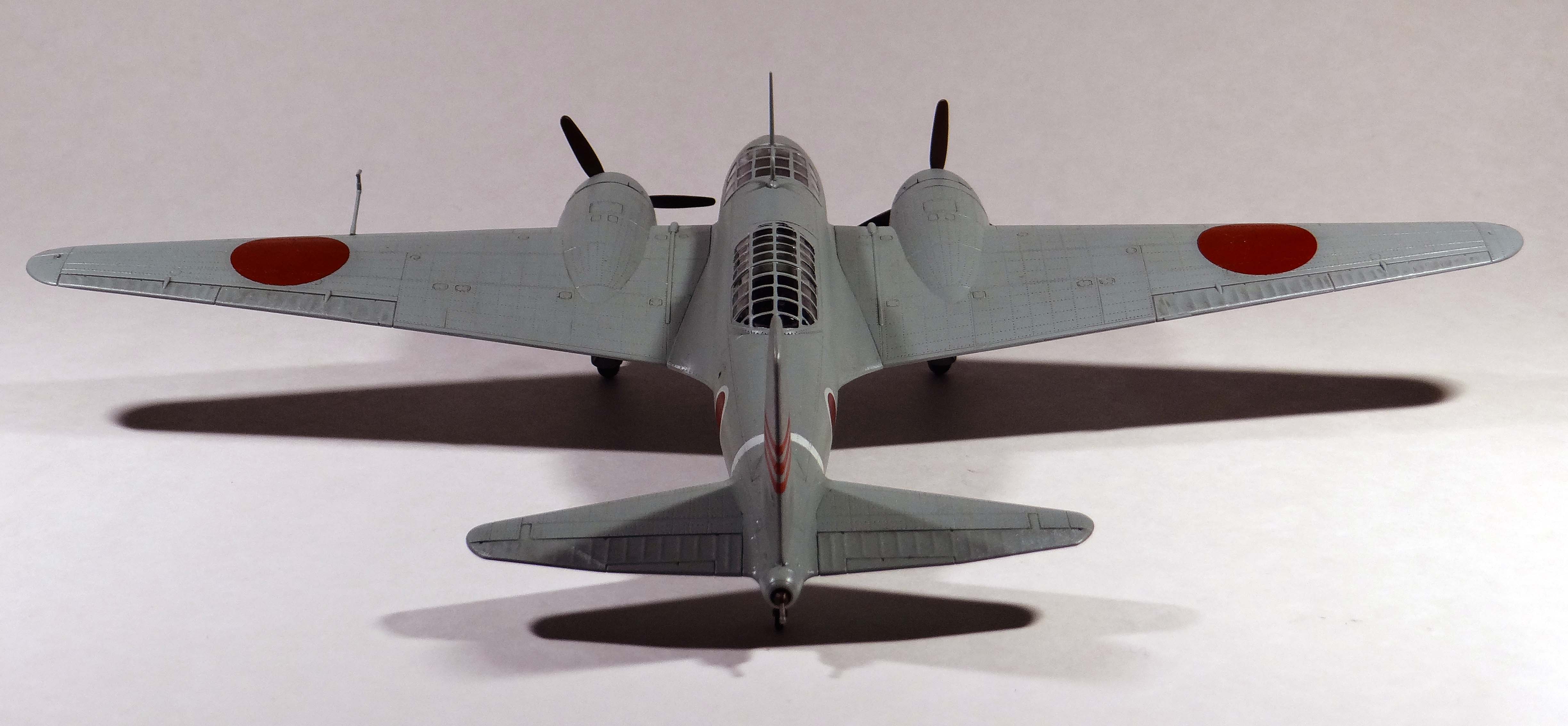
No, not the recently released ICM new tool but another Revell classic, this time the first of a pair of Mitsubishi Ki-21 'Sally' bombers in 1/72 scale made from the Takara releases of the 1975 Revell kit, which featured here back in 2012, by Gonzalo Guzmán. Gonzalo has had these kits since 1982 and the announcement of the ICM release was the stimulus for him to build them, and a fine job made of that too.


The Ki-21-II Ko model represents an aircraft of the 2nd Chutai, 58th Sentai based in Sumatra during 1942. Although classified as a heavy bomber in the JAAF the Ki-21 was comparable to the RAF's Vickers Wellington.


Hiko Dai 58 Sentai was established at Gongzhuling, Manchuria under Col Dankichi Ogawa with three heavy bomber Chutai from the 2nd Daitai of the 12th Hiko Rentai in July 1938. In June 1939 it moved to Jiamusi and worked up in expectation of operations against Russian forces. In May 1940 Col Noboru Taki assumed command of the unit and from early August to mid September 1940 18 bombers of the unit conducted attacks againt Kweilin and other Chinese targets from Canton. Ground crew were transported to Canton in the Fiat BR20s of its sister unit the 12th Sentai. On 29 August all four Ki-21s which had sortied against Zhaoguan were forced to make emergency landings on the way back from their target due to very heavy cloud conditions. When the weather cleared the four bombers took off from the very short landing ground with only pilots on board, the other crew members returning by boat with the aircraft machine guns under the leadership of Sgt Tsuruo Sakamoto.


In early February 1943 with the situation becoming critical in the SW Pacific the 58th was moved south together with the 60th Sentai and both began conducting Indian Ocean patrols from Sumatra. In late July 1943, in response to concerns that new forward Allied airfields in China would be used for raids against the Japanese mainland, 23 aircraft of the 58th staged to Hankow from Medang, Sumatra via Pingdong and Shanghai from where daylight attacks were conducted against Lingling, Chunking and Hengyang. On 23 July Lingling was attacked by the bombers each carrying two 250 kg and five 100kg bombs, the Sentai commander Lt Col Takenao Tsubouchi, who had assumed command in February of that year, flying on the mission in the Ki-21 of the 3rd Chutai leader Capt Nobuhiko Kuwabara. In a fierce air battle with P-40s on approach to the target four bombers were lost and all the returning aircraft received damage. Lt Kazuoki Odaka's aircraft managed to return on one engine, closely escorted by his former classmate Lt Kyoshi Namai flying a Ki-43 from 33rd Sentai. The following day 18 bombers went to Hengyang escorted by no less than three fighter sentai but the aircraft of Lt Shigeru Shimizu was shot down. The unit then withdrew to Dachangzhen airfield at Shanghai, conducting three raids at the end of the month against Jianou.

On 23 August the unit bombed Chunking and despite aerial opposition the only loss was the Ki-21-II of 1/Lt Heijo Maeda. Anti-aircraft fire over the target was inaccurate, bursting well below the 58th's bombing altitude of 23,000 ft. The following day Chunking was again the target but an adverse weather report from a recce flight diverted the raid to Wanxian. On 26 August the unit withdrew from China to Saigon and in mid November moved to Medang, Sumatra via Saigon from where it again flew sea searches and convoy patrols with detachments at Singapore. During this period three aircraft and 23 personnel were lost in training accidents or missing on patrols but the losses were not as heavy as in other Ki-21 units. In January 1945 it moved to Kompong Kunang from where it conducted patrols across the South China sea, losing the aircraft of 2Lt Torii to a P-38 on 3 March. One aborted plan was to raid Ceylon and modification began to fit extra fuel tanks in the fuselage and reduce the crews to three in order to extend the range but the operation was cancelled before being attempted.


On 4 March four aircraft staged to Dong Muang, Thailand for a night attack against the airfield at Schwebo in Burma. The airfield lights were on and the attack was successfully pressed from 1300 ft against a clearly visible line-up of aircraft on the ground. Sgt Masayoshi's aircraft was attacked by a Beaufighter but the dorsal gunner Sgt Maj Yoshida was able to warn the pilot to break away by a system of cords attached to the pilot's arms. The attack killed the ventral gunner Sgt Maj Shinobu Taki whose head was blown off, set one wing tank on fire and dropped one of the undercarriages. They were able to extinguish the fire and limp away, losing altitude and landing at Moulmein because they would not have been able to cross the mountains. The retracted undercarriage would not lower but Sgt Masayoshi managed to land the aircraft. The veteran Ki-21 c/n 1025 had been on strength with the unit since Manchuria but the Beaufighter attack had left large holes in the airframe.


In mid-July the 58th moved to Formosa (Taiwan) where it ended the war.


With special thanks to Gonzalo for sharing these images of his excellent and evocative model built from a classic kit. Part 2 will feature his Ki-21-II Otsu also made from the Takara release of Revell's Ki-21. Reference material on 58th Sentai operations from Japanese Army Heavy Bomber Units by Dr Yasuho Izawa.


Image credit: All © 2023 Gonzalo Guzmán; References: Japanese Army Heavy Bomber Units by Dr Yasuho Izawa, translated manuscript courtesy of the author