Showing posts sorted by date for query D3A1. Sort by relevance Show all posts

Saturday, 26 April 2025

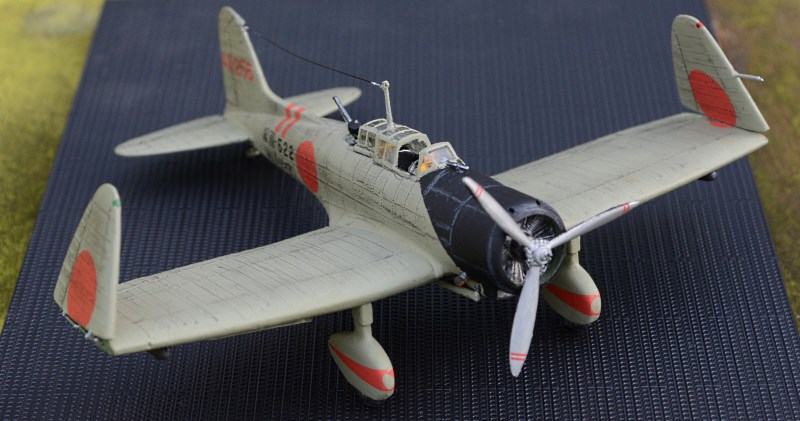
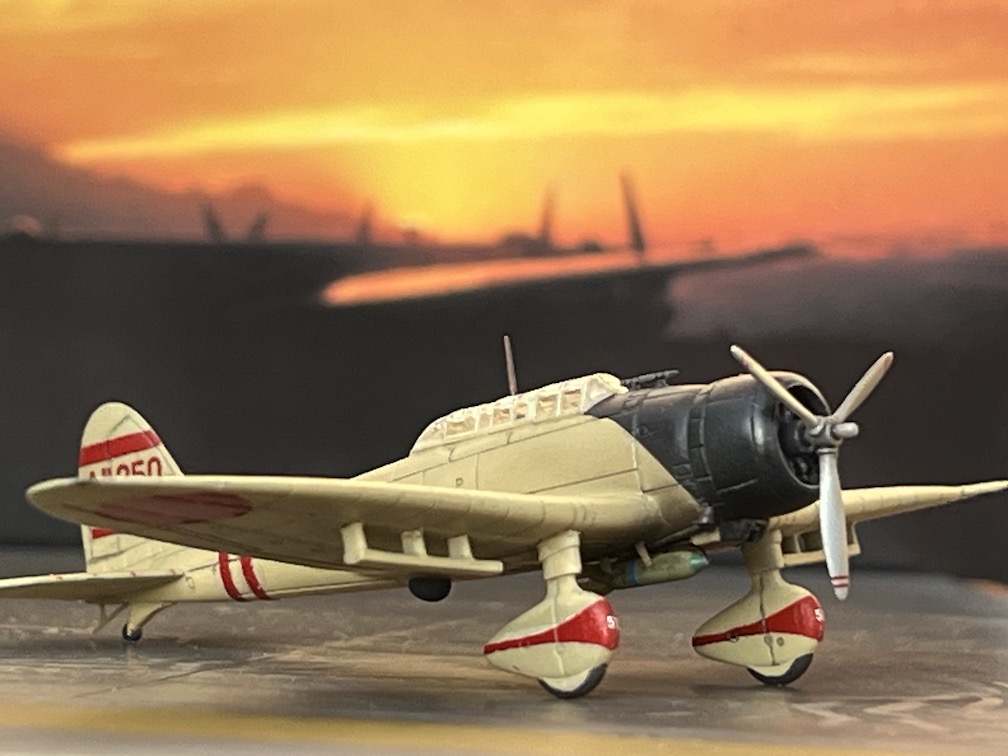
Aichi D3A1 'Val' in 1/144 Scale by Mark Smith


The first of two 1/144 scale features by Aviation of Japan Texas correspondent Mark Smith. this one presenting his build of the Aichi D3A1 'Val', Type 99 Carrier Attack Bomber (Kyu-Kyu Shiki Kanjoh Bakugeki-ki  - 九九式艦上爆撃機 or in short Kyu-Kyu Kanbaku - 九九艦爆). There has been a resurgence of interest in kits of this scale with a greater variety of types available but this one appears to be hard to find. Over to Mark then:-


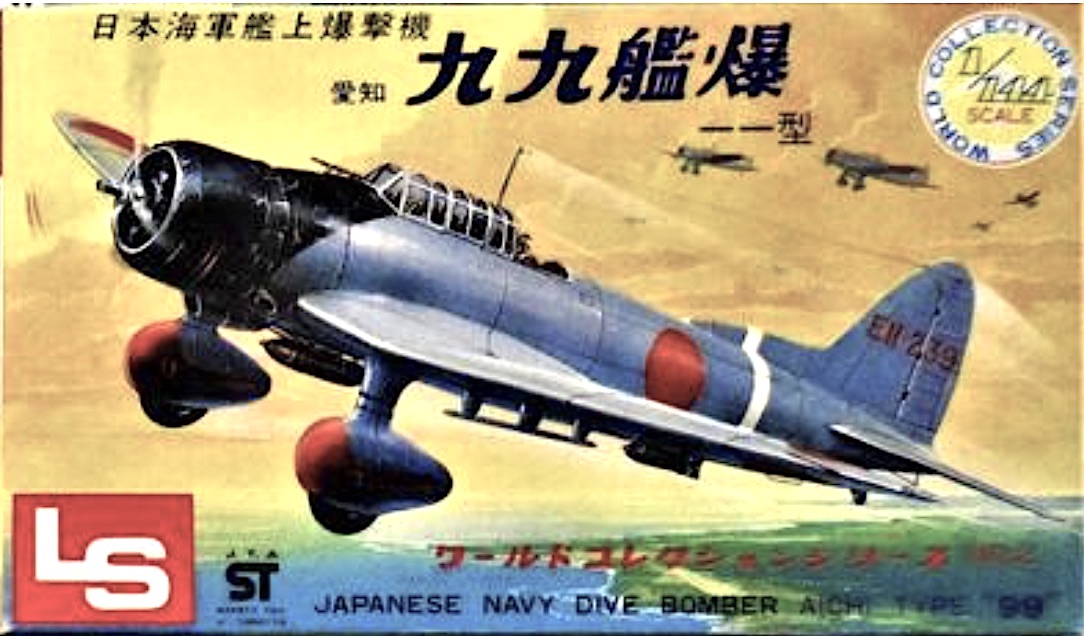
'In 2005 Monochrome released a very welcome kit for 1/144 modelers of the Aichi D3A1 'Val'.  There had been a couple of kits in the scale which took a stab at the type, including an LS kit from over 35 years ago, but this one was streets better. Its details, especially considering the scale, were superbly rendered, with the exception of the laughably thick dive brakes and overwrought panel lines. But those brakes could be scratchbuilt, I thought. These came with two kits in the box, with attractive decals a little spoiled by hinomaru that were too orange. So I found MYK decals that looked much better. I couldn't read the Japanese instructions for them, but decals are decals, right? 
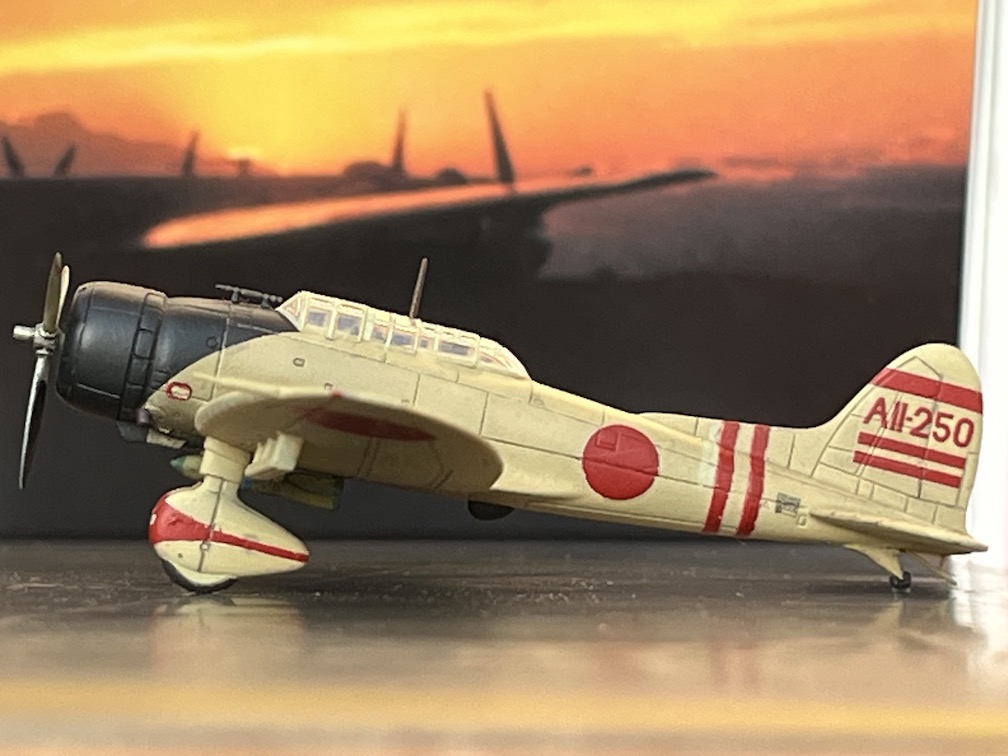

'Well sort of, it turned out.  The MYK decals were intended to have the carrier film gently removed after 24 hours, either with the tip of a blade or low-tack tape - a concept that works, but I knew nothing about it, and they curled up with handling in ways that I made worse trying to repair them. If knowledge is power, ignorance is trouble, and the build suffered, needing retouching, especially of the fuselage stripes and tail, which I had made worse. Eduard later used a similar type of decal, which some love and some hate. There are English instructions for the MYK decals now available online, which were also included in the instructions of their later releases. MYK decals are much harder to find now and often prohibitively expensive online - when one can find them. The earlier WWII Japanese ones have become quite rare. 


'This has one of my best cockpits in a model, as the kit gives a decent start and I had lots of info to try to approximate the rest. I had planned to open the pilot's canopy, but for some reason, I just couldn't pull a tight vac-formed copy of the canopy with clean edges, so used the over-thick kit canopy. In keeping with the rest of the project, I planned to use decals strips for canopy framing, but the same paint had a very different appearance when applied over the clear Monochrome plastic. Between this and the mess I made with the kit decals, I was discouraged with the project, and only finished it much later, sticking the terrible dive brakes on and calling it finished. However, I still like this model because the shape looks like a Val, a remarkably attractive design. And it's proof that it is better to finish an abandoned project than to abandon the project. And hopefully, encouragement to sooner or later build another and better one. 


'I'll close with a mystery. I opened by calling this a welcome release in 2005. But it immediately disappeared. If my old college roomie and modeling buddy P F Simmons hadn't presented me with the kit I would never have seen it. Then when I tried to get another from the same place where he found it, or any other place for that matter, no joy. Finally in the last few years, two friends who knew of this frustration found one for me at model shows, though not cheaply. While Trumpeter picked up the 1/144 Mavis and F-86 that Monochrome first released, the Val came and went very quickly, and looking at that invaluable site Scalemates, it notes only the 2005 release/boxing. Why it became a rare kit, I don't know.  There are only so many railroad or maritime accidents involving kit molds to go around :-)'


Mark Smith 
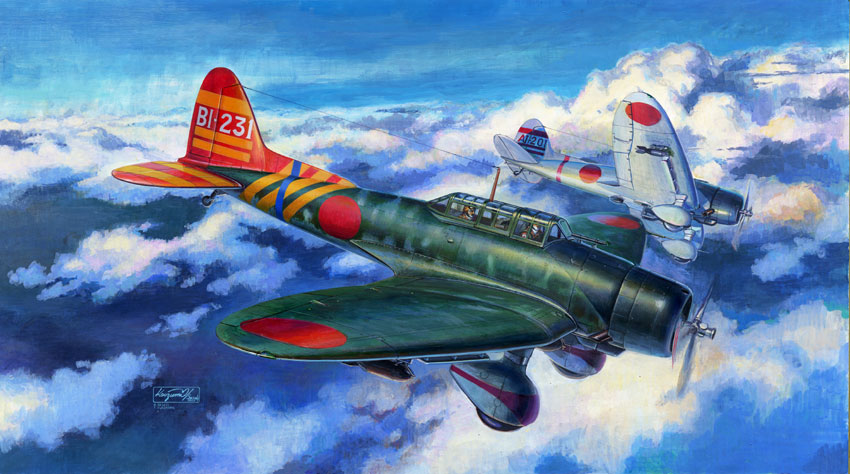
With special thank to Mark for sharing these images and notes. The Monochrome box art for the kit  is shown above. The relationship between Trumpeter and Monochrome for some kits seems obscure as to which is the 'chicken' and which the 'egg'.  In addition to the LS kit mentioned by Mark, shown below and later released as a double kit with the Aichi B7A2 'Grace', there was also a Crown kit issued in 1975. The Crown kit - and others - had originally been devised by Ikko-Mokei but were never released under that brand name and in 1979 were taken over and re-marketed by Arii. A D3A1 kit # H-1002 was also included in the Revell (Japan) 'Mini Series' range of 1/144 kits circa 1975 previously featured in the blog here. Not having seen an example of this kit I do not know if it originated from one of the kits described above.


Mini Series 1/144 D3A1 from Revell (Japan) Catalogue 1975 

Image credit: All model photos © 2025 Mark Smith; Box art © Monochrome, LS, Crown, Arii & Revell (Japan)

Saturday, 20 May 2023

Notice - Detailing the D3A1 by Ryan Toews


With the recent release of the Infinity Models 1/32 scale kit of the Aichi D3A1 attention is drawn to the excellent PDF 'Detailing the D3A1' by Ryan Toews as featured in this blog's sidebar and here. Please note that this PDF is not available from Aviation of Japan but can be requested direct from the author by clicking on the 'Request a copy' link in the sidebar. If you should encounter any problems using that please email me and I'll pass your request on to Ryan. 


Image credit: Profile and box art © 2023 Infinity Models 

Friday, 1 October 2021

Airfix Val Rides Again!


Airfix have announced the re-issue of their venerable 56 years old 1/72 Aichi D3A1 'Val' kit this autumn, presumably to coincide with the 80th anniversary of the attack on Pearl Harbor. The other two aircraft deployed in the attack, the Mitsubishi A6M2 Zero and Nakajima B5N2 'Kate', have both been released by Airfix in new tool versions but the price of the Val kit suggests it will be the original moulding perhaps, hopefully, with some cleaning up. The pre-order price of £9.99 is modest by currently ever increasing standards for kits but even so a far cry from the 3/-6 (three shillings and sixpence = 17.5p) of 1965.

The Airfix website shows the original Roy Cross artwork (above) but whether the kit is presented in that same guise or offers any new identity or warpaint remains to be seen. Despite its supposedly fatal flaws I have always rather liked this simple kit. The number available on eBay suggest that I am in a minority about that. Various improvements, including sanding off the rivet matrix, are easily accomplished and excellent replacement ordinance is now available via Ushi. Going the whole hog might include re-setting the angle of the undercart and replacing the crude interior of pegs and chairs with scratch-built plastic card, but with the canopy closed up very little can be seen. There is no doubt that a new tool Val in this scale would be welcome as the Fujimi alternative (cloned in poor imitation by ZTS Plastyk) is now in the hard to find category, also rather dated compared to current technologies, whilst the Dragon/Cyber Hobby kit (also released by Platz) is both flawed and expensive, costing even more than the superior Hasegawa 1/48 scale kit.  

Image credit: Box art © 2021 Airfix & Hornby Hobbies Ltd

Saturday, 20 March 2021

Jake - A Tale of Two Scales ~ Part 3

Continuing the season of IJN floatplanes with a follow up to Part 1 (way back in 2016) which promised a more detailed appraisal of the near 50 year old Hasegawa 1/72 scale kit of the Aichi E13A1 'Jake', also taking the opportunity to note two further releases since then, both in combo form with other kits. In 2018 the Jake was released in combo with the A6M2-N 'Rufe' to represent aircraft of the Kamikawa Maru (shown above), the kit offering optional decals for Z1-23 and ZI-26 based in Indo-China during December 1941, both in overall grey finish. A second  combo kit (shown below) was released in 2020 featuring 'Jake' with less well known markings options for 'Omi-4' (オミ-4) or 'Omi-5' and Kawanishi E7K1 Type 94 Model 1 'Alf' with markings options for 'Omi-3' and 'Omi-6' from the Ominato Ku. Ominato Ku established in 1933 and was based near the city of that name in Japan located in northern Honshu. The IJN's Ōminato Guard District (大湊警備府, Ōminato Keibifu) monitored the Tsugaru Strait between Honshu and Hokkaidō and patrolled the Hokkaidō, Karafuto and Kurile Islands coastlines.  It operated various aircraft types deployed for crew training, reconnaissance, escort duties and air defence . In December 1944 it was disbanded and incorporated into 90 Ku.


In both cases the box art presented a rather more agreeable profile of the aircraft than the assembled kit manages to achieve. At the time of writing it remains the only game in town in this scale, somewhat maligned and one of those kits much said to be in need of a better replacement. However from a cursory glance at eBay it seems to more than hold its own in terms of value on the second hand market. It was a Navy workhorse, used from first to last in many diverse roles, including strategic bombing in its long ranged attacks on the Canton-Hankow railway. 

For such a venerable and singular kit of an arguably significant, ubiquitous as well as iconic type the lack of aftermarket improvements and accessories for this kit is mysterious. There is a replacement vacform canopy by Falcon (which corrects the rake of the windscreen and the depth of the canopy), a set of canopy masks for the kit part by Dead Design, and a trio of Rising Decals sets to provide a replacement cowling with individual exhaust stacks, radar antennae and a 20mm cannon, each with relevant decals. There is also a dedicated decal sheet for the type from Print Scale - 72-206 - which offers no less than 13 markings options in both overall grey and green over grey. But there appears to be nothing to improve or replace the kit's sparse interior, not even a basic Airwaves etched sheet. A pity too that a beaching trolley was not included in the kit. At present therefore the modeller of Jake must resort to the time honoured use of plastic card and other improvised methods to enhance the model. 

Without comparing the kit to plans an impression is immediately given of a too short rear fuselage and a too tall canopy which starts the resultant model on an unfortunate journey towards a Nob caricature, detracting from the more svelte appearance of the original. The overall length of the original aircraft is variously given as 11.265 to 11.3 metres, measuring from the front of the floats to the rear of the tail cone, although the Shuppan-Kyodo Encyclopedia gives a curiously variable measurement of 11.49 to 11.30 metres. The only available 1/72 plans for this appraisal were those in Aviation News Vol.21 No.2 of June 1992 but examination revealed those are also slightly underscale, the length calculating to just 11.1 metres. The kit rear fuselage is the problem appearing too short from the rear of the canopy to the tailfin even when offered up to those plans and calculates as short by 6.25 mm in 1/72 scale to the original fuselage length. It should be feasible to cut the rear fuselage (at the rearmost panel line) and either to insert a laminated plastic card plug or 'girders' and filling to correct the length. The canopy is marginally too tall in profile, which emphasises the fuselage length issue, and the windscreen is not quite raked enough. The appearance can be improved either by judicious reduction of the canopy's lower edges or by replacement with the Falcon vacform canopy. 

The kit is flawed, but arguably not fatally, and there are positives, especially making allowance for its vintage.  Before the invention of fatal flaws and trial by online forum Scale Models magazine (August 1973) described the kit as 'charming' - 'well moulded in pale grey and, as usual, the surface detail is confined to panel lines, not an oversized rivet in sight! The model is straightforward to construct and the usual precision of this manufacturer's tooling leaves only a minimum of filling to be necessary.'

The moulding is on the whole delicate, with fine raised panel lines (which to re-engrave would not be too onerous a task) and fabric covered control surfaces perhaps better represented than in more recent kits from this manufacturer. The engine is a separate six part assembly with optional open or closed cowling flaps with commendably fine edges which can be further thinned with judicious use of wet'n'dry. In the original kit four separate open cowling panels were provided in order to display the engine, with the modeller requested to provide supports from wire or heat stretched sprue. That option has been omitted in more recent releases. Alternative early and later form exhausts are provided as well as the option for radar antennae. Additional struts were included to provide for early and late float configurations.

Engraving defines the centre section bomb-bay doors with their distinctive blisters but there is no provision to model them open and no ordnance is included. Jake could carry two 60kg bombs inclined in the bomb bay (hence the blisters) and a further two 60kg bombs on external racks outboard of the centre section. Alternatively a single 250kg bomb could be carried externally under the centre section on a rack offset to port. All of this lethality can be added by the intrepid modeller and excellent 3D moulded IJN ordnance sets are now available from Ushi (blissfully without the need to bend and fiddle photo-etched fins onto resin bomb casings).

The under fuselage windows are included as transparencies. Maru Mechanic identifies the starboard window for bomb aiming and the port window for photo-reconnaissance. The central navigator/bomb-aimer was equipped with a tubular bombsight which was stored on the port cockpit wall and could be inserted into a gimbal in the bomb-aiming window when required. Cockpit detail in the kit consists of a crude floor tray with three seats and three identical crewmen. In the earlier kits a single instrument panel for the pilot was included but in later kits a second panel for the navigator/bomb-aimer has been added. Further detail is limited to the A-frame behind the pilot's head and an RDF loop, both to be added to the fuselage decking beneath the canopy. Although not much is to be seen there is plenty of scope for improving the cockpit by building on the kit floor, whilst the kit supplied seats are not bad and a definite improvement on the 'armchairs' in the Betty kit. For the more intrepid modeller a folded wing presentation is always possible. So far then, all is not lost and for adding more detail Maru Mechanic is your friend. As Bill Bailey might say:- "Not too bad - all things considered". 

Cockpit colour is a grey-green, similar to FS 24226, with a darker green for various components such as radio sets. For the overall grey versions a choice between the greenish grey of J3 (approx FS 16307) or the amber grey (approx FS 16350) of the Aichi D3A1 'Val' is a matter for the modeller. The Hasegawa combo box art chanels Maru Mechanic's unconvincing light grey white but the instructions suggest Mr Color 35 IJN Gray Mitsubishi which is a blueish grey as measured (H61 IJN Gray is closer to J3 and was suggested in some earlier releases).  For the upper surface dark green the slightly more greenish D2 (approx FS 14056) is probably a better bet. The wing walkway lines, often depicted as yellow, should be silver. The diagonal stripes often applied to the tailplanes, and sometimes the inboard wing leading edge, were not as often suggested guidance for the gunner but rather for the navigator to calculate wind drift with the use of smoke floats or dye markers. Some kit releases suggest Gunze H339 for the underside of floats on all grey examples without listing that in the paint colours table. It is Engine Gray FS 16081. 

Update: A listing of additional Hasegawa 'Jake' kits released since this blog article may be found here.

Image credit: Box art and catalogue image © 1978, 2018 & 2020 Hasegawa Corp.; Review kit photo © 1973 P Kirby via Scale Models magazine (Model & Allied Publications Ltd.); Kit part schematics © 2021 Aviation of Japan

Monday, 22 February 2021

Detailing the D3A1

Ryan Toews has recently completed and shared a very fine analysis illustrating a number of details of the Aichi D3A1 'Val', Type 99 Carrier Bomber (99 Shiki Kanjoh Bakugeki-ki - 九九式艦上爆撃機) known as 99 Kanbaku (九九艦爆) with an important goal being to compile a list of modifications and/or additions applicable to the 1/48 Hasegawa kit. The 19-page PDF 'Detailing the D3A1' presents full text with photos, schematics and colour data (sample page thumbnail below) and is available from Ryan on request. A direct link for requesting this PDF has now been added to the sidebar below the blog archive. 

With special thanks to Ryan for sharing this excellent and valuable study and very kindly offering it to others via Aviation of Japan. 

Image credit: Profile © 2013 Hasegawa Corp; Sample Page © 2021 Ryan Toews

Wednesday, 10 February 2021

A 1/32 scale Aichi D3A1 'Val' from Infinity Models

I'm very grateful to several correspondents for alerting me to news of this kit at around the same time and apologise for the time it has taken to mention it here. My thanks to all of you who very kindly sent me emails about it or mentioned it in other emails. The kit has not been released yet but details and progress may be found on the Infinity Models webpage. That suggests that there will be at least two markings options, for the well-known and colourful B1-231 of Lt Cdr Takashige Egusa (although uncoded in the website profile) from Soryu and the overall grey houkoku-adorned AII-256 of Flyers 4/c Shinsaku Yamakawa and Katuzô Nakata from Kaga. The aircraft depicted on the box art is another grey or perhaps slightly greyish-green (!) E1-231 from Shôkaku - all being Pearl Harbor attackers.

Regarding the colour of 'Val', over the years the late and sadly missed Jim Lansdale shared a wealth of valuable paint colour data at j-aircraft.com and via email from various actual D3A1 relics. Broadly speaking those all fall within a category of a warm to distinctly brownish amber grey, with somewhat fugitive greenish undertone, the wartime appearance of which was probably not that far from the box art depiction of EII-233 from Zuikaku for the 1970s Bandai 1/50 scale D3A1 kit (shown below). More precise colour presentations for 'Val' closer to release.

The Infinity Models kit will build into an impressive model of 'Val' with a wingspan of just over 17.5 inches and a length of just over 12.5 inches, but it doesn't appear to have an option for folding wing tips!   

Also being re-released in the autumn is the venerable 1/72 D3A1 kit from Airfix, (original box art by Roy Cross above), unfortunately not (it seems) a new tool to accompany their more recent A6M2 and B5N2 for the 80th anniversary of the attack on Pearl Harbor. What a pity because none of the currently available 1/72 kits of 'Val' are without issues. The three box arts shown here usefully present the three main and competing perceptions of D3A1 colour.

Image credit: Infinity Models box art © 2021; Bandai box art © 1970s; Airfix box art © 2021

Sunday, 1 September 2019

More Dead Design Goodies - 1/72 scale


Jan Hajicek's prolific Dead Design Models has recently released a plethora of goodies to enhance many different Japanese subject kits in both 1/72 and 1/48 scales. They include canopy masks, a real boon for those with older but still decent kits in their stashes, vacform canopy replacements, resin replacement control surfaces and 'Optical Illusion' masks for control surfaces. 

 VM72056 Canopy & Glazing Masks for the Arii (ex-LS) C5M2 Kit

Released in June were canopy masks for the following 1/72 kits:-

VM72006 Fine Molds Ki-61-1 Hien Otsu/Hei - includes wing light and main wheel discs
VM72009 Dragon Ki-61 Hien -includes wing light and main wheel discs
VM72038 Fine Molds A6M2/3 Model 21, 22 and 32 Zero - open + closed canopy and main wheel discs
VM72039 Fine Molds A6M5 Model 52 Zero - - open + closed canopy and main wheel discs  (see heading photo)
VM72042 Sword J2M5 Raiden  - includes main wheel discs
VM72050 Hasegawa Ki-51 Sonia - includes side and ventral glazing plus main wheel discs
VM72051 Fujimi B6N1/2 Tenzan - includes side and ventral glazing plus main wheel discs
VM72053 Sword Ki-84 Hayate - includes main wheel discs
VM72054 Sword C6N1/1-S Saiun - includes ventral glazing and main wheel discs 
VM72055 Fujimi C6N1/2 Saiun - includes ventral glazing and main wheel discs 
VM72056 Arii (ex-LS) C5M2 Babs - includes side, ventral and wing light glazing, plus main wheel discs (shown above)
VM7263 Fine Molds A7M1/2 Reppu - includes bullet proof glass and main wheel discs 
VM72064 Sword Tachikawa Ki-106 - includes main wheel discs
VM72065 RS Models Nakajima Ki-87 - includes all wheel discs 
VM72066 RS Models Tachikawa Ki-94 II - includes main wheel discs
VM72067 Clear Prop! Mitsubishi A5M2b Early - includes main wheel discs

In addition set VM72068 provides masks for national insignia to replace the decals in Clear Prop! Mitsubishi A5M2b Early.


SM72004 is an innovative 'Optical Illusion' mask (shown above) for creating a rib and fabric effect on both surfaces of the ailerons, elevators and rudder of the Fujimi or AVI Models family of kits of the Mitsubishi A5M Claude.  

VM72070 Canopy Mask for Hasegawa Ki-46-II  'Dinah' Trainer

In August the following 1/72 canopy masks were added to the range:-

VM72022 Aoshima Ki-61-1d - with main wheel discs
VM72023 Aoshima Ki-61-II (Fastback) 
VM72024 Aoshima Ki-61-II (Bubbletop)
VM72025 Aoshima Ki-100 I (Fastback)
VM72026 Aoshima Ki-100 I (Bubbletop)
VM72027 Fujimi Ki-36/55 Ida - includes side and ventral glazing
VM72047 Hasegawa Ki-46-II - includes all glazing
VM72049 Hasegawa Ki-46-III - includes all glazing
VM72069 Hasegawa Ki-46-III Kai Interceptor - includes all glazing
VM72070 Hasegawa Ki-46-II Trainer  (shown above) - includes all glazing
VM72071 Fujimi D3A1 Val - includes all glazing
VM72072 Fujimi D3A2 Val - includes all glazing
VM72073 Fine Molds A6M1/2a - includes both canopies
VM72075 Hasegawa J7W Shinden

VM72074 National Insignia Masks for Fine Molds A6M1/2a Combo Kit

In addition set VM72074 provides masks for national insignia and tail codes to replace the decals for both versions in Fine Molds A6M21/2a combo kits (shown above). 

SM72001 'Optical Illusion' Mask for control surfaces of Fine Molds Ki-43-1 Hayabusa Kit

And the following additional 'Optical Illusion' masks for control surfaces:-

SM72001 Fine Molds Ki-43-1 Hayabusa control surfaces (shown above)
SM72002 Fujimi Ki-43-1 Hayabusa control surfaces
SM72003 Tamiya Ki-61-1d control surfaces
SM72005 Fine Molds A6M21/2a - both versions
SM72006 Aoshima Ki-61-1/II Hien & Ki-100
SM72007 Fine Molds Ki-61-1Hien

 RM72003 Corrected Control Surfaces for Fujimi/AVI Models A5M Claude Kit

In addition set RM72003 provides corrected control surfaces in resin for Fujimi/AVI Models A5M Claude kit (shown above).

With special thanks to Jan for sharing details of these useful and innovative enhancements to 1/72 Japanese aircraft models.   

Image credit: All © 2019 Jan Hajicek and Dead Design Models


Wednesday, 31 August 2016

IPMS USA Nats Display ~ Part Three

More pics from the IPMS USA Nats courtesy of Ken Glass. This time all IJN subjects again. Please do get in touch to correct or add any attributions, thanks.  My presumption about the origin of that nice Ki-43-I model published yesterday was wrong and I have now updated the blog article and added another pic. I should have known better because Ken had already identified the manufacturer on each pic and that one was coded 'Has' . . . 

Ken has since told me that he couldn't get a shot at a low enough angle to capture the kit's 'broken-backed' appearance but that it could certainly be seen by the unaided eye. In case anyone wonders what I'm on about all is revealed here although focussing on the Ki-43-II kit. The Hasegawa kits appear to be based on the Matsuba Minoru plans which show on both the Ki-43-I and Ki-43-II a distinct re-angling of the upper fuselage line from the rear of the cockpit that is not evident from photographs and has the unfortunate effect of disfiguring the aircraft's true aerodynamic form.


This impressive Aichi D3A1 'Val' on carrier deck display was built from the Hasegawa 1/48 kit - unfortunately builder unknown. Good looking colour choice on the model. 'EI-201' led the 21st Section of the 1st Hikotai from the carrier Shokaku during the first wave dive-bombing at Pearl Harbor and was flown by Lt Masao Yamaguchi with NAP1/c Fumio Sumeno as his observer-gunner.


Another Pearl Harbor 'Val' from the Hasegawa 1/48 kit, this time crafted by Craig Livingston and displayed on a mirror base with the canopies opened and the rear gun deployed. This aircraft 'BI-231' was flown by Lt Cmdr Takashige Egusa with  PO Tatsu Ishi as his observer-gunner. Egusa led the second wave dive-bombing attack at Pearl Harbor from the carrier Soryu, releasing his bombs against the USS New Orleans. The garish colour scheme, said to have been applied to aid identification and reforming and for which the aircraft was reportedly nicknamed 'jajauma' (じゃじゃうま) has been variously interpreted over the years but Craig's model appears to be based on the convincing profile and first hand descriptions in Sam Tagaya's excellent Osprey title 'Aichi 99 Kanbaku 'Val' Units 1937-42', # 63 in their Combat Aircraft series. Sam states that 'jajauma' refers to a ceremonial horse adorned in red but dictionaries also describe it as a colloquial term for a restive horse or a shrewish, unmanageable woman!


This Nakajima B5N2 'Kate' displayed with wings folded was built from the Hasegawa 1/48 kit and represents 'AI-301', the famous lead aircraft of the first wave level bombing attack against Pearl Harbor commanded by Mitsuo Fuchida (as navigator-observer) with Lt Mitsuo Matsuzaki as pilot and PO1/c Tokunobu Mizuki as radio operator-gunner. The actual colour schemes of the Pearl Harbor Kates have long been in contention due to various depictions and sometimes conflicting descriptions so modellers are blessed with the opportunity for personal interpretations.


This formidable looking Aichi B7A2 'Grace' torpedo bomber was built from the Hasegawa 1/48 kit and displayed on a splendid Rising Sun base with black and gold nameplate. The model represents 'Yo-251', an aircraft of the Yokosuka Kokutai's 2nd Hikotai in Japan during the summer of 1944. Ken believes the model was crafted by Randy Lutz who had cited a Swedish camouflage colour for the topside black green. And very good it looks too - although perhaps just a wee bit too matt for an aircraft in service. 


This Tamiya Mitsubishi G4M1 'Betty' in 1/48 scale is believed to have cbeen built by Andrew Frill and represents a moderately weathered bird, probably from 702 Ku (although I don't recognise that particular tail number and stripe combination), with what looks like a replacement starboard flap.  and the unusual flag-type fuselage Hinomaru.


Another Tamiya G4M1, this time '359' of 3rd Chutai, 705 Ku operating from Rabaul circa 1943 and displayed in a pristine albeit very matt condition as suggested by photos.  


Dropping a couple of scales now for a topical Kawanishi H8K2 'Emiy' flying boat made from the very nice LS/Arii 1/144 scale kit by David Pratt. In 2010 Rob Taurus of the Czech Republic released a comprehensive detailing set for this kit which included resin engines and beaching wheels, vacform canopy replacements and a photo-etch sheet, but I do not know if it was used for this model which represents a flying boat of the 3rd Hikotai of 801 Ku based at Yokohama, Japan during 1945. 


And finally a Mitsubishi J2M3 Raiden of 302 Ku made from the Hasegawa 1/48 kit.

That's all for now folks! More to follow. With special thanks to Ken Glass for taking the pics and sharing them.
  
Image credits: All photos © 2016 Ken Glass; formatting, presentation and write-ups by 'Straggler'

Thursday, 25 August 2016

Airfix 1/72 Nakajima B5N1 'Kate'


The new Airfix B5N1 is now out and very nice it is too. Essentially the same as the previous B5N2 kit but with a new sprue for the forward fuselage, engine and cowling. Decals are included for the very colourful 'CI-301' of 3 Ku operating off the carrier Zuiho in 1941 or '9 over 348', a green and brown field-camouflaged example from 14 Ku operating from Sanzao Dao in South China during 1938-39. The decal sheet is sharply printed in good colour by Cartograf and includes stenciling, wing walkways and instrument panels for pilot and navigator (not strictly accurate for the latter). The painting and decal instructions are in full colour with closest Humbrol paints called out to avoid mixing. 


Moulded crisply in light grey plastic with engraved details, features of the kit include the option to display the finished model with the wings folded. Sensibly the wing parts are provided as single upper and lower halves which need to be cut for folding with rib frame inserts for the open ends. In addition the flaps can be fitted in the lowered position and the ailerons, rudder and elevators are all separate pieces to permit animation. The panel lines are finely engraved and the representation of the fabric covered components with light dishing between ribs is superior to that in many Japanese kits where the ribs are moulded as hard raised lines above the aerofoil surface. A fairly detailed interior benefits from another option to show the canopies open - no cutting this time as alternative parts are included. A nice touch is a third alternative for a closed canopy for pilot and navigator but with the rear canopy fairing open and the radio operator's gun deployed for action. In the kit examined for this brief in-box review the clear parts are perfect with none of the unfortunate moulding flaws found in some other Airfix kits recently. A full crew of three is also included so with imagination the canopy and flying control options will permit the creation of dramatic in-flight displays. The detailed instructions include the need to cut off the indicator pins on the top surface of the wings if a retracted undercarriage is selected.

The kit contains the same selection of ordinance as for the B5N2 but with options in the instructions only for the torpedo armed aircraft or an aircraft loaded with six Type 97 No.6 60kg bombs for attacking land targets - a suitable load for the 14 Ku option. This provides a spare Type 98 No.25 250 kg bomb (parts 03 and 04 on Frame D) to make up the deficit for a staggered twin bomb option in the B5N2 kit. These and the larger bombs can also be put to use in other kits. 

The glitch in the otherwise superb box art is my fault. Here the fatal eror of presuming rather than checking occurred and I suggested that the red fuselage stripe on CI-301 was a command marking rather than common to reserve fleet aircraft as is now apparent. The artist Adam Tooby had it correct from the start with the aircraft in the background also bearing the stripes and subsequently modified it only at my suggestion. So please blame me rather than Adam or Airfix research.  Mea culpa!

This is an impressive kit of a historically important aircraft showing great attention to detail by Airfix and offering the opportunity for creative and imaginative displays. It really does render the veteran Mania/Hasegawa kit obsolete. With the fine Airfix A6M2 the Pearl Harbor trio is almost complete but sadly a re-tooled D3A1 seems unlikely. I should love to see a new Airfix kit of that type to the same quality as this fine production.

Image credit: Box art © 2016 Hornby Hobbies Ltd


Saturday, 20 February 2016

Jan Voorbij's 1/72 Aichi D3A1 'Val'


Jan Voorbij from the Netherlands has very kindly shared these images and build report of his delightful Aichi D3A1 'Val' model in 1/72nd scale.  The model was built from the latest release of the venerable 51 year old Airfix kit. Aviation of Japan readers will know that this kit, so often maligned elsewhere, is always welcome here. I can remember when it first appeared too, and how much appreciated it was in an era when so few kits of Japanese aircraft were available. "Eye-key Dai-Val' we called it then, in our ignorance. It is rightly a classic, to be built and enjoyed without qualms.


Aichi D3A1 Type 99 Model 11 ('Val')
Imperial Japanese Navy, Carrier Division 1, Carrier Kaga
December 1942 - March 1942
Crew: F1c Shinsaku Yamakawa (pilot) and F1C Katuzo Nakata (gunner, radio operator)

"I first built this kit when I was a 12 year old youngster, attracted by the box art, and revisited it now, at the age of 62 - how times flies. . . It was originally released in 1965 and this one is a rebox from 2011 with new, very good decals. I chose it this time for a project that I had started about the air war over the Dutch East Indies in early 1942. 


"F1/c Yamakawa’s Type 99 is seen here in standard Kaga markings and early war finish. This aircraft was a presentation machine as shown by the inscription on the rear fuselage superimposed over the twin red stripes. This reads 'Hokoku  522 (Dai55 Zen Nippon G)' denoting that it was the 522nd aircraft presented to the IJN and the 55th machine purchased by nationwide subscription. In this particular case the aeroplane was purchased by student donations from girls’ schools throughout Japan.


"Yamakawa flew this aircraft from Pearl Harbor through to the anti-shipping sweep south of Java in March 1942. All presentation weapons, including aircraft, for the IJN were referred to as hokoku, (Ed: 報國) while those for the Imperial Army were called aikoku (Ed: 愛国). Both terms may be translated as ‘patriot’or ‘patriotism’, although the literal translation for hokoku is ‘service to country’, while aikoku is ‘love of country’. Yamakawa’s dive-bomber also sports a different style of flash marking seen on the wheel covers of some Kaga  aeroplanes, with the upper and lower edges converging in a straight line instead of a curve. The difference between the two styles probably reflects separate maintenance buntai assignments for the aircraft. Finally, note the white stencilling block on the side of the engine cowling. This served as a handily placed checklist for Type 99 engine maintenance personnel.  


"I decided to experiment with a different approach: instead of building the kit according to the instructions I wanted it to show that it was a carrier borne aircraft with its wing tips folded. This took a lot of precise measuring and sawing; a tricky job indeed. The Hinomaru decals had to be cut in two, as they were positioned across the fold. I used reference pics to imitate the construction of the wingtips and how they were attached to the wings showing some tubes (bars?) in the mechanism that moved them up or down. A problem that I could not solve to my satisfaction was the canopies. I wanted to display them open, so that the personnel and the scratched interior would be visible. For the gunner's position this meant that the rear parts of the canopy should be placed on top of each other. However, like most of the 1960s Airfix kits, the transparencies are too thickly moulded so this was nor feasible. Therefore I decided to leave the rear part off as it isn't noticed if one doesn't look too closely ;-)


"The kit went well together and there was not much putty needed to fill the gaps. I added two small bombs from the spares box to the wings. For the overall paintjob I decided to choose Tamya XF-76 IJN Grey Green (instead of Humbrol 90 Beige Green the Airfix recommendation). To add weathering I used a dark grey wash and conté pencils. A HB pencil was used to lighten up the rivets.
 

"There is one other omission - there are no small decals with the number '256' that should be displayed on the front of the wheel spats. All in all, despite some shortcomings, this is a kit I would like to recommend and I very much enjoyed building it."
 
Jan Voorbij
 
References:

Tagaya Osamu, 'Aichi 99 Kanbaku 'Val' Units 1937-42 (Osprey Publishing 2011)
Francilion René J, 'Imperial Japanese Navy  Bombers of World War Two' (Hylton Lacy Publishers Ltd 1969)

With special thanks to Jan for sharing the images of his model and build report here. Incidentally, the subject of Jan's model is featured as Profile 9, painted by Jim Laurier, in Osamu Tagaya's superb Osprey book on Kanbaku units.

Image credits: All © 2016 Jan Voorbij