Saturday, 9 July 2022

Woody Kubacki's 1/48 Mitsubishi Raiden Duo # 1

Following up on the Rising Decals Raiden sheet it is a real pleasure to share these images of Woody Kubacki's superb 1/48 models of Mitsubishi Raiden, built from the Hasegawa kits. First up is his J2M3 Raiden of 332 Ku. Woody provided details of his project as follows:-

'The cockpit was detailed with additional wire and levers and the radio was scratchbuilt as I believe that the kit radio was far too small.

'The kit went together fairly well, with most of the filling and sanding required to fit the upper decking to the fuselage (there is a seam most leave but it has to be filled) and the front cowl. I decided to rivet the entire plane and designed templates for each line, cutting them out on my Cameo 4 cutter. The model was primed in Gunze Mr.Finishing Surfacer 1500 Black, selected areas were sprayed with Mr Color C8 silver, and then hairspray to represent chipping, black base and top coat. The masks for the markings were also designed and cut on my Cameo 4, leaving only three decals to apply.

'The model represents an aircraft from the 332 Kokutai sometime in 1945. I don't know much about the history of the plane or who flew it, but I do have one photo of it, with two pilots (clearly friends) in front of it. Actually, their comraderie and anonymity is what drew me to this particular aircraft.

'The model was painted with AK Real Colors (Mitsubishi interior colour, D2, Olive grey (mixed with 10% white) and Mr Color paints then weathered with various oils.  During my research for this build, I noticed that despite many Raiden having chipped or flaking paint, the overall finish was fairly glossy, and that is what I attempted to achieve.'

Woody's attention to detail is very impressive, based on his extensive and careful study of photographs and film. Close examination of the model photos will repay appreciation for his work (click on the images and then re-open them in a new tab or screen to enlarge them to full size). 

332 Ku was established in August 1944 under Cdr Takeo Shibata for the air defence of the Kure area, Japan with a mixed complement of Zero fighters, Raiden and Gekko night fighters. A Zero contingent under Ltjg Susumu Takeda departed to the Philippines in November of that year and in Japan the unit also became responsible for defending the Hanshin area, a detachment of Zeros and Raiden moving to Naruo whilst the Gekko contingent moved to Itami. On 22 December 1944 CPO Akeshi Ochi claimed the the first B-29 of the unit flying Raiden 32-101 and was presented with a bottle of whisky by Cdr Shibata. In February 1945 Cdr Katsutoshi Yagi took command of the unit. 

When the B-29 force began bombing Kyushu during the Okinawa campaign 17 Raiden of the unit under the command of Lt Kohei Nakajima moved to Kanoya to form a combined air defence force with 20 Raiden of 302 Ku under Lt Susumu Itoh and 7 Raiden of 352 Ku under Lt Yoshihiro Aoki as the Tatsumaki (竜巻 - Tornado) group, operating from the end of April to 12 May 1945. Subsequently the unit was re-organised with a planned strength of 48 Raiden and 24 Gekko. Ensign Susumu Ishihara was a notable veteran pilot who served in 332 Ku from its establishment until war's end flying both Zero and Raiden against the B-29 with officially recognised claims for 16 victories (including previous claims with Tainan, 582, 204 and 202 Ku) but was reputed to have achieved more than 30 in total. 

With special thanks to Woody for sharing these images of his superbly convincing Raiden model.

Image credit: All photos © 2022 Woody Kubacki 

Saturday, 25 June 2022

Raiden from Rising

RD72099 is one of three splendid Rising Decals sheets for IJN fighters in 1/72 scale with markings for eight Mitsubishi Raiden subjects as follows:-

  • J2M3 Model 21 '3525-50' of 352 Ku at Omura in March 1945 - a speculative depiction of an aircraft with a large yellow lightning flash on the fuselage in D1 Deep Green Black over J3 Grey. The suggested paint for the upper surface Mr Color 124 Dark Green (Mitsubishi) is closer to D2 Green Black but lighter and greener. Mr Color 35 IJN Grey (Mitsubishi) is suggested for the under surface colour and this is the current 'go to' fad in Japan supposed to represent J3 Hai iro. However Mr Color 35 is a blueish grey - a Munsell B - Blue - and not the supposedly 'neutral grey' of J3, which is, er, not a neutral grey of pure black and white anyway but a Munsell GY - Green Yellow! The original paint was a 'warm', slightly yellowish grey similar to RAL 7034 Gelbgrau (Yellow grey) which chalked with exposure to an appearance similar to FS 36307. J3/2-6 is also close to FS 36307, thus whatever your paint poison all bets should be covered, so don't let Facebook grind you down.     
  • J2M6 Model 31 '352-18' of 352 Ku in Japan, 1945 - D1 over J3
  • J2M3 Model 21 '02-615' of 602nd Hikotai, 381 Ku at Balipapan, Autumn 1944  - D1 over J3. The tail code is depicted as yellow but could have been white and both options are usefully included on the sheet. Raiden is most often associated with the air defence of Japan so subjects representing units operating elsewhere, as in this case for defence of the Borneo oil facilities, are especially welcome.  
  • J2M3 Model 21 'B1-01' of 381 Ku at Singapore, 1945 - D1 over J3. This aircraft was subsequently test flown by ATAIU-SEA with RAF markings. 
  • J2M2 Model 11 '32-101' of 332 Ku at Naruo, Japan in 1944 - D1 over J3. Flown by CPO Akeshi Ochi on 22 December 1944 to claim the unit's first B-29. The white borders of the upper wing and fuselage hinomaru have been over painted in dark green or black.  
  • J2M2 Model 11 '81-101' of 381 Ku at Nagoya, Japan in September 1945 - D1 over J3. An aircraft which had been returned to the Mitsubishi factory for evaluation due to technical problems 
  • J2M3 Model 21 '81-124' of 381 Ku in the Philippines, late 1944 - D1 over J3. 
  • J2M2 'YoC-104' of 301 Ku at Oppama, Japan, December 1943 - overall orange-yellow. A 14-Shi interceptor trial aircraft.


Recommended kits are Sword and Hasegawa, the latter a J2M3 from 1977 but with engraved panel lines and still intermittently available, also in combi special editions from time to time. Sword offered three Raiden kits: the J2M3 Model 21 from 2011; the J2M5/6 Model 33/31 from 2012; and the J2M2 Model 11 Late Version from 2015, although all now seem hard to find. No doubt these decals could also be adapted for the old Tamiya and Nichimo kits for some upgraded retro modelling. Raiden is seemingly a 'marmite' subject, either strongly liked or disliked, and true enough schemes and markings for the type offer little variety. However this set offers something different from the classic and well-known 302 Ku schemes, some of which feature on Rising sheet RD72094 here. The 381 Ku examples are especially welcome but sadly Raiden subjects from the China-based units are conspicuous by their absence.  Maybe next time . . . 

With special thanks to Mirek of Rising Decals for the review sheet and apologies for the delay in presenting it. Late to the party as usual. 

Image credit: All © 2022 Rising Decals  

Thursday, 2 June 2022

More John Haas Magic Part Two


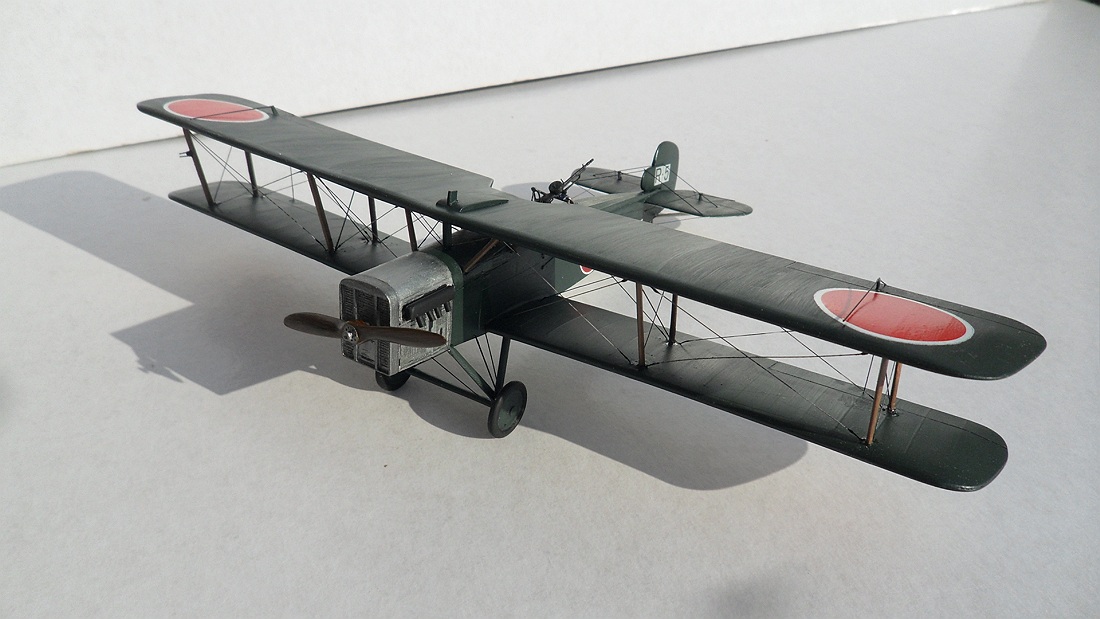
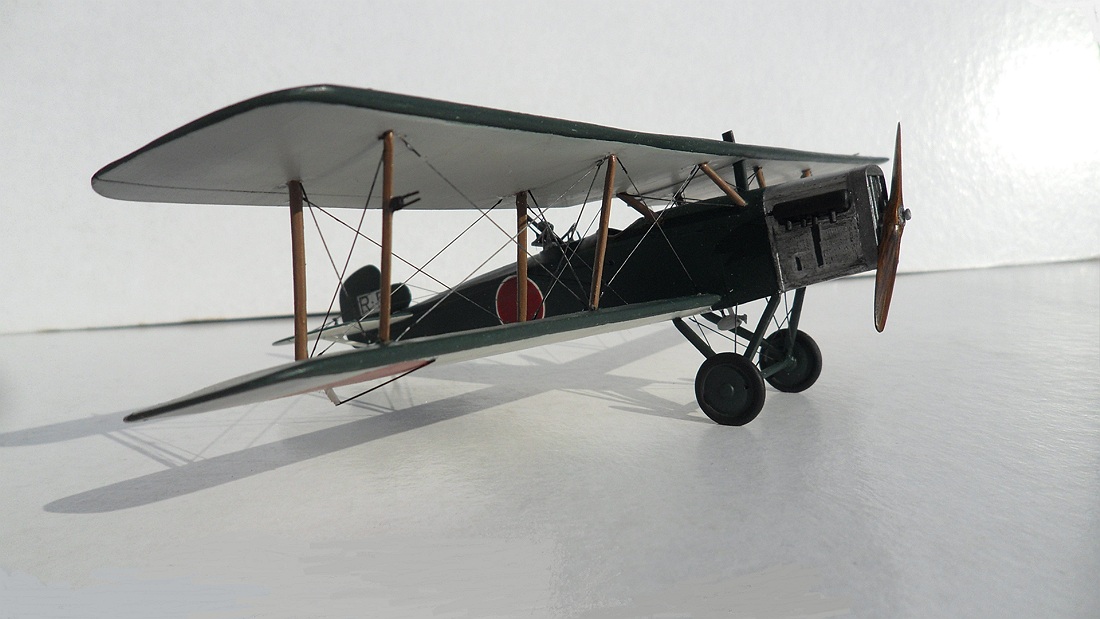
Here, later than planned, is the second part of John Haas' wonderful scratch build of the Navy Type 10 Carrier Reconnaissance Aircraft, Mitsubishi 2MR1 in 1/48 scale. Over to John for his build report then.

'Firstly, I would like to thank all the members for their nice comments after Part One. Now my model was more or less complete, the rigging between the wings, undercarriage and tail feathers were in place, so it was time to do some more painting.

'I always use an undercoat of Polly S Acryl dark green first, then a final coat of JNAF dark green. The sides of the fuselage were left unpainted to avoid any damaged through handling as you can see on the first pictures. All painting was done with a brush as it is hardly possible to tape and spray these biplane models without damage. Only on the wing leading edges I used a small piece of tape to get a straight line between the green and grey. The engine panels and the radiator were painted silver, with a drawing pencil, I added some accents for the louvres and panel lines.

'Now I could start with some smaller details. First I made a scarff- ring for the second cockpit. Again I had to use photos of other aircraft; I modified a leftover Vickers MG from a Roden RAF Be-2C; and Francillon's book was a great help in this.

'The next step was the aileron and rudder cables and their levers. On the wings they are placed over the Hinomaru, so I used some decals from the spare box and placed them on the wings. The rudder cables were a bit more complicated, first I had to paint the fuselage in green, then wait a few days, and yes: ....watching the paint dry....:-)

'After the fuselage Hinomaru, I could start the tricky job of getting the rudder cables in the right place. A lot of patience was required here, as there were only very small spots to apply the CA glue. And those cables, you want them straight and tight. I had to print the white squere with black number on the rudder on my PC.

'Now the end was in sight, I added a small indentification plate on the left side of the fuselage and as finishing touch, a small wind driven generator was placed between the undercarriage legs. The rigging of the undercarriage was made of stretched sprue. So finally my model was finished. I hope you enjoy the pictures ! After taking the final photographs, I dicovered a loose aileron- cable on the upper left wing! That's fixed now....(smile).'

With special thanks to John for sharing the details and images of his impressive scratch build and for his patience in waiting for them to appear here.

Image credit: All photos © 2022 John Haas


Tuesday, 10 May 2022

Update - Arma Hobby Ki-84

Another hat tip to Warren for kindly providing a link to an in-box review of the 1/72 Arma Hobby Nakajima Ki-84 Hayate kit, with the link now added as an update to the original blog announcement. 

Also, thank you to all those who have kindly sent me alerts about the forthcoming Special Hobby Mitsubishi Ki-21 'Sally' kit in 1/72 scale. 

Saturday, 19 March 2022

New 1/72 Hayate!

A hat tip to Warren for kindly alerting me to this forthcoming surprise release by Arma Hobby of a new Nakajima Ki-84 Hayate kit in the divine scale. Judging by their previous kits it should be a good one and will relegate previous kits in this scale to secondary consideration. 

The 'expert set' kit due out in April this year offers Ko or Otsu versions of the fighter with photo-etch and a comprehensive decal sheet with options for a well-chosen variety of schemes and markings. The box art nicely reflects Revell's classic 1966 kit in 104 Sentai guise as painted by Brian Knight, but correctly depicts the yellow trim and wingtips of 2nd Chutai leader Lt Mitsuo Tomiya's Hayate.  Other markings options are as follows:-

  • Ki-84 '46' of 2 Chutai, 11 Sentai; this is the surviving airframe originally captured in the Philippines. Hayate s/n 1446 was manufactured in December 1944 so should have been in the factory scheme of olive drab, rather than green, over a brownish grey
  • Ki-84 '29' of 10 Rensei Hikotai (練成飛行隊 - Training Transformation Air Unit) in unpainted, overall natural metal finish
  • Ki-84 '45' of Sakura-tai, 47 Sentai in the factory scheme as flown by Capt Tei-ichi Hatano during the February 1945 air defence sorties against US carrier task force raids
  • Ki-84 of 57 Shinbu-tai, one of 15 special attack units organised from within the Akeno Training Air Division in March 1945. It completed training at Shimodate and became operational at the end of May for attacks against US ships off Okinawa   
  • Ki-84 of 2nd Yuso Hikotai of the Army Transport Unit at Ota, the Nakajima factory airfield; this white tiger adorned Hayate with unusual reticulated 'giraffe' camouflage was flown by Lt Shuho Yamana of that unit from Ota to the Army Air Depot in Saigon towards the end of 1944 for delivery to a combat unit. The unusual reticulated scheme was seen on some Hayabusa and Hien aircraft as well as Hayate. The tiger was painted on the tail freehand by Lt Terai, the commander of the Seibi Shotai maintenance section of the unit, and differed on each side of the tail fin. It signified the Chinese mythology that a tiger could travel a great distance and return within a single day. 
Follow the link above to see the profiles of these subjects at the Arma Hobby website. Thoughts on Hayate schemes were featured at the blog in November 2013 and November 2014 but a consideration of the reticulated scheme was never completed. Arma Hobby's new kit might inspire that.    

With thanks to Warren for the heads-up on this new and welcome kit.

Update: An in-box review of this kit here with sprue shots and other details. 

Image credit: All © 2022 Arma Hobby

Wednesday, 9 March 2022

More John Haas Magic


The skilled and resourceful John Haas has kindly shared details of his latest scratch-built project - the Navy Type 10 Carrier Reconnaissance Aircraft, Mitsubishi 2MR1 in 1/48 scale, again inspired by the Choroszy Models catalogue. The type appealed to John as it reminded him of the Boeing DH-4M, a moidel of which he had built with much pleasure years ago. Again information on this type was sparse and John had to resort to one small three-view drawing and a few photos.


So, over to John for his build report:- 

'First I tried to enlarge the drawing to 1/48. The result was not great, barely usable, but at least I could determine the dimensions of the large parts. The smaller details I had to derive from the photos. The fuselage I again constructed according to my tried and tested method, the main parts from thick plastic sheet and the sides covered with thin 0.5 mm sheet. The interior is really guesswork, I could find no information, so I built the interior according to what was typical at the time.

'The wings were built using Mr Harry Woodman's technique. I thought the leading edges were straight, but just in time I discovered that they had a slight sweep-back which was not clearly visible on the drawing. After drilling a lot of holes for the wingstruts and the rigging, I could glue the underwings to the fuselage. The upperwing was another story. The short fuselage-struts are slanted backwards, so I could not follow my usual way of placing the wing on these struts. I had to fabricate a kind of construction- rig to hold the upperwing in place, after that I could glue all the main struts between the wings. And all those loose ends of the rigging did not help either. But perseverance wins and after several attempts everything sat in place.

'Next I could make the tail feathers and parts for the undercarriage. The wheels were again turned with my home made lathe. I searched my spare box for the right prop, but you guessed it! I had to make one myself :-).

'The painting was done between several building stages. I concocted the IJN Green by following Nick's recipe of Humbrol Green 195, Gloss Brunswick Green 3, Oxford Blue 104 and some Black.The under surfaces are painted Revell Light Grey SM 371.

'I hope you enjoy my report with the photographs, so up to the next one!'

Mitsubishi's 2MR1 was designed by Herbert Smith, scaled up from the Type 10 Fighter, and the prototype flew successfully from the Nagoya factory airfield piloted by William Jordan on 12 January 1922. The IJN quickly adopted it as the Type 10 Reconnaissance Aircraft with production commencing that same year and continuing until 1930 with a number of different configurations and a total of 159 constructed. After the type's operational service some were released to civil use for communications and liaison flights, etc., mainly by press organisations. 

With special thanks to John for sharing yet another gem, no kit required!  

Image credit: All © 2022 John Haas