Tuesday, 9 June 2015

More Thoughts on Shiden in 1/72


Prior to the appearance of the Aoshima Shiden the only realistic game in town had been the limited run MPM kit (above) released a mere couple of years beforehand. It was typical of MPM's early efforts consisting of basic if not crude short run plastic mouldings with plenty of flash but it did benefit from a crisp vacform canopy (still crystal clear in my example), a photo-etch sheet and photo-film instrument panel. The decal sheet, by Propagteam, offered markings for four subjects - 'ケ-1174' of the Genzan Ku, '341S-12' and '341-16 over S' of the 341st Ku's 402nd Hikotai and '201-53' of the 201st Hikotai. Whilst the Aoshima Shiden trumped the MPM kit, making it effectively redundant, it was in turn upstaged by Tamiya's release of its own N1K1-Ja in 2001. Tamiya have a deserved reputation for detail and fit and their Shiden kit surpassed the Aoshima kit in a number of features. 

New kit in town; the Tamiya Shiden pushed aside the batwing doors of the modelling saloon in 2001

Panel line detail on the Tamiya kit includes rivets around the cowling panels and wing root fairings not represented by Aoshima. The Aoshima kit omits the lowest of the three cooling slots behind the exhausts - probably because it is concealed by the pitot and wing in most plan profiles. The retractable access steps in the wing root fairings are represented by indented slots in the Tamiya kit but not at all in the Aoshima kit.  These were not toe holds but rather 'L' shaped  stirrups that dropped down on each side and were often seen deployed when the aircraft was on the ground. Above and to the front of these is a square panel that hinged inwards to provide a second step and this is shown in both kits. In addition there were two further retractable handles/steps on each side of the fuselage that operated with the stirrup and which are also seen deployed when the aircraft is on the ground. Sometimes only one of them is shown on drawings and plans. Both kits represent the handles/steps in the retracted position but the Aoshima kit represents the rearmost one as a hinged panel rather than as a spring loaded protruding handgrip. The painted areas around these handles/steps were often worn away.

Comparison of Shiden kit fuselage halves

Instead of a relief moulded engine Tamiya provides a fully formed two part twin row radial. Exhaust outlets and cowl flaps are separate parts whereas Aoshima has them moulded integrally with the fuselage halves. Perhaps because of this I found the three way join of the fuselage halves with their tapered fronts and the single piece lower wing less precise than in the Aoshima kit. In fact I would go so far as to say the Aoshima kit provides for a slightly more straightforward construction all round. Tamiya has the underwing cannon gondola as separate parts whereas apart from the rear fairings the Aoshima gondola are moulded integrally with the single piece lower wing. 

Comparison of Shiden kit lower wings

The Aoshima wheel wells are shallower than Tamiya, again moulded integrally with the wing, whereas the Tamiya wells are open with their detail moulded into the upper wing halves. The complex Shiden undercarriage could never retract into those Aoshima wells so some cunning trompe-l'œil painting is required. The Aoshima undercarriage struts and retraction arms are moulded as one piece together with their doors whereas those are all separate parts in the Tamiya kit. The Tamiya flying controls, ailerons, elevators and rudder, have their fabric surfaces more subtly represented than Aoshima. 

Aoshima cockpit interior parts ~ simple but easily enhanced

As far as interiors go the Tamiya kit has rudimentary sidewall detail and the Aoshima kit none. The Aoshima cockpit is a simplified five-part affair of floor, seat, stick, instrument panel with integral gunsight and rear bulkhead. The Tamiya kit doesn't have many more parts but they are designed for a more detailed appearance. Not much will be seen when the models are completed, especially if the Aoshima pilot figure is used. Kora have released a resin and photo-etch enhancement set for the Aoshima and Kopro kits. Rob Taurus make replacement vacform canopies for both the Aoshima and Tamiya kits.

Tamiya kit cockpit interior assembly ~ note clear gunsight piece

In terms of overall shape there is not much to choose between the two kits. There are subtle differences in the shape of wing tips and tail fins. I have seen comments that the Aoshima kit is under scale but both kits have similar dimensions and both appear under scale when compared to the plan profile drawings by Rikyu Watanabe in FAOW # 124. However those drawings are not marked as to their scale.


Comparison of kit cowlings to original

Neither kit has captured the shape of the lower cowling scoop quite correctly. Overall the Aoshima cowling is slightly more tapered in plan and profile whist the Tamiya cowling is slightly more bulbous. A judgement as to which looks better seems to be subjective.

The Tamiya model provides markings for four aircraft - 'ツ-7' of the Tsukuba Ku,ヨ-110' of the Yokosuka Ku, '341S-23' of the 341st Ku's 402nd Hikotai and '341-16 over S' also of the 341st's 402nd Hikotai. The sheet includes a decal for the seat belt - waist belt and single shoulder strap on IJN aircraft - plus yellow wing leading edge IFF strips and instrument panel dials.

The overall impression is that the Aoshima is a simpler kit which has compromised on the level of detail in some areas. That is not to suggest the kit is flawed in any way - it still builds nicely into a good looking model. Price wise the Tamiya kit retails in Japan for less than the Aoshima, about £4.75 (¥900) vs £6.31 (¥1,200) - if you can find one. The 1/48th scale Arii (ex-Otaki) kit of the N1K1-J is being sold for the same price as the Tamiya kit.

More 1/72nd scale Shiden Kai thoughts and comparisons to follow and a mighty wind will blow in too - with apologies to 1/48th and up modellers! Are these blogs useful/interesting or have all the Shiden itches and axes already been scratched and ground?

Image credit: All box art, kit parts and instructions © MPM, Tamiya Inc., and Aoshima Bunka Kyozai Co., Ltd

Monday, 8 June 2015

Aoshima Shiden and Shiden Kai Family

The arrival of Aoshima's 1/72nd scale Shiden Type 11 (Kawanishi N1K1-Ja) their 'New WWII Fighter Series' in 1995 came as a complete surprise to many, more familiar with that company's pioneering but rather crude and clunky output of Japanese aircraft kits in the 1960s and 70s, remembered here, here and here. Here was a sharply moulded, well fitting and fine scale kit of comparable quality to Hasegawa.


Kit # 1 (01585) represented the first operational version of Shiden (紫電 - Violet or Purple Lightning), developed from the Kawanishi company's Kyofu (強風 - Strong Wind) floatplane fighter (of which more anon). This version of the rotund and pugnacious fighter is distinguished by a mid-wing configuration having the second pair of its quartet of wing mounted 20mm cannon in underslung gondola. The Aoshima Shiden kits tend to have sparse colour and markings instructions, usually not covering all the options provided on the decal sheet, and this one was no exception. The box art depicts an aircraft of the 341st Kokutai (Ku) - '341S-12' whilst the instructions show an aircraft of the 201st Ku- '201-53', but in addition to both the decal sheet provides a tail code for another 341st bird - '341-16 over S' - of the 341st's 402nd Hikotai. The decal sheet includes the chalked on 'Off-Limits'/'Keep Off' graffiti in English and Filipino for 201-53 as captured in the Philippines. 

The 341st first took its Shiden into action over Formosa (Taiwan) in the early autumn of 1944, operating from Takao in the intercept role with A6M2 Zeros augmenting the new fighter in two of its three Hikotai. Towards the end of October the 341st staged into the Philippines in preparation for its invasion by US forces. The 201st is better known as a predominantly Zero unit with little information about its deployment of the Shiden.


In 2002 the N1K1-Ja kit was re-issued with new box art (above) and new decals for three aircraft in the 'WWII Ace Pilot' series, although only two of the options were shown in the instructions. They include  ヨ-117 of the Yokosuka Ku, 'C/343-36' of the 343rd Ku flown by Lt. Ryoichi Yamada, the leader of that unit's 3rd Hikotai 701 and 'H/341-152' of the 341st Ku flown by Takeo Yamada. The kit sheet also includes the tail code 'ヨ-801' applied to a captured F6F Hellcat which was tested at Yokosuka.


Kit # 2 (016275) also released in 1995 represented the N1K1-Jb or Otsu, distinguished from the 'a' or Ko by having the quartet of 20mm guns installed in the wings, like the later Shiden Kai, but retaining the mid-wing configuration. Curious box art for this one that appears to show a Shiden taking off from the side of a glacier! The decal sheet includes options for two aircraft of the Genzan Ku - ケ-1172 and ケ-1174 but also includes two sets of 1-0 digits in yellow to allow other codes to be made up and an image of the Japanese schoolboy cartoon character 'Fuku-chan' associated with captured Allied aircraft assembled at Bandoeng in Java. 'Fuku-chan' was the creation of cartoonist Ryuichi Yokoyama (1909-2001) who visited Bandoeng as a correspondent and painted the character on several aircraft there including a Douglas Boston and B-17E. Shiden usually had unpainted, natural metal under surfaces but some Japanese sources depict the Shiden of the Genzan Ku with the under surfaces painted grey.


This kit was also re-released with new box art and new decals in the 'WWII Ace Pilot' series with markings for five aircraft: 'ヤ-1163' and 'ヤ-1164' of the Yatabe Ku, 'ツ-183' and 'ツ-185' of the Tsukuba Ku and '210-149'. The sheet also includes the nose art for B-29 42-93852 "Tokyo Rose" (T Square 12 (4) - an aircraft of the 498th BG which survived until 1949).


Kit # 3 and 4 in the Aoshima 'New WWII Fighter Series' are the Focke-Wulf Ta 152 so don't search for them as 'missing' Shiden kits! In 1996 Aoshima released Kit # 5 (016947 above) representing the first production version of the Model 21 N1K2-J Shiden Kai with broad chord tail fin and a major modification to a low-wing configuration. This kit's decal sheet provides markings for 'B/343-03' of the 343rd Ku's (2nd) Hikotai 407 flown by WO Hiroshi Ohara and curiously the Model 32 prototype '517' - a N1K4-J - discussed in yesterday's blog. Also included is the tail number '91' for the Shiden Kai prototype in orange yellow.


Kit # 6 (017517 above) released the same year represents the N1K2-Ja or Ko, with the narrower chord tail fin introduced with the 101st production aircraft (c/n 5101). Markings are included for 'A/343-11' of the 343rd Ku's (1st) Hikotai 301, with additional tail codes 'ヨ-103' of the Yokosuka Ku, コ-K2J-6 for the sixth supplementary prototype Shiden Kai in overall orange yellow and an anonymous aircraft with the tail number '5423', an identifying production number applied to a Shiden Kai rolled out at the Kawanishi Naruo factory before gunsight and armament had been fitted.


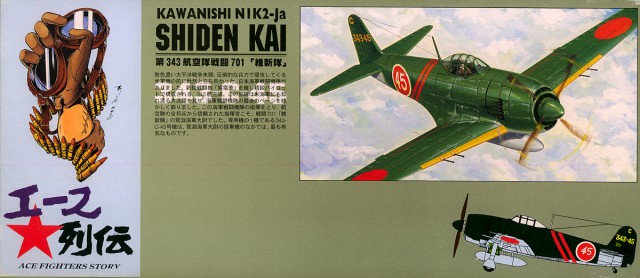
In 2011 the two Shiden Kai kits were re-released with new box art in the 'Ace Fighters Story' series (above). In addition to the kits covered here there have also been limited edition re-issues of the Shiden Kai under the C.G. logo in rather unattractive boxes with cgi illustrations of aircraft (below). At the end of 2011 Kopro of the Czech Republic also announced the release of the Aoshima kits under their own label with new box art.


The latest and most recent re-release of Aoshima's Shiden Kai includes not just the parts for four air-to-air rocket bombs and their racks but also a new, improved cowling and cockpit interior (below).


At the time of their release the Aoshima Shiden and Shiden Kai filled an important gap in the availability of 1/72nd scale mainstream kits of the Kawanishi fighter, a gap further closed by the release of the Kyofu floatplane fighter in various guises by Hasegawa in 1996. It is probable that a good proportion of modellers have just bought the kits haphazardly to put a "George" in their collection rather than to build examples of each variant but the development from floatplane fighter to Shiden Kai is interesting enough to justify a line up. It is also possible to produce a line-up which displays a different scheme for each variant and the various units operating them.

Colours for Shiden and Shiden Kai were explored here, here and here, now warranting an update and completion. Further thoughts on Shiden and Shiden Kai kits to follow.

Image credit: All box art © Aoshima Bunka Kyozai Co., Ltd


Saturday, 6 June 2015

Aoshima's New Shiden Kai


With the boxes marked predominantly 'Shidenkai' it is easy to presume that Aoshima's latest pair of 1/72nd scale releases are just re-issues from their much hailed 1996 Shiden Kai kits. But in small lettering on the boxes are the designations 'Kawanishi N1K3-J' and 'N1K3-Ja' revealing that these kits are supposed to represent the Model 31 with its boosted armament of two synchronised Model 3 13mm machine guns in the cowling position to augment the four wing mounted 20mm cannon and the engine mount extended by 15 cm to accommodate them.  In fact despite these designations the box art and markings options of the first kit (above), moulded in grey, represent the two prototypes (# 517 and # 520) of the Model 32 - N1K4-J - a Model 31 with a Homare 23 engine equipped with a low pressure fuel injection system replacing the Homare 21 of earlier models.


The second kit (above) also conceals a secret because, despite the box art showing Shiden Kai on a carrier deck with a carefully concealed unit tail code, it offers only the tail code for the prototype of the Model 41 N1K4-A - a carrier capable Model 32 with an arrestor hook -  コ-K2J-5 (in black or white) of the Koku Gijitsu Sho (Naval Air Technical Arsenal) at Yokosuka in an overall yellow scheme. And just so you get the idea the kit is moulded in vibrant orange yellow too! The prototype was reported to have conducted carrier landing trials on Shinano although none were produced, so the finished model could be legitimately displayed on a carrier deck base.

Kit # 11 contains only one markings option for an experimental prototype in yellow but a white tailcode is also included to facilitate camouflage painting

Both kits contain new longer fuselage halves with the double row of cooling slots and provision for the arrestor hook, filled by an insert in the first kit and a hook in the second. There is a new cowling with the machine gun troughs although sprue frame B from the previous kits which has the older cowling, marked 'not for use', is still included.

The longer fuselage of the Model 31/41~  note the distinctive twin row of cooling slots

New cowling with 13mm machine gun troughs

Sprue frame C from the older kits also has several other parts marked 'not for use' because there is an entirely new frame G which includes improved engine and cockpit interior parts as well as an under cowling insert to facilitate use of the original kit wings.

New sprue frame G

The old relief moulded engine is redundant and replaced by a two part radial - although the moulding is a little flabby. The final reduction gear and pitch control unit is now made up of five separate parts and somewhat inexplicably the spinner is in two halves. The interior parts now include extra seat mounting parts, control levers, separate rudder pedals, gunsight frame, separate sidewall frames and a nicely engraved instrument panel. As with previous kits there are optional parts to display the canopy in the open position but no separate flaps. 

All new cockpit and engine - just add seatbelts

An improvement on this 'old' cockpit - although not much will be seen with the canopy closed

Some might look askance at the Hinomaru on the modest kit decal sheets but they are printed in the correct to standard very bright red colour, although the wing leading edge IFF strips look too lemon. 

Decal Sheet for kit # 10 Model 32

Decal sheet for kit # 11 Model 41

So there is much more to these kits than just longer fuselages and a new cowling and they provide the potential for cross kitting to improve the older kits if prototypes and what-ifs are not your thing (we'll explore the previous kits in the Aoshima Shiden and Shiden Kai family tomorrow). But in addition to enhancing a Kawanishi fighter line-up (only the Model 25 N1K5-J with Ha43-1-1 engine and two seat N1K2-K are now missing) they do inspire some speculative modelling, with a Model 41 perhaps displayed on a carrier deck with suitable Kokutai tail codes, a Japanese Bearcat, positing a Midway disaster that wasn't so disastrous. 

Image credit: All box art, side panels, instructions and decal sheets © 2015 Aoshima Bunka Kyozai Co., Ltd.; fuselage comparison author using Aoshima kit parts.


Friday, 5 June 2015

Haunting Images


An undeveloped film roll sent to a collector from Hiroshima, Japan reveals its secrets. The man appears to be wearing an Army summer flying suit and helmet, per Ritta Nakanishi*, points of identity being the twin breast pockets with vertical flaps, the integral belt of the jacket and the cuff zips. The large Hinomaru on his sleeve suggests that the photograph was taken during the later air defence of Japan. He carries a sword. The other photos suggest that his family lived on a farm and the castle in the snow has been identified as being at Aomori.


The film lay neglected in a house and was found by its new occupants together with other photographic ephemera. Historical aviation and military buffs know the value of such records but not everyone is a historical aviation or military buff. Such emerging photographs are just the tip of a huge iceberg, millions lay forgotten, unknown in albums and boxes, and sadly thousands more have already been consigned to the skip or the bonfire. My own aunt burnt scores of candid photographs of the French army taken in their front line trenches and dressing stations by my grandfather during 1916-17, a fact that only became known to me when I chanced on a few partially burned surviving prints rescued by my uncle. Many historic collections are jealously guarded and permission to reproduce photographs to a wider audience refused. But what will happen to them when their determined owners pass on? Will surviving relatives appreciate their value or will they disappear for ever?


The other photos from the roll may be seen here and my thanks to Mr Sajó for letting me share the story here.


* Ritta Nakanishi, Japanese Military Uniforms 1930~1945 (Dai Nippon Kaiga, 1991)

Image credits: an unknown Japanese family via lebedeff via Tamás Sajó

Thursday, 4 June 2015

Pete in Colour and Dutch Buffalos

A wee bit off topic but two interesting films that might interest readers. The colour film of 1946 action in the Dutch East Indies against nationalist insurgents shows a Pete floatplane at 2:19 and also P-40s in colour as well as a Catalina taxying. Warning - there is some candid footage of dead and wounded insurgents in the 1946 film. The monochrome Pathé film of Dutch Brewster Buffalos, Martin bombers and a Hudson is exceptionally sharp and clear. 


Hat tip to Ronnie Olsthoorn for the heads up to these!


Wednesday, 3 June 2015

Rising Decals Emperor's Eyes Pt.II RD72069


Rising Decals have recently released Part II of Emperor's Eyes, set RD 72069, with decals for a further selection of IJA and IJN reconnaissance aircraft. The Ki-15, Ki-46, C6N1 and bonus D4Y1-C subjects are well chosen and include some interesting schemes.


The Army aircraft subjects consist of:-
  • Ki-15-II of 8th Sentai - an aircraft with a named crew operating over Burma in 1942 with a disruptive camouflage applied over the base grey-green. This aircraft would make an excellent display companion to an 8th Sentai Ki-48 using the LS/Arii Ki-15-II and Hasegawa (ex-Mania) Ki-48 kits. Note than the fuselage Hinomaru has a rough 'halo' where the camouflage has been applied over it. It is possible that the added camouflage was green and brown creating a three colour upper surface scheme.
  • Ki-15-I of Dokuritsu Hiko 50th Chutai  - an early model in standard scheme. This unit was originally established at Canton, China, from the 1st Chutai of the 15th Sentai in July 1941 and operated over French Indo-China, Malaya and the Dutch East Indies during the Japanese invasion. It was transferred to Manchuria in April 1942 and re-incorporated as the 1st Chutai of the 15th Sentai in January 1944. The unit also operated the Ki-46.
  • Ki-15-II of Dokuritsu Hiko 101st Chutai - a Babs of the antecedent unit of the 17th DHC featuring a welcome tail emblem which will facilitate modelling all the aircraft of this interesting unit. In 1942 the 101st were based at Chofu, Japan as the reconnaissance unit of the 17th Air Brigade.
  • Ki-46-II of 115th Kyoiku Hiko Rentai - based in China during 1943 this training aircraft appears to have a dark green field applied scheme over the original factory scheme. This Kyoiku Hiko Rentai was a development training unit for reconnaissance crews.
  • Ki-46-II of Dokuritsu Hiko 74th Chutai - a Dinah from a well known recce unit operating over the SWPA theatre in standard factory scheme. Although captioned as being 74th Chutai the red 'S' marking is usually attributed to the 76th Chutai, both being original and subsequently re-incorporated component Chutai of the 10th Sentai. An aircraft from this unit was one of the subjects in a 1979 re-issue of the venerable Airfix kit.   
  • Ki-46-II of 1st Yasen Hojyu Hikotai - another welcome marking for the Ki-46 from a specially tasked reserve unit based in Singapore. The Ki-46-III on display at RAF Cosford was from this unit which operated multiple Chutai equipped with many different aircraft types.
  • Ki-46-II of 2nd Dokuritsu Hikotai - with only a single Katakana character ス ('Su') on the rudder this aircraft is distinguished by its unusual camouflage scheme of dark green sworls and dabs - a painting challenge! 
  • Ki-46-III of 141st Kokutai - a Dinah operated by an IJN unit in the Philippines making for an unusual subject. As an alternative to the Army olive brown this aircraft could also be painted in the black green Navy colour.
  • Ki-46-III of 106th Sentai - an unusual emblem attributed here to the "missing" 106th Sentai, although the 'wing' of the design has four tails. Many ad hoc units were consolidated, created and designated during the Philippines campaign.
  • Ki-46-III of 10th Sentai - in late war olive brown this Dinah operated from Taiwan during the Okinawa campaign, the unit being reconstituted in Japan following the New Guinea campaign and adopting the new marking of a stylised representation of the number '10'.
  • Ki-46-III of Sakura Shinbu Tai - a special attacker from one of the units engaged in the Okinawa campaign which flew Dinahs loaded with 500lb bombs and displays a skull and crossbones 'death' insignia. As an alternative to the overall olive brown this aircraft could also be painted in dark blue grey. Shinbu tai (sometimes written as Shinpu or Shimbu) means a unit to inspire a martial spirit.


And for the Navy:-
  • C6N1 of 121st Kokutai - a Saiun operating from Tinian in the Mariana Islands during 1944 in standard scheme with yellow tail code
  • C6N1 of 121st Kokutai - as previous but with a different tail code in white
  • C6N1 of East Caroline Group - a Saiun based at Truk in 1945 with standard scheme but a different demarcation between upper and lower colours.
  • C6N1 of 210th Kokutai - an aircraft based at Korumo in Japan during 1945 with angled tail code and the same demarcation as the previous subject
  • D4Y1-C off Soryu - a speculative scheme for one of the first reconnaissance Judys deployed on operations. The possible appearance of this aircraft has been subject to much debate and it has been depicted before in overall grey. This bonus decal decal includes the tail code and data plate only.

This is another excellent sheet from Rising Decals which continues to plug the gaps in available aftermarket markings for interesting Japanese aircraft subjects. It includes the unit markings and sufficient Hinomaru for one Ki-15, two Ki-46 and one C6N1. 

Image credits: All © 2015 Rising Decals